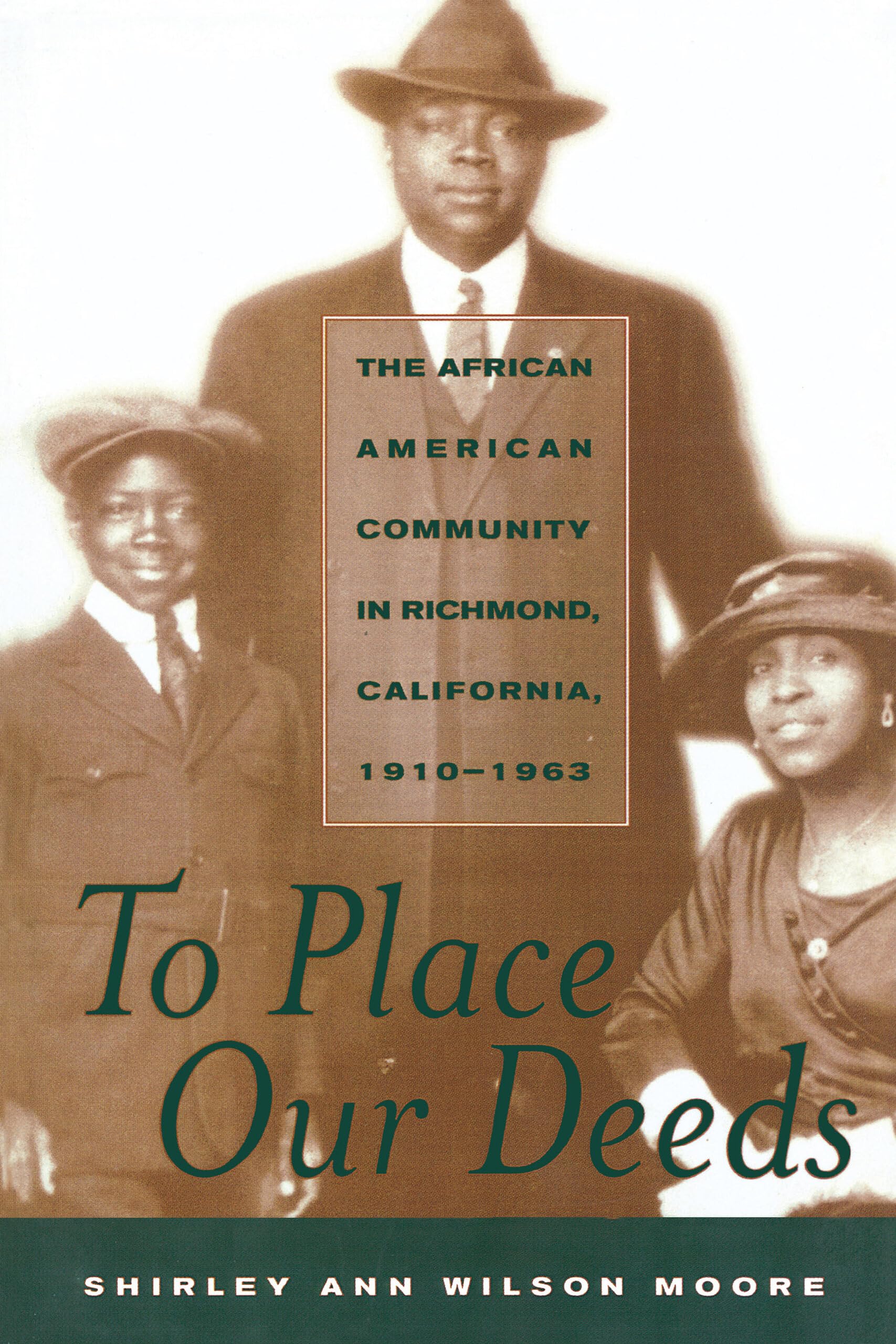
To Place Our Deeds: The African American Community in Richmond, California, 1910-1963
$28.90
by Shirley Ann Wilson Moore



To Place Our Deeds traces the development of the African American community in Richmond, California, a city on the San Francisco Bay. This readable, extremely well-researched social history, based on numerous oral histories, newspapers, and archival collections, is the first to examine the historical development of one black working-class community over a fifty-year period. Offering a gritty and engaging view of daily life in Richmond, Shirley Ann Wilson Moore examines the process and effect of migration, the rise of a black urban industrial workforce, and the dynamics of community development. She describes the culture that migrants brought with them―including music, food, religion, and sports―and shows how these traditions were adapted to new circumstances. Working-class African Americans in Richmond used their cultural venues―especially the city's legendary blues clubs―as staging grounds from which to challenge the racial status quo, with a steadfast determination not to be "Jim Crowed" in the Golden State. As this important work shows, working-class African Americans often stood at the forefront of the struggle for equality and were linked to larger political, social, and cultural currents that transformed the nation in the postwar period. "The great virtue of Moore's work is its concentration on the effects of broad national and international developments on the everyday lives and times of ordinary people. Her analysis is both an important piece of social history and a point of departure for future studies of how African American communities respond to the new realities of the post-industrial era."--Charles Wollenberg, CALIFORNIA HISTORY "A fascinating study. . . . It truly comes alive in its expert use of African American oral histories" Waldo E. Martin, University of California, Berkeley "A fascinating study. . . . It truly comes alive in its expert use of African American oral histories"―Waldo E. Martin, University of California, Berkeley Shirley Ann Wilson Moore is Professor of History at California State University, Sacramento. To Place Our Deeds The African American Community in Richmond, California,1910-1963 By Shirley Ann-Wilson Moore University of California Press Copyright © 2001 Shirley Ann-Wilson Moore All right reserved. ISBN: 9780520229204 Introduction So many things we were doing no one ever gives [us] credit. No one wants to place our deeds in the right light. But we were there and did it. Margaret Starks, 1988 Richmond, a sleepy backwater on the San Francisco Bay in Northern California, was transformed into the quintessential war boomtown when Henry J. Kaiser and other defense contractors located four shipyards and numerous war industries there in 1940. Although the war is an important part of the story of that transformation, the history of African Americans in Richmond begins long before World War II brought hundreds of thousands of black people west.1 Decades before the war the small black community, operating under visible and invisible constraints and stigmatized by other Bay Area blacks as unsophisticated and "primitive," was busy raising families, establishing institutions, and building economic structures. The influx of hopeful, determined black newcomers from the South in the 1940s only rejuvenated processes that had already been set in motion. Black wartime newcomers, determined not to be "Jim Crowed" in California, helped shatter racial barriers that had marginalized African Americans for decades. The war was only one phase of this transformation, however. This book examines the history of the African American community in Richmond during the critical transitional years of the first half of the twentieth century. It places the activities of black working-class men and women, regarded by some as unlettered peasants who were spatially and intellectually isolated from larger social currents, at the center of the nation's most profound, transformative events. In the past two decades a number of works have begun to explore African American history from a new perspective. These works have liberated blacks from their role as passive victims in history. They have examined black agency using a model that recognizes the impact of internal as well as external forces on the lives of African Americans. However, most of these works have limited their analyses to African American communities east of the Mississippi River.2 In recent years, a number of works have begun to examine the history of African Americans in the West, and several have explored the impact of World War II on blacks in the San Francisco Bay Area.3 This book, however, moves beyond the eastern focus to look at the experiences of African Americans in what is now the country's largest and most influential state. This work is the first to examine the historical development—including migration, the rise of a black urban industrial workforce, and the dynamics of community development—o