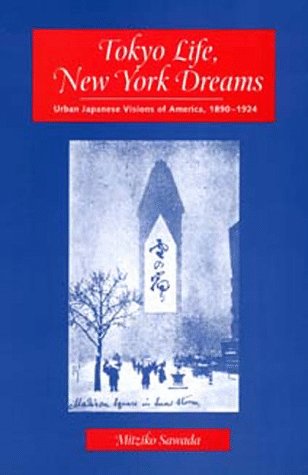
Tokyo Life, New York Dreams: Urban Japanese Visions of America, 1890-1924
$46.51
by Mitziko Sawada



Tokyo Life, New York Dreams is a bicultural study focusing on Japanese immigrants in New York and the ideas they had about what they would find there. It is one of the first works to consider Japanese immigration to the East Coast, where immigrants were of a different class and social background from the laborers who came to the West Coast and Hawaii. Beginning with a portrait of immigrants' lives in New York City, Mitziko Sawada returns to Tokyo to examine the pre-immigration experience in depth, using rich sources of popular Japanese literature to trace the origins of immigrant perceptions of the U.S. Along with discussions of economics and politics in Tokyo, Sawada explores the prevalent images, ideologies, social myths, and attitudes of late Meiji and Early Taisho Japan. Her lively narrative draws on guide books, magazines, success literature, and popular novels to illuminate the formation of ideas about work, class, gender relations, and freedom in American society. This study analyzes the Japanese construction of a mythic America, perceived as a homogeneous and exotic "other." Mitziko Sawada is Dean of Multicultural Affairs and Visiting Associate Professor of History at Hampshire College. Tokyo Life, New York Dreams: Urban Japanese Visions of America, 1890-1924 By Mitziko Sawada University of California Press Copyright © 1996 Mitziko Sawada All right reserved. ISBN: 0520073797 Chapter 1 Introduction After about five minutes, the lines of the boat were loosened. As we sailed off, the dresses of the women on the dock became blurs in the distance and resembled flowers in a garden. The sight of the glorious Hudson, majestically flowing into the sea, unfolded before our very eyes. The tall buildings of New York City loomed high in the center against the brilliant summer sky. On the city's right, across the Hudson, soot and smoke hung over the cities of New Jersey. On its left, hosts of vessels which had gathered from the ports of the world, sailed freely back and forth under the Brooklyn Bridge. And beyond that, Brooklyn. The Statue of Liberty, with a halberd [sic] up high in one hand, stood over the water far beyond the harbor, commanding a view of this fearsome, awesome, and peaceful battlefield. —Nagai Kafu* , Amerika monogatari (Stories from America) Nagai Kafu* , the Meiji writer, wrote this short but vivid paragraph when he came to New York City at the turn of the century. To Kafu* , the panorama of New York harbor, its breadth and its busyness, connoted a battlefield in which freedom—the freedom to move and engage in commerce—was a vital factor. In this battlefield people competed with each other intensely but with gentility and politeness. In his short stories based on his years in the United States, Kafu* also wrote of freedom of another sort: a personal life unfettered by the restrictive and rigid social demands made on one by family, relatives, teachers, and other elders as in Japan. Amerika and, most of all, New York were symbols of youth and dynamism that signified these freedoms. Yet they also instilled fear and awe—a tension that resulted from the expectations of a new life and the anxieties of not knowing exactly how it would unfold. The American scholarship on Japanese immigration to the United States in the late nineteenth and early twentieth centuries largely focuses on the migration of Japanese to the Pacific states.1 Most of the earlier works utilized American English-language sources. Yuji Ichioka broke that practice in his pioneering efforts, relying on Japanese-language sources, many of them based on immigrant writings, and adding a vital dimension to the historiography.2 Nevertheless, American knowledge about Japanese immigrants is broad and assumptive, contributing to a general and homogenized view of Japanese immigrants as peasants from four poor agricultural prefectures in southwestern Japan, uneducated, unmarried, and male. The assumption that all Japanese immigrants shared these characteristics is based largely on evidence of the early years of migration, when laborers were imported from Hiroshima-, Wakayama-, Yamaguchi-, and Fukuoka-ken (prefecture) to work in Hawaii and California. There is little room left for the exceptions, who represent an integral part of any group of people and who, in the New York and East Coast cases (as well as, I suspect, on the Pacific Coast), constitute a stark contrast to the all-encompassing view.3 Other than sociologist T. Scott Miyakawa's essay and the book by Haru Reischauer, which in part is about her maternal grandparents, who settled in New York, nothing has been written in English about the Japanese on the East Coast.4 When I began this work I thought a research project on the Japanese who chose to settle in New York City was feasible. However, I soon realized that vital primary sources were insufficient and inadequate for a satisfactory study and that I should think of another subject