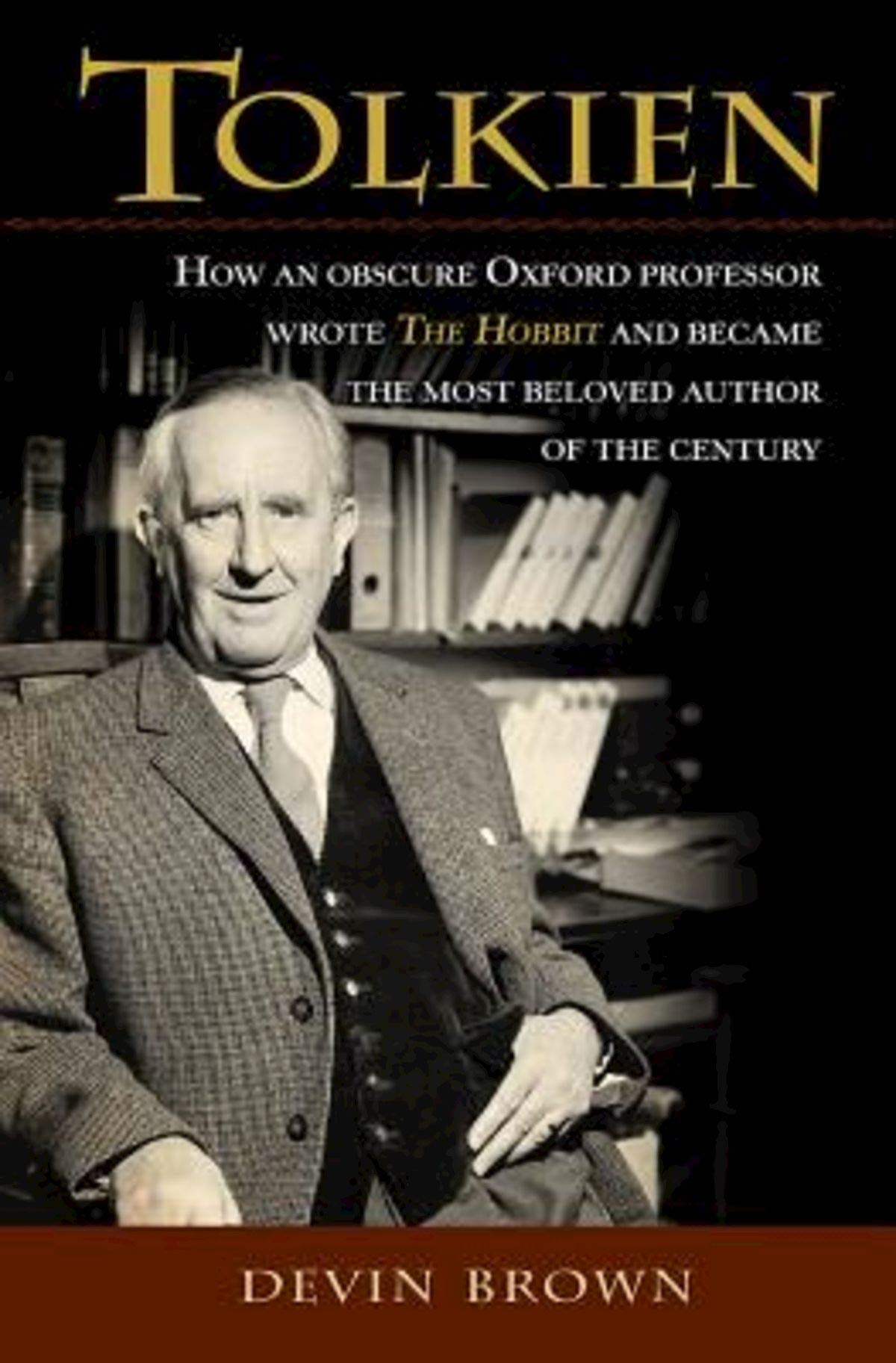
Tolkien: How an Obscure Oxford Professor Wrote The Hobbit and Became the Most Beloved Author of the Century
$15.96
by Devin Brown



Devin Brown tells the story of how J. R. R. Tolkien went from being an obscure Oxford philologist to being one of the best-known writers in the history of literature, a true tale as fascinating and as inspiring as any of the fictional ones Tolkien would go on to write. Weaving in the major aspects of the author's life, career, and faith, Brown traces the amazing odyssey of how The Hobbit and The Lord of the Rings came to be written and published. With the final film in the Tolkien catalogue soon to be released, this book answers the question of what factors contributed to the world and worldview of The Hobbit's celebrated author and allows readers to get to know the man behind the myth, Tolkien. A winsome, whimsical look at the obscure scholar whose work has delighted fans for more than 75 years. Devin Brown is a Lilly Scholar and a Professor of English at Asbury University where he teaches a class on Lewis and Tolkien. He is the author of The Christian World of the Hobbit and Hobbit Lessons , both published by Abingdon Press. He has spoken at Lewis and Tolkien conferences in the UK and the U.S. Devin has published numerous essays on Lewis and Tolkien, including those written for CSLewis.com, ChristianityToday.com, SamaritansPurse.org, and BeliefNet.com. Devin earned a PhD at the University of South Carolina and currently lives in Lexington, Kentucky. Tolkien How an Obscure Oxford Professor Wrote The Hobbit and Became the Most Beloved Author of the Century By Devin Brown Abingdon Press Copyright © 2014 Devin Brown All rights reserved. ISBN: 978-1-4267-9670-8 Contents Prologue, Part One Son and Schoolboy, Part Two Scholar and Soldier, Part Three Storyteller and Mythmaker, Epilogue, Curious Facts of Tolkien's Life and Writing, Fourteen Tolkien Sites to Visit without Ever Leaving Your Armchair, Resources, CHAPTER 1 Son and Schoolboy A Hot, Parched Country Visitors to the U.K. will find tastefully understated, round plaques in a dignified shade of blue marking the birthplace of many of the country's most famous writers—figures such as Charles Dickens, Dorothy Sayers, C. S. Lewis, and Graham Greene. Although there is a plaque in the Oxford suburbs on the house at 20 Northmoor Road where J. R. R. Tolkien lived from 1930 to 1947, marking it as the very place where The Hobbit and The Lord of the Rings were written, there is no plaque marking his birthplace. His birthplace has no plaque because Tolkien was not born in Oxford or England but literally a world away in Bloemfontein in the Orange Free State, the former colony we now know as South Africa. On January 3, 1892, just three days into the new year, John Ronald Reuel Tolkien came into the world. Born with his father's eyes and his mother's mouth, he was the first child of Arthur and Mabel Tolkien, who had recently emigrated from England. Named "John" after his grandfather, and "Reuel" because it was a family name, he would be called Ronald by his family and John Ronald by school chums. Later at Oxford, he would be Tolkien to his colleagues, and to his friends he would simply be Tollers. Back in 1892, Bloemfontein was not quite fifty years old and not the bustling modern city it is today. Although it had two churches, a hospital, a library, a tennis club, and a railway station, it was still a dusty frontier town set on the edge of a treeless plain where wild dogs, monkeys, jackals, and the occasional lion still roamed. Tolkien later wrote that his earliest childhood memories were of a "hot parched country" and that the first Christmas he recalled was not a frosty, snow-covered morning, but a day with a blazing sun, curtains drawn against the heat, and in place of a cheerful English pine, a eucalyptus tree that was so dry it drooped. After working for a time at Lloyds Bank in Birmingham, Arthur Tolkien had gone to South Africa, like many emigrants from England at the time, in search of a better position. Because of recent discoveries of gold and diamonds in the region, promotions in the banking business were speedier and more available there than in Britain. After a number of temporary postings, Arthur had been named as the manager of the Bloemfontein branch of the Bank of Africa. With a modest but adequate income and housing provided for him on the second floor above the bank, he felt ready to ask his young fiancée to join him. Arthur Tolkien and Mabel Suffield were married in Cape Town's Anglican Cathedral on April 16, 1891. She was twenty-one. He was thirty-four. After a brief honeymoon on the coast in nearby Sea Point, Arthur and "Mab," as he called his new bride, boarded a train for the arduous 700-mile trek inland to Bloemfontein to begin their new life together. Nine months later, Arthur wrote to his mother back in England with the exciting news: "Mabel gave me a beautiful little son last night." Among the many incidents that took place during Ronald Tolkien's first years, three bear noting. First there cam