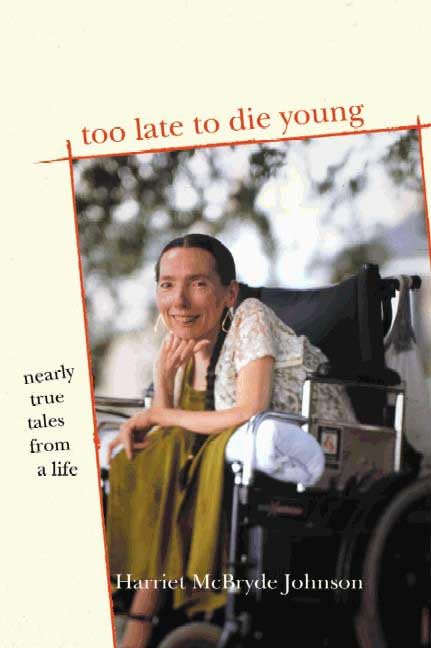



With a voice as disarmingly bold, funny, and unsentimental as its author, a thoroughly unconventional memoir that shatters the myth of the tragic disabled life Harriet McBryde Johnson isn't sure, but she thinks one of her earliest memories was learning that she will die. The message came from a maudlin TV commercial for the Muscular Dystrophy Association that featured a boy who looked a lot like her. Then as now, Johnson tended to draw her own conclusions. In secret, she carried the knowledge of her mortality with her and tried to sort out what it meant. By the time she realized she wasn't a dying child, she was living a grown-up life, intensely engaged with people, politics, work, struggle, and community. Due to a congenital neuromuscular disease, Johnson has never been able to walk, dress, or bathe without assistance. With help, however, she manages to take on the world. From the streets of Havana, where she covers an international disability rights conference, to the floor of the Democratic National Convention in Chicago, to an auditorium at Princeton, where she defends her right to live against philosopher Peter Singer, she lives a life on her own terms. And along the way, she defies and debunks every popular assumption about disability. This unconventional memoir opens with a lyrical meditation on death and ends with a surprising sermon on pleasure. In between, we get the tales Johnson most enjoys telling from her own life. This is not a book "about disability" but it will surprise anyone who has ever imagined that life with a severe disability is inherently worse than another kind of life. " Too Late To Die Young is a wonderful mix: a keen mind, exuberance, activist politics, along with a special brand of Southern women's wit."-Adrienne Rich Harriet McBryde Johnson has been a lawyer in Charleston, South Carolina, since 1985. Her solo practice emphasizes benefits and civil rights claims for poor and working people with disabilities. For more than twenty-five years, she has been active in the struggle for social justice, especially disability rights. She holds the world endurance record (thirteen years without interruption) for protesting the Jerry Lewis telethon for the Muscular Dystrophy Association. She served the City of Charleston Democratic Party for eleven years, first as secretary, then as chair. She is a regular contributor to The New York Times Magazine and to the disability press and lives in Charleston, South Carolina. A person who experiences a terrible personal tragedy and chooses to write about it faces a daunting challenge. Though every detail of the sad and difficult journey is searingly meaningful to the afflicted writer, will anyone else care? Or will the distant reader think the misfortune is merely repellent and shrink away, relieved that so awful a fate did not afflict him? In Too Late to Die Young, Harriet McBryde Johnson has overcome this problem with her essential wit, humanity and pluck. This is a transporting tale about a determined and attractive woman with congenital neuromuscular disease, who has never walked, who expected to die young and yet who has gone on to a distinguished career in the law, an often fun-filled life as a brassy activist for the handicapped and a rich existence with friends and colleagues in the mossy insouciance of Charleston, S.C. This is a book full of surprises. Johnson puts us on notice at the outset that she has a wry eye for the "natural" world. She rejects the "formulaic narratives" that we have constructed featuring handicapped people as "stock figures" to be pitied and at the same time praised for their courage and inspiration to others. Though her spine may be horribly twisted, though a simple tumble from a wheelchair may turn into a life crisis, she argues for her humanity in the fullest and most equal sense. She is prickly and feisty. She is not to be trifled with. And yet there is great value in knowing what the life of a fragile figure, imprisoned in a wheelchair and unable to swallow solid food, is like in modern America, especially the America that has been considerably improved by the Americans With Disabilities Act of 1990. The logistics are formidable: the need for caregivers, the navigation of streets and buildings, the simple acts of getting into bed or going to the bathroom, the desperate risks that may lurk around any corner. Life for the handicapped is pretty elemental. Johnson escorts us into what she calls "cripworld" or "cripdom" with bubbly good cheer, almost daring us to feel sorry for her. No authority, no impediment seems to stymie her. As an undergraduate at the University of South Carolina, she took on the Secret Service and Ronald Reagan when the police invaded her private space and tried to shut down her protest of the president's visit to her campus. Eight years later when she was assistant city attorney in Charleston, she became a leading figure in a protest against Jerry Lewis and his pity-inspiring comme