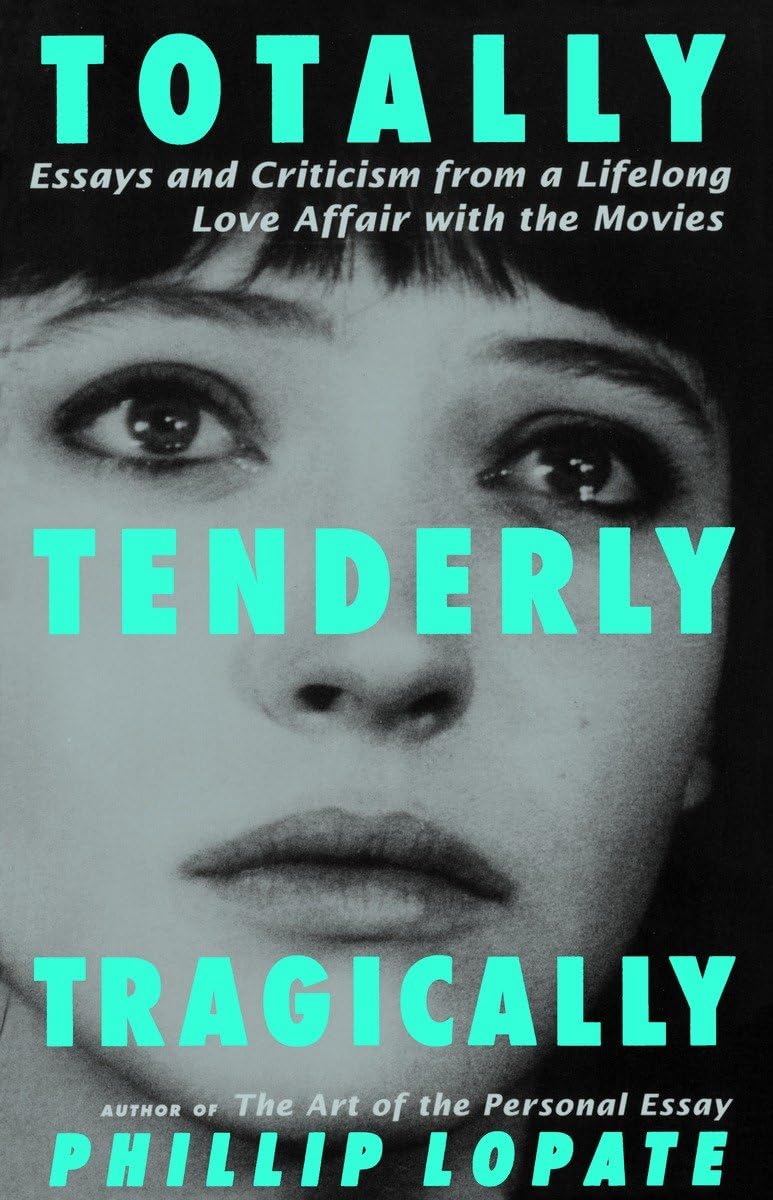
Totally, Tenderly, Tragically: Essays and Criticism from a Lifelong Love Affair with the Movies
$13.99
by Phillip Lopate



Phillip Lopate has been obsessed with movies from the start. As an undergraduate at Columbia, he organized the school's first film society. Later, he even tried his own hand at filmmaking. But it was not until his ascent as a major essayist that Lopate found his truest and most lasting contribution to the medium. And, over the past twenty-five years, tackling subjects ranging from Visconti to Jerry Lewis, from the first New York Film Festival to the thirty-second, Phillip Lopate has made film his most cherished subject. Here, in one place, are the very best of these essays, a joy for anyone who loves movies. Phillip Lopate's reputation in American letters resides primarily in his championing of the personal essay, both as an editor ( The Art of the Personal Essay , The Anchor Essay Annual ) and as a writer ( Against Joie de Vivre , Portrait of My Body ). So it might seem odd, at first, to imagine him as a film critic--but as his thoughtful considerations of Pauline Kael and Andrew Sarris demonstrate, the movies are as likely a subject for a skilled essayist's reflection as any other. Like his favorite critics, "I have sought out," Lopate writes, "precisely those films that would take me to a place where the uncanny, the sublime, the tragic, the ecstatic, the beautifully resigned, all converge." These are not, then, so much reviews--although Lopate happily discusses the strengths and weaknesses of his chosen films--as they are meditations. In his best pieces, such as his essays on Godard's Contempt (the film from which this collection derives its title) and Scorsese's The Last Temptation of Christ , Lopate performs extended readings that tease out the richness of the films' texts with delicate intricacy. But this artful approach can only be carried so far--not even Lopate can quite redeem Jerry Lewis's Three on a Couch , which the most ardent Lewis fans acknowledge as a lesser work, no matter how earnestly he probes it for Freudian subtext. Folks who simply want to enjoy the movies may find the high culture assumptions of Totally, Tenderly, Tragically , including Lopate's overwhelming emphasis on foreign directors, a bit much, but if even one reader is inspired to seek out a film by Luchino Visconti, Kenji Mizoguchi, or Yazujiro Ozu on the basis of the descriptions herein, Lopate's efforts at conveying the artistic value of film will have been a success. --Ron Hogan Essayist Lopate (Portrait of My Body, LJ 7/96) is a lifelong movie fan, with a particular interest in foreign-language cinema. This collection, which begins with his student days at Columbia University when he wrote about the first New York Film Festival in 1963, will strike a chord with anyone raised on the classic art films of the 1950s and 1960s. "Films have always been a way for me to aspire to the spiritual without taking it too seriously," he writes, perfectly summing up the dichotomy of this book. Here is a man who loves "difficult" directors like Robert Bresson and Yasujiro Ozu but keeps some perspective on the filmgoing experience. Of particular interest will be Lopate's carefully nuanced late-1980s portrait of film critic Pauline Kael. Recommended for most collections.?Thomas J. Wiener, "Satellite DIRECT," Vienna, Copyright 1998 Reed Business Information, Inc. Essays in film criticism, fueled by Lopate's heartfelt (if snobby) obsession with the cinema and Les Cahiers du Cinma. Before he found his vocation as a personal essayist, Lopate (Portrait of My Body, 1996, etc.) wrote a wrap-up of the first New York Film Festival in 1963 for a Columbia student newspaper, during what he calls the heroic age of moviegoing'' that began his film education. Although not a hardcore cineaste, Lopate quickly declares his loyalties here: auteurs like Truffaut, Dreyer, and Mizoguchi over mere directors; Europe and Japan over Hollywood; mise-en-scne over montage; realism over escapism. His hesitant, somewhat fawning contribution to a Festschrift for auteur-theorist Andrew Sarris shows how deep these formative allegiances run. In this mode, such as when he discusses Japanese director Yasujiro Ozu, experimental filmmaker Warren Sonbert, writer-directors David Mamet, Paul Schrader, and John Sayles, and Jerry Lewis's Three on a Couch (really), Lopate loses some of his intellectual independence and much of the slightly egotistical charm that enlivens his personal essays. When, however, he profiles Pauline Kael, whose entertainment-driven film aesthetics are not so congenial but whose writing and company are attractive, he shows his movie buff's heart, as well as hersalthough the prickly Kael disliked his well-written, incisive piece. Lopate shines in a charming retrospective of Japanese director Mikio Naruse, in his ambivalent musings on Martin Scorsese's Last Temptation of Christ, in assessing the significance of montage in contemporary sex scenes, and more. To dramatize his love affair with celluloid, he takes his title from a bit of dialogue in Goda