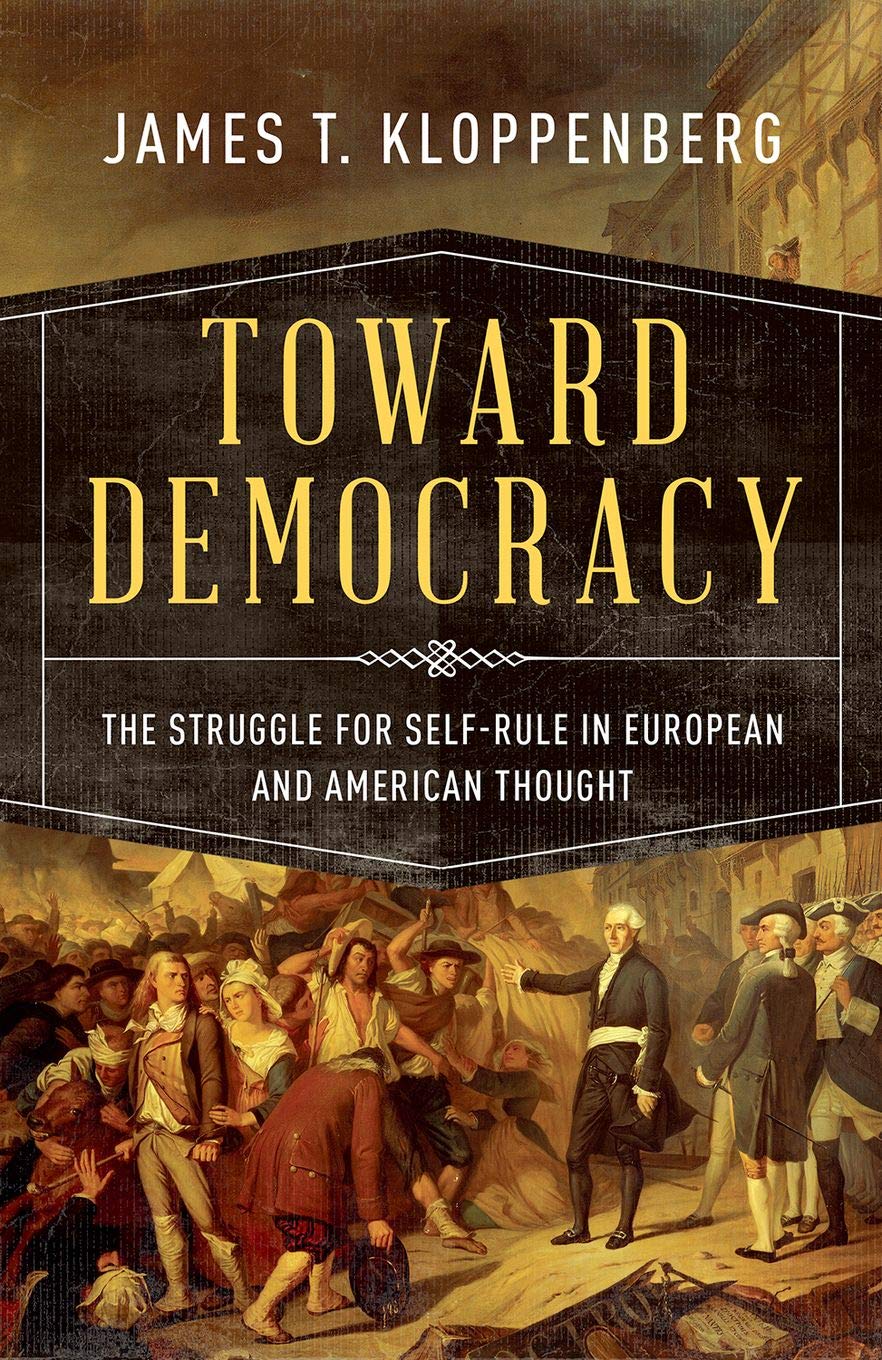
Toward Democracy: The Struggle for Self-Rule in European and American Thought
$34.99
by James T. Kloppenberg



In this magnificent and encyclopedic overview, James T. Kloppenberg presents the history of democracy from the perspective of those who struggled to envision and achieve it. The story of democracy remains one without an ending, a dynamic of progress and regress that continues to our own day. In the classical age "democracy" was seen as the failure rather than the ideal of good governance. Democracies were deemed chaotic and bloody, indicative of rule by the rabble rather than by enlightened minds. Beginning in the 16th and 17th centuries, however, first in Europe and then in England's North American colonies, the reputation of democracy began to rise, resulting in changes that were sometimes revolutionary and dramatic, sometimes gradual and incremental. Kloppenberg offers a fresh look at how concepts and institutions of representative government developed and how understandings of self-rule changed over time on both sides of the Atlantic. Notions about what constituted true democracy preoccupied many of the most influential thinkers of the Western world, from Montaigne and Roger Williams to Milton and John Locke; from Rousseau and Jefferson to Wollstonecraft and Madison; and from de Tocqueville and J. S. Mill to Lincoln and Frederick Douglass. Over three centuries, explosive ideas and practices of democracy sparked revolutions--English, American, and French--that again and again culminated in civil wars, disastrous failures of democracy that impeded further progress. Comprehensive, provocative, and authoritative, Toward Democracy traces self-government through three pivotal centuries. The product of twenty years of research and reflection, this momentous work reveals how nations have repeatedly fallen short in their attempts to construct democratic societies based on the principles of autonomy, equality, deliberation, and reciprocity that they have claimed to prize. Underlying this exploration lies Kloppenberg's compelling conviction that democracy was and remains an ethical ideal rather than merely a set of institutions, a goal toward which we continue to struggle. "In exploring the variety of democratic forms that arose in the Atlantic world, Kloppenberg reminds readers that popular self-government was not preordained by modernity nor brought into the world at a single heroic moment."-- Foreign Affairs "The book dazzles through its range and sweep, offering new interpretations of familiar texts and drawing attention to unfamiliar ones."--Kunal M. Parker, The Journal of American History "This ambitious book is much more than a description of successive democratic ideals. Kloppenberg identifies a specific set of principles that characterize democracy and another set of conditions of possibility for a democratic order...The historical narrative illuminates the history of democratic thought and simultaneously advances an argument for specific institutional features of modern democracy."--James Livesey, American Historical Review "James T. Kloppenberg's thoughtful and ambitious intellectual history of democracy is most welcome. Toward Democracy: The Struggle for Self-Rule in European and American Thought is learned, well-written, and jargon-free. Its scope is immense...With Toward Democracy , James Kloppenberg has written a strikingly thoughtful work on the democratic experiment. He is an eloquent partisan who writes seriously about self-limitation and the moral foundations of democracy."--Daniel J. Mahoney, Claremont Review of Books "An original discussion of how the idea of democracy took root and has been transformed in the West...As [Kloppenberg] observes, the ability of people to govern themselves without an entrenched class of overseers has long been a matter of controversy, though the argument has a chicken-and-egg quality to it . . . Surveying the subsequent political landscape, Kloppenberg allows that the debate has found plenty of room to continue to rage. Elsewhere, he writes of the idea that the people have not just the right, but also the duty to resist 'tyrants who flout divine law,' as well as the idea that the source of authority truly lies in the consent of the governed and 'the conscience of individual citizens.' . . . A book to read, profitably, alongside Karl Popper's The Open Society and Its Enemies." - Kirkus Reviews "This is intellectual history on a monumental scale. In a time when democracy again seems tragically fragile, James Kloppenberg has given us a sweeping, searching and enormously timely account of its development in European and American thought. Starting with Michel de Montaigne reflecting upon savage religious violence in France, and concluding with Abraham Lincoln trying to bind up America's wounds at the end of the Civil War, Kloppenberg's account is framed by bloodshed, underlining his central argument about just how difficult the struggle has been for democratic ideals to prevail." -David A. Bell, Lapidus Professor, Department of History, Princeton Univers