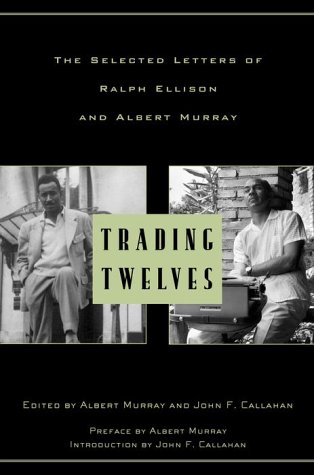
Trading Twelves: The Selected Letters of Ralph Ellison and Albert Murray
$40.03
by Ralph Ellison



A joyous and important collection of letters between two great American writers and old friends, baring their hearts to each other about life, work, and the American scene. When two jazz musicians trade twelves with each other in a jam session, one musician begins by riffing off twelve bars of music, the other musician throws the twelve bars back through his instrument, the first answers, and so on, back and forth, in an ecstatic exchange of ideas and emotions. So it is with these letters, joyful music created by the exchanges between two dear friends. Reading these letters, you sense that each man was the other's lifeline, that the emotional and intellectual companionship they found in each other was unique in their lives. They spill it all out here--their struggles, frustrations, ambitions, fears; thoughts on literary gossip, jazz, photography--and the result is literary history, and a book that reminds you what friendship is all about. Some friendships spring instantly to life, while others require a lengthy period of germination. The rapport between Ralph Ellison and Albert Murray fits into the second category. Both attended the Tuskegee Institute in the fall of 1935, and while they were never formally introduced, Murray recalls being impressed by his fellow student's formidable intellect, not to mention his snappy wardrobe. It wasn't until 1947, however, that their relationship got rolling. The two shared a love for jazz and photography and the American vernacular, along with a comically skeptical view of the social sciences. They were also joined by a sense of literary vocation that seems truly bracing in our own age of ironic retrenchment: "He and I conceded nothing to anybody," recalls Murray, "when it came to defining what is American and what is not and not yet." Their intention was to create a "universally appealing American epic." Ellison delivered his epic, Invisible Man , in 1952, while Murray's arrived on the installment plan, parceled out among nine books and three decades. Yet this divergence in their careers, which might have easily divided them into literary turtle and hare, never made a dent in their friendship--a fact amply testified to by the letters collected in Trading Twelves . The title refers to the old custom whereby jazz soloists would lob 12-bar phrases back and forth, upping the ante with each exchange. Murray and Ellison seem similarly energized by their epistolary cutting contest. Here's the latter on the as-yet-unpublished Invisible Man , which he describes in surprisingly gutbucket terms: For me it's just a big fat ole Negro lie, meant to be told during cotton picking time over a water bucket full of corn, with a dipper passing back and forth at a good fast clip so that no one, not even the narrator himself, will realize how utterly preposterous the lie actually is. Elsewhere he urges his correspondent to hurry up "that low-down southern cullud jive of yours and spread it all over western civilization," while Murray takes their mutual idol William Faulkner to task: "As for Marse Faulkner, he's good, but he ain't never come to terms with poro & straightening combs, let alone jazz and all that cadillac kick dynamism." Decades after they were written, the letters in Trading Twelves remain an ardent and entertaining conversation about art, politics, race, and the intricacies of what Murray would later call Omni-American life. --James Marcus In jazz, two musicians are said to be "trading twelves" when they trade feelings and ideas by alternating riffs of 12 bars of music. In much the same manner, Ellison and Murray, in letters written between 1949 and 1960, exchange views on literature and music, among other subjects. The letters shed light on the literary processes of Ellison, whose Invisible Man (1952) remains one of the masterpieces of 20th-century literature, and Murray, the undervalued author of such novels as Train Whistle Guitar (1974), The Spyglass Tree (1991), and The Seven League Boots (1996). However, these letters are important not only for their views on literature and culture but also for their warm and engaging record of a friendship that began when the two men met at Tuskegee in 1935 and endured no matter how vast the geographic distance between them. Brief but insightful prefatory material by Callahan (who edited Ellison's posthumous novel, Juneteenth, LJ 5/1/99) and Murray sets the letters in context. Recommended for all collections of American literature and/or African American culture.DLouis J. Parascandola, Long Island Univ., Brooklyn Campus Copyright 2000 Reed Business Information, Inc. “An invaluable slice of literary history.... Fascinating and endlessly informative.”– The Miami Herald “The greatest pleasure to be found in Trading Twelves is the warmth of friendship.”– The New York Times Book Review “The prospect of reading letters exchanged between Ralph Ellison and Albert Murray suggests an opportunity to eavesdrop on history in