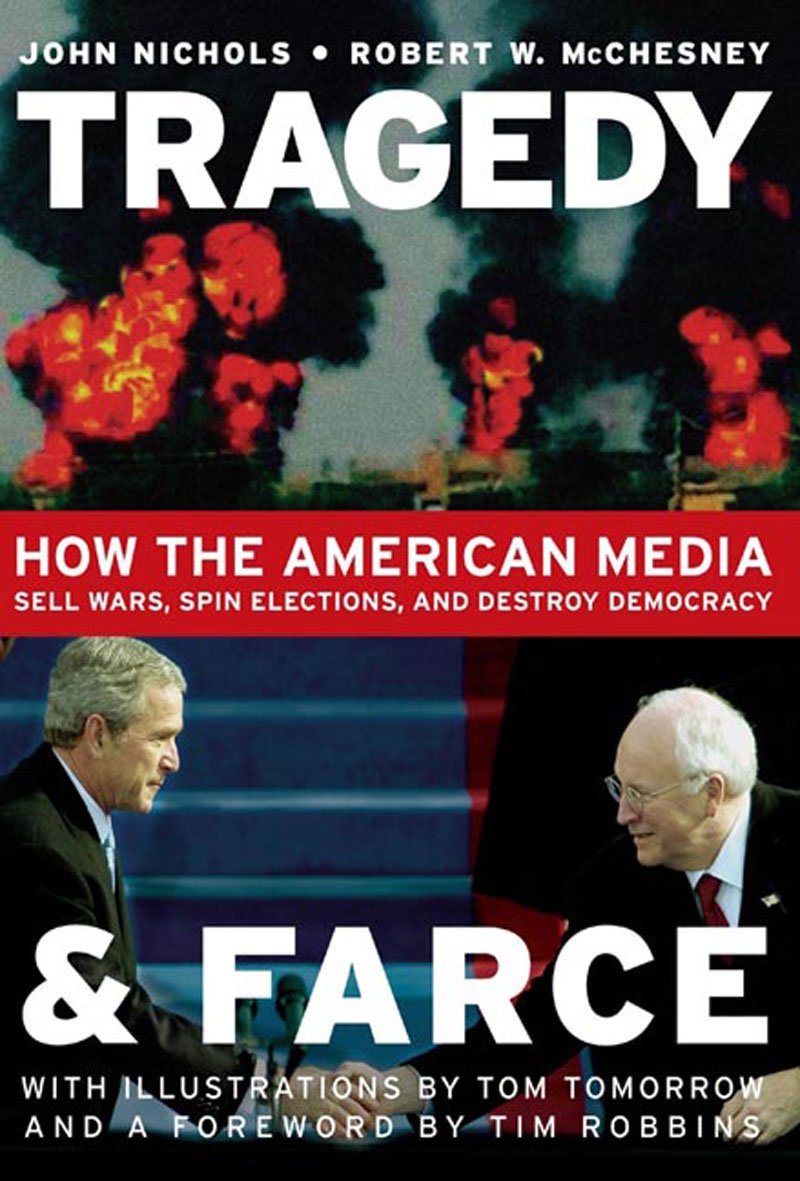
Tragedy and Farce: How the American Media Sell Wars, Spin Elections, and Destroy Democracy
$9.39
by John Nichols



Bestselling authorities on the media analyze recent election coverage and its contribution to the decline of American democracy. "A popular government without popular information or the means of acquiring it is but a Prologue to a Farce or a Tragedy or perhaps both." James Madison, 1822 James Madison's worst fears were realized in 2004, when voters in a popular election lacked popular information and the means to acquire it. More than anything John Kerry, George Bush, or even Karl Rove did, the media's miscoverage of the campaign decided the election. Most disturbingly, the problems with the election coverage reflect long-term problems with U.S. journalism. John Nichols and Robert W. McChesney, two of the country's foremost media analysts and founders of the national media reform group Free Press, dissect the troubling trends in journalism that surfaced in 2004the decline in resources and standards for political journalism and the organized campaign by the political right to control the news cycle. They show how government decisions made without the informed consent of the American people have led to a media system that undermines democracy. Including newsmaking interviews with John Kerry, Howard Dean, Barack Obama, and other key players in the political process, this book is both an exposé and a call to action. Nichols, a correspondent for the Nation , and McChesney, a journalism professor, excoriate the media for failure to hold politicians accountable for their words and deeds, thereby failing in their responsibility to protect American democracy. The authors examine current media practices in the context of press freedoms guaranteed by the Bill of Rights and the concepts held by the Founding Fathers. The troubling recent presidential elections and the war in Iraq--and the lackluster reporting by the media--are the latest in a long trend toward a kind of corporate media that treats Americans as consumers rather than citizens. The authors compare manipulation of American news reporting and elections to practices of the Soviet Union at its strongest, with the political Right exerting more control of the news cycle. The authors also examine some promising trends--including the Internet and creation of independent media. The book includes interviews with John Kerry, Howard Dean, Barack Obama, and other key political figures, exploring concerns about the media's role in democracy. Vanessa Bush Copyright © American Library Association. All rights reserved "We need McChesney and Nichols desperately. Their book is a lifeboat for surviving the burst dam of bullshit called ‘American media.’" —Greg Palast, author of The Best Democracy Money Can Buy "If we want a media that matters again, we have to build it from the ground up. Nichols and McChesney point the way. Let’s act." —Jim Hightower "Good fuel for progressive responses to the Fox cabal." — Kirkus Reviews Robert W. McChesney , professor at the University of Illinois, is the author of the award-winning Rich Media, Poor Democracy (The New Press, 2000) and, with John Nichols, Our Media, Not Theirs . He lives in Champaign, Illinois. John Nichols is The Nation 's Washington correspondent and an editor at the Capital Times. He is the author of The Rise and Rise of Richard B. Cheney and Jews for Buchanan . He lives in Madison, Wisconsin, and Washington, DC.