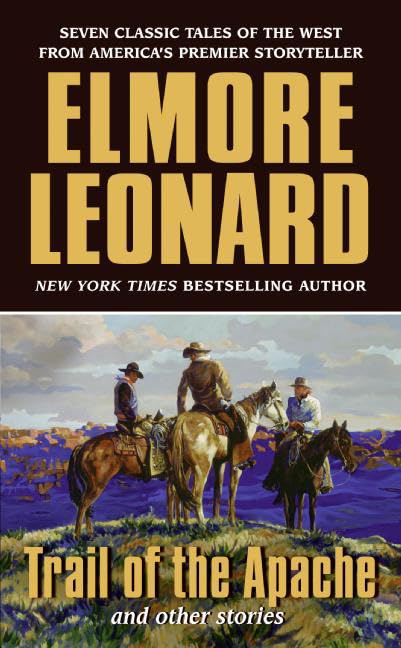
Trail of the Apache and Other Stories: Seven Classic Western Tales of Trust, Destiny, and Survival
$6.99
by Elmore Leonard



The New York Times -bestselling Grand Master of suspense deftly displays the other side of his genius, with seven classic western tales of destiny and fatal decision . . . and trust as essential to survival as it is hard-earned. Trust was rare and precious in the wide-open towns that sprung up like weeds on America's frontier—with hustlers and hucksters arriving in droves by horse, coach, wagon, and rail, and gunmen working both sides of the law, all too eager to end a man's life with a well-placed bullet. In these classic tales that span more than five decades—including the first story he ever published, “The Trail of the Apache”—Elmore Leonard once again demonstrates the superb talent for language and gripping narrative that have made him one of the most acclaimed and influential writers of our time. “Leonard is the real thing.” - Washington Post Book World “The man knows how to grab you.” - Entertainment Weekly “Even the earliest of his western yarns show Leonard to be a master storyteller.” - Los Angeles Times “Leonard has penned some of the best western fiction ever.” - USA Today Destiny, restlessness, and greed moved the white man west, into lands occupied for centuries by a proud and noble people: Arapahoe, Navajo, Apache, Sioux . The bitter misunderstandings and brutal clashes of cultures that resulted ultimately shaped the nation we know today. In seven classic western tales, the New York Times -bestselling Grand Master re-creates a world of violence, deception, vengeance, and strange beauty with the same peerless storytelling power that distinguishes his acclaimed suspense fiction. Elmore Leonard wrote more than forty books during his long career, including the bestsellers Raylan , Tishomingo Blues , Be Cool , Get Shorty , and Rum Punch , as well as the acclaimed collection When the Women Come Out to Dance , which was a New York Times Notable Book. Many of his books have been made into movies, including Get Shorty and Out of Sight . The short story “Fire in the Hole,” and three books, including Raylan , were the basis for the FX hit show Justified . Leonard received the Lifetime Achievement Award from PEN USA and the Grand Master Award from the Mystery Writers of America. He died in 2013. Trail of the Apache and Other Stories By Elmore Leonard HarperCollins Publishers, Inc. Copyright © 2007 Elmore Leonard All right reserved. ISBN: 9780061121654 Chapter One Trail of the Apache Under the thatched roof ramada that ran the length of the agency office, Travisin slouched in a canvas-backed chair, his boots propped against one of the support posts. His gaze took in the sun-beaten, gray adobe buildings, all one-story structures, that rimmed the vacant quadrangle. It was a glaring, depressing scene of sun on rock, without a single shade tree or graceful feature to redeem the squat ugliness. There was not a living soul in sight. Earlier that morning, his White Mountain Apache charges had received their two-weeks' supply of beef and flour. By now they were milling about the cook fires in front of their wickiups, eating up a two-weeks' ration in two days. Most of the Indians had built their wickiups three miles farther up the Gila, where the flat, dry land began to buckle into rock-strewn hills. There the thin, sparse Gila cottonwoods grew taller and closer together and the mesquite and prickly pear thicker. And there was the small game that sustained them when their government rations were consumed. At the agency, Travisin lived alone. By actual count there were forty-two Coyotero Apache scouts along with the interpreter, Barney Fry, and his wife, a Tonto woman, but as the officers at Fort Thomas looked at it, he was living alone. There is no question that to most young Eastern gentlemen on frontier station, such an alien means of existence would have meant nothing more than a very slow way to die, with boredom reading the services. But, of course, they were not Travisin. From Whipple Barracks, through San Carlos and on down to Fort Huachuca, it went without argument that Eric Travisin was the best Apache campaigner in Arizona Territory. There was a time, of course, when this belief was not shared by all and the question would pop up often, along the trail, in the barracks at Fort Thomas, or in a Globe barroom. Barney Fry's name would always come up then—though most discounted him for his one-quarter Apache blood. But that was a time in the past when Eric Travisin was still new; before the sweltering sand-rock Apache country had burned and gouged his features, leaving his gaunt face deep-chiseled and expressionless. That was while he was learning that it took an Apache to catch an Apache. So, for all practical purposes, he became one. Barney Fry taught him everything he knew about the Apache; then he began teaching Fry. He relied on no one entirely, not even Fry. He followed his own judgment, a judgment that his fellow officers looked upon as pure animal instin