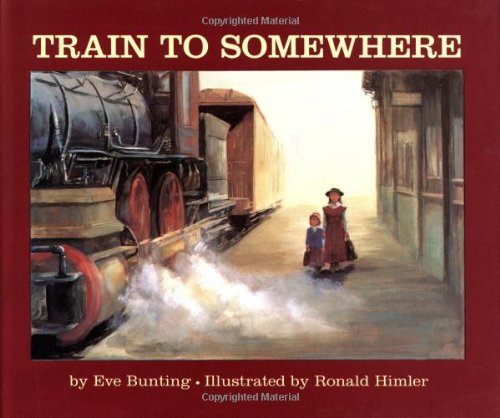



Marianne, heading west with fourteen other children on an Orphan Train, is sure her mother will show up at one of the stations along the way. When her mother left Marianne at the orphanage, hadn't she promised she'd come for her after making a new life in the West? Stop after stop goes by, and there's no sign of her mother in the crowds that come to look over the children. No one shows any interest in adopting shy, plain Marianne, either. But that's all right: She has to be free for her mother to claim her. Then the train pulls into its final stop, a town called Somewhere . . . Grade 2-4?From the mid-19th century until after World War I, thousands of homeless "orphans" were sent West by charitable agencies to find homes with families seeking workers, children to adopt, or mother's helpers. In telling the story of one child, Bunting encapsulates the fears and sometimes happy endings of those fateful trips. Marianne is among the oldest and least attractive of the 14 children sent on a train to the Midwest, and she starts the journey with hopes that her mother will be waiting at one of the stops. At each station, papers are signed and children are placed, until only Marianne remains when the last town of Somewhere is reached. Only an elderly couple, hoping for a boy, is waiting there. They look kindly at Marianne, and the grandmotherly wife sums up the story's theme when she remarks that "Sometimes what you get turns out to be better than what you wanted in the first place." By making this slice of American history into an appealing tale, Bunting offers an opportunity to compare present-day social policies with those of times past. The book is timely yet universal in showing the desire of every child for a loving family. Himler's full-page, bordered paintings portray the people and towns in warm colors and softly blended brush strokes. Beyond this gentle story lie the social issues of our own day.?Shirley Wilton, Ocean County College, Toms River, Copyright 1996 Reed Business Information, Inc. Gr. 2^-5. Another heartbreaking picture book by the pair who did The Wall (1990) and Fly Away Home (1991). This time, it's the story of the Orphan Train, told in the voice of one girl. Marianne is in a group of 14 homeless children traveling with a guardian from New York to the Midwest in 1878 in search of families to adopt them. The words and pictures are understated; readers will fill in the spaces for themselves. "I'm not pretty," Marianne tells us. She's the one nobody wants. She's older than the others, not as cute as the little girls, not as muscular as the boys, not manipulative. The train stops at small towns and railway sidings; the orphans try to smile and look their best; it's like an auction. The townspeople look them over ("They feel the boys' muscles through their coats" ). It's clear that some children will find loving homes; some will not. Marianne tries to tell herself that her mother is waiting for her somewhere out West. Himler's paintings in watercolor and gouache set the story against a bleak midwestern fall landscape. Occasional small pictures show the train steaming across the prairie. The group scenes of the children lined up for inspection evoke images of stiff family photos. Then, as the numbers dwindle, the focus is on individual faces staring ahead as their companions are embraced and adopted. The guardian is gentle--in one beautiful picture she combs Marianne's hair to prepare her for the last train stop--and the quiet ending is hopeful. Marianne is taken, finally, by an elderly couple. They really wanted a boy, but they like her, and they're kind. Even older students will find the history compelling and will want to find out more about what happened to those lonely children. Hazel Rochman A moving piece of Americana from a veteran team (Fly Away Home, 1992, etc.), introducing the orphan trains of the 19th and early 20th century to a picture-book audience. Marianne narrates; she's among 14 children from the orphanages and streets of New York City who are being shipped to the ``New West'' of Illinois and Iowa in search of good homes. At stop after stop her traveling mates are chosen, some clearly for their strength and usefulness, others for their looks. Marianne is neither strong nor pretty and is repeatedly passed over. Secretly she has promised herself that her mother would be at one of the stops to meet her. In the end she is taken in by a nice, elderly couple whom readers know will treat her well. Himler's lovely watercolor and gouache paintings express both the loneliness and hope of the children in scene after scene of the rugged new country. A reminder that the good old days were not so idyllic; this book will have a place in the history curriculum, but it's also an involving read-aloud. (Picture book. 6-10) -- Copyright ©1996, Kirkus Associates, LP. All rights reserved. "A heartbreaking picture book tells the story of the nineteenth-century Orphan Train in the voice of the plain