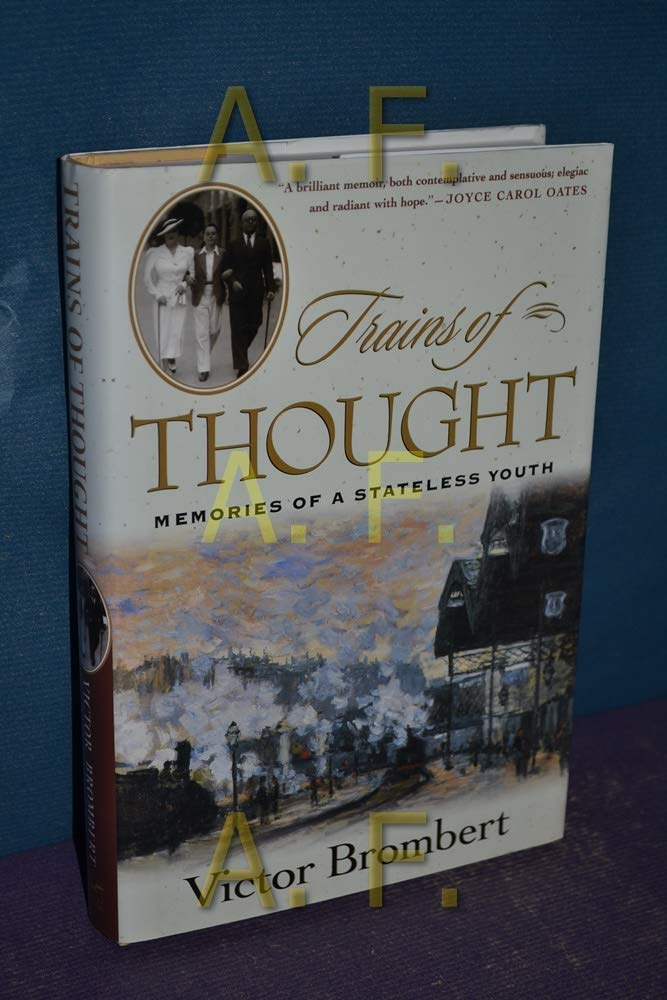



"A beautifully cadenced work of art―it will remind some readers of Nabokov's classic Speak, Memory ."―Joyce Carol Oates Paris in the 1930s―melancholy, erotic, intensely politicized―provides the poetic beginning for this remarkable autobiography by one of America's most renowned literary scholars. In Trains of Thought Victor Brombert recaptures the story of his youth in a Proustian reverie, recalling, with a rare combination of humor and tenderness, his childhood in France, his family's escape to America during the Vichy regime, his experiences in the U.S. Army from the invasion of Normandy to the occupation of Berlin, and his discovery of his scholarly vocation. In shimmering prose, Brombert evokes his upbringing in Paris's upper-middle-class 16th arrondissement, a world where "the sweetness of things" masked the class tensions and political troubles that threatened the stability of the French democracy. Using the train as a metaphor to describe his personal journey, Brombert recalls his boyhood enchantment with railway travel―even imagining that he had been conceived on a sleeper. But the young Brombert sensed that "the poetry of the railroad also had its darker side, for there was the turmoil of departures, the terror . . . of being pursued by a gigantic locomotive, the nightmare of derailments, or of being trapped in a tunnel." With time, Brombert became acutely aware of the grimmer aspects of life around him―the death of his sister, Nora, on an operating table, the tragic disappearance of his boyhood love, Dany, with her infant child, and the mounting cries of "Sale Juif," or "dirty Jew," that grew from a whisper into a thundering din as the decade drew to a close. The invasion of May 1940 dispelled the optimistic belief, shared by most of the French nation, that the horrors that had descended on Germany could never happen to them. The family was forced to flee from Paris, first to Nice, then to Spain, and finally across the Atlantic on a banana freighter to America. Discovering the excitement of New York, Brombert nonetheless hoped to return to France in an American uniform once the United States entered the war. He joined the U.S. Army in 1943, and soon found himself with General Patton's old "Hell-on-Wheels" division at Omaha Beach, then in Paris at the time of its liberation, and later at the Battle of the Bulge. The final chapter concludes with Brombert's return to America, his enrollment at Yale University, and the beginning of a literary voyage whose origins are poignantly captured in this coming-of-age story. Trains of Thought is a virtuosic accomplishment, and a memoir that is likely to become a classic account of both memory and experience. This very personal yet also very political memoir by a self-described "poet of modern life" offers many pleasures. Brombert is a distinguished literary scholar he is Henry Putnam University Professor of Romance and Comparative Literature Emeritus at Princeton University whose subjects have included Flaubert, Hugo, Stendhal, and Eliot. Turning his frank, analytic, and often amused gaze on himself, the author considers his life from early youth until young adulthood. This is never a seamless time in anyone's life, but Brombert's coming-of-age was particularly disjointed. The child of Russian emigres, Brombert grew up in Paris during the roiling events of the 1930s; he eventually escaped to America only to return to Europe as a soldier, participating in the final months of World War II. Brombert's sense of dislocation is aptly conveyed by the word trains, which refers to the trains he frequently took with his family as well as the lovely excursions of the mind he now invites us to share with him. Recommended for all libraries. Ellen D. Gilbert, Princeton, NJ Copyright 2002 Cahners Business Information, Inc. Both as a ubiquitous mode of transportation and as a haunting metaphor for the rocking, rhythmic movement of reverie, the railroad train carries Brombert through this memoir of his often turbulent adolescence and young adulthood. Again and again, it is on a train journey that a perplexed youth is initiated into life's mysteries: maternal grief on a train bound for Genoa, anti-Semitism at a railway stop in Cologne, parental resourcefulness during an escape by rails from Vichy terror, masculine bravado on a troop train bound for Fort Dix. Finally, it is a short train stop in New Haven that allows an impulsive young veteran to enroll at Yale and so discover his vocation in literature. Resisting the impulse to reduce the past to rational order, he retraces the tangled episodes of his life without attempting to dispel their ambiguities. Evocative and luminous, a book to be savored. Bryce Christensen Copyright © American Library Association. All rights reserved A beautifully cadenced work of artit will remind some readers of Nabokov's classic Speak, Memory. -- Joyce Carol Oates A great kaleidoscope of a story. -- Roger Shattuck Victor Brombert is