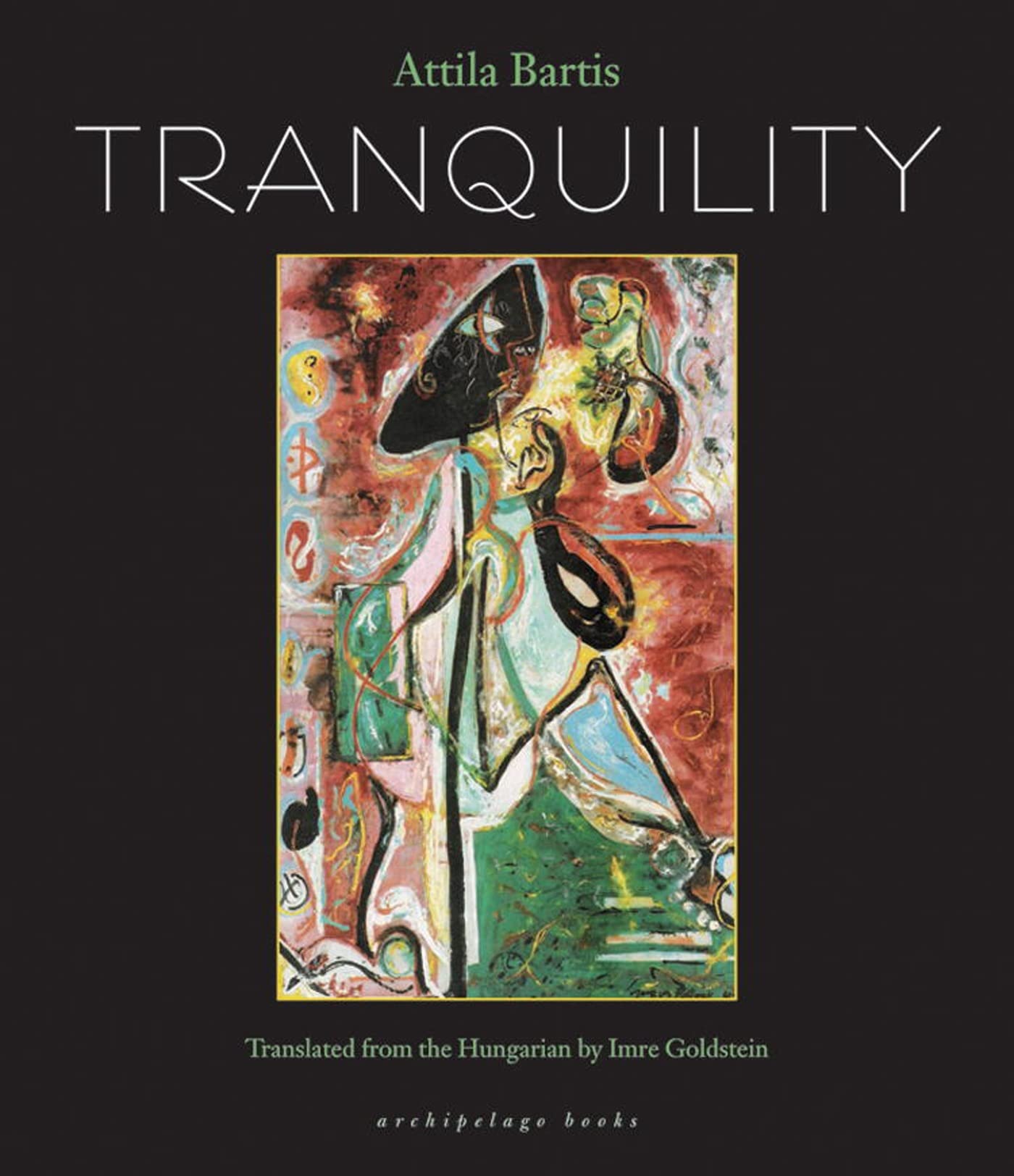



" Tranquility is a moving, emotionally complex, subtle, shocking novel …" Los Angeles Times Tranquility , the acclaimed third novel by Hungarian Attila Bartis, is simultaneously a private psychodrama and a portrait of the end of the Communist era. Reading it, we arrive at ourselves, at our own obsessions, in our own silence,” writes Ilma Rakusa. A thirty-six-year-old writer struggles to escape his hellish, Oedipal inter dependency with his actress mother as Hungary’s Communist infrastructure collapses around him. One of the most psychologically dark and ironic novels to have emerged from contemporary Hungarian literature, it is also, as far as human psychology and political farce are concerned, one of the most illuminating. Attila Bartis has been hailed by Hungarian readers as a maverick, unorthodox, and highly inventive postmodern writer. Tranquility is his first novel to appear in English. Imre Goldstein has translated dozens of books and plays from the Hungarian. He is currently translating a three-volume novel by Péter Nádas. "GREAT ANTICIPATION preceded the release of the maverick writer Attila Bartis's new novel, A nyugalom ( Tranquility ), after his previous book, A keklo para ( Bluish Mist ; see WLT 73:4, P. 784), had solidified his fame as an unorthodox, highly inventive postmodern writer. Its reception has been almost as ambiguous as its main character's psyche. Through anguished retrospection and daredevilish rumination, a baffling and mesmerizing tale unfolds in communist Hungary." WLT, Jan. 02 "Bartis at times puts one in mind of Joyce, at others of Kafka, at others of Roth, yet ultimately eludes all comparison by the strength of his originality." Arturo Mantecón, ForeWord "Oddly beautiful and unsettling, the novel boldly illustrates the lengths people go to in securing their own private hells." Publishers Weekly (Starred Review) "Reading like the bastard child of Thomas Bernhard and Elfriede Jelinek, Tranquility is political and personal suffering distilled perfectly and transformed into dark, viscid beauty. It is among the most haunted, most honest, and most human novels I have ever read." Brian Evenson "With impressive force of language, Bartis succeeds in laying bare the ambivalences of his characters, their love-hate relationships and self-destructive energies … The play that mother and son perform … is part Strindberg and part Chekhov, but mostly sheer Beckett or even pure theater of cruelty." Richard Kämmerlings, Frankfurter Allgemeine Zeitung Bartis's first novel A seta (1991) won the Móricz Zsigmond Scholarship. His works include the short story collection A kékl_ pára (1995), the novel A nyugalom (2001), and a series of literary essays entitled Lazarus's Apocrypha (2001). Bartis has lived in Budapest since 1984. After the 1956 revolution in Hungary, Imre Goldstein escaped to the United States where he earned a Ph.D. in Theater. Since 1974, he has been living in Israel. He has translated dozens of books and plays from the Hungarian. Currently, he is translating a three-volume novel by Péter Nádas. The funeral was at eleven in the morning on Saturday, though I would have liked to have waited a few more days, in case Eszter showed up, but they wouldn’t continue with the refrigeration, not even for extra payment. The woman in the office quoted some new regulation and then asked why not cremate the body; it would be cheaper and much more practical since I could pick a time convenient for everybody in the family, to which I replied that I would not incinerate my mother, let the funeral be on Saturday, and I paid in advance for the three days of storage; she gave me a receipt, entered casket number 704-Saturday-Kerepesi-cemetery into the delivery log, and then put some papers before me, showing with a ballpoint pen where to sign. Used Book in Good Condition