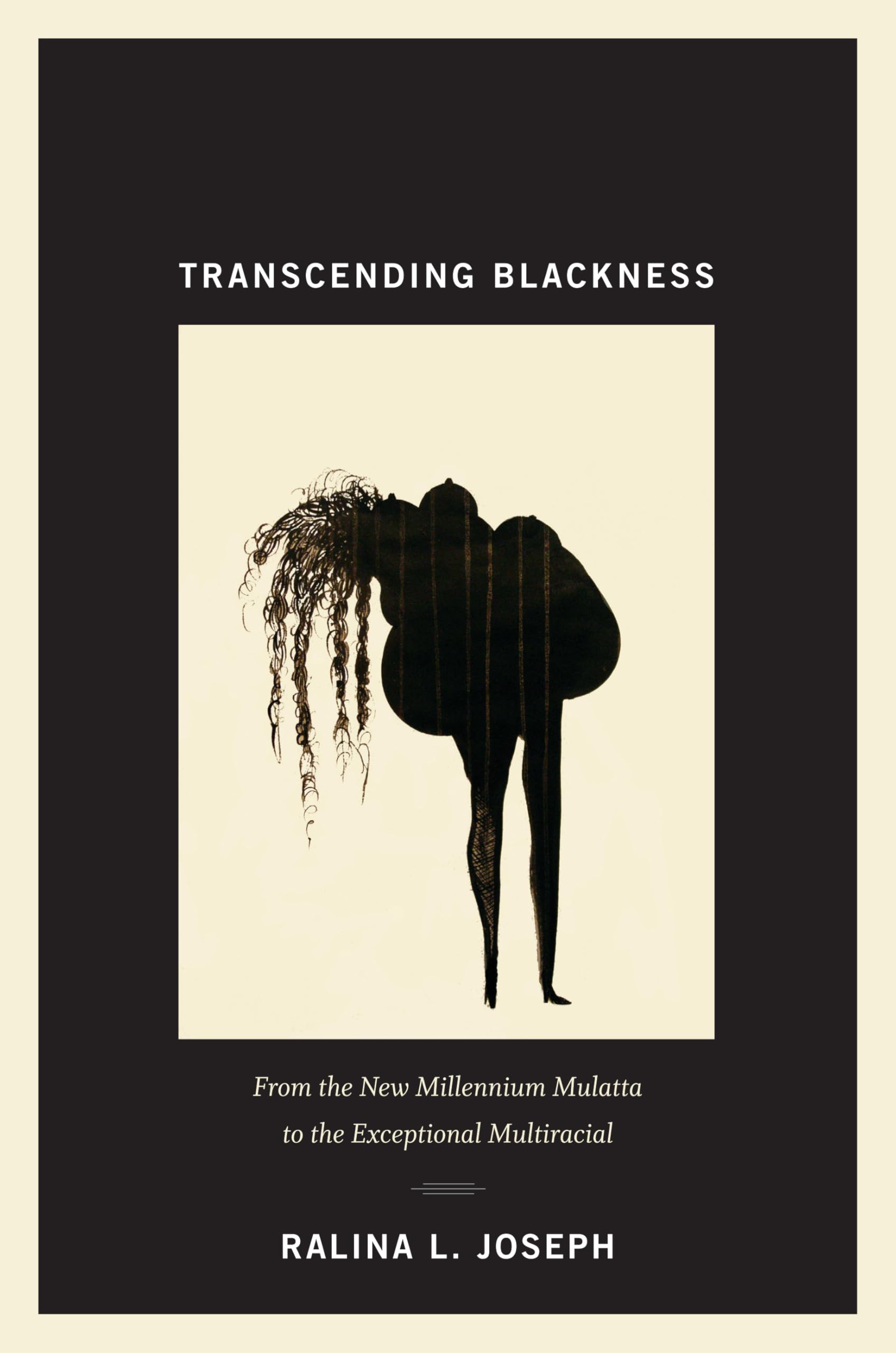
Transcending Blackness: From the New Millennium Mulatta to the Exceptional Multiracial
$112.95
by Ralina L. Joseph



Representations of multiracial Americans, especially those with one black and one white parent, appear everywhere in contemporary culture, from reality shows to presidential politics. Some depict multiracial individuals as mired in painful confusion; others equate them with progress, as the embodiment of a postracial utopia. In Transcending Blackness , Ralina L. Joseph critiques both depictions as being rooted in—and still defined by—the racist notion that blackness is a deficit that must be overcome. Analyzing emblematic representations of multiracial figures in popular culture—Jennifer Beals's character in the The L Word ; the protagonist in Danny Senza's novel Caucasia ; the title character in the independent film Mixing Nia ; and contestants in a controversial episode of the reality show America's Next Top Model , who had to "switch ethnicities" for a photo shoot—Joseph identifies the persistence of two widespread stereotypes about mixed-race African Americans, those of "new millennium mulattas" and "exceptional multiracials." The former inscribes multiracial African Americans as tragic figures whose blackness predestines them for misfortune; the latter rewards mixed-race African Americans for successfully erasing their blackness. Addressing questions of authenticity, sexuality, and privilege, Transcending Blackness refutes the idea that race no longer matters in American society. " Transcending Blackness is unique in the field of multiracial studies and a truly groundbreaking and brilliant book. It is also a pleasure to read. Ralina L. Joseph is a rigorous interdisciplinarian, well versed in a number of fields, and she meticulously analyzes and cites these literatures throughout this important work."— Imani Perry , author of More Beautiful and More Terrible: The Embrace and Transcendence of Racial Inequality in the United States " Transcending Blackness will make a great contribution to the literature on race, gender, and popular culture. Through close readings of diverse works in genres such as television, literature, film, and news media, Ralina L. Joseph explores how the ways that multiracial African Americans imagine themselves and are imagined by others have evolved, highlighting the significance of postracial and postfeminist discourses in this transformation."— E. Patrick Johnson , author of Appropriating Blackness: Performance and the Politics of Authenticity “An important and timely reminder that we must question the construction of the ‘exceptional multiracial’ and uncover the ongoing racist mythologies that undergird such representations.” -- Sinèad Moynihan ― Journal of American Studies “Joseph’s primary contribution lies in focusing on how the celebration of mixed race usually perpetuates negative attitudes toward blackness, and how central gender is to performance of raced identity.” -- G. Jay ― Choice “Joseph provides a thorough history of the representation of ‘mulattas’ and mixed-race individuals and analyzes the vexed terminology used to describe them. . . . . Joseph’s book aptly captures the complexity of mixed-race positionality in contemporary America because she never underestimates the impact of racism, both as it is directed toward multiracial people and as it is perpetrated by them, nor does she collapse the specific experiences of mixed race individuals into one category in response to that persistent racism.” -- Stefanie Kyle Dunning ― Signs “Ralina L. Joseph’s timely book about representations of multiracial black women in popular culture makes a significant contribution to the growing field of critical mixed-race studies…. In short, Transcending Blackness represents rigorous, relevant, and ethical scholarship at its best.” -- Sarita Cannon ― MELUS “As an analysis of cultural texts, Transcending Blackness is enlightening, exposing new texts and proposing a unique interpretive lens.” -- Heidi Ardizzone ― African American Review “This is a work of substantial scholarship, accompanied by some 30 pages of notes and 20 pages of bibliography. Whatever the concepts discussed (and they include, for example, the ideology and use of the phrase ‘the race card’, race switching, forms of racial passing, ‘color blindness’, and ‘post-race’), Joseph dusts them off to offer a refreshed and insightful analysis that revitalises and enlivens our debates around them. Adopting an interdisciplinary perspective, this elegant, lucidly written and challenging book will be very widely read.” -- Peter J. Aspinall ― Ethnic and Racial Studies “Ralina Joseph’s Transcending Blackness provides thoughtful insight and conjures serious contemplation in an increasingly neoliberal/neoconservative America that abhors the mention of race…. Overall, Transcending Blackness provides a view not often presented (or considered) in a highly, silently racialized America, and Joseph’s work is critical to turning up the volume on race.” -- Amanda R. Martinez ― Journal of Race