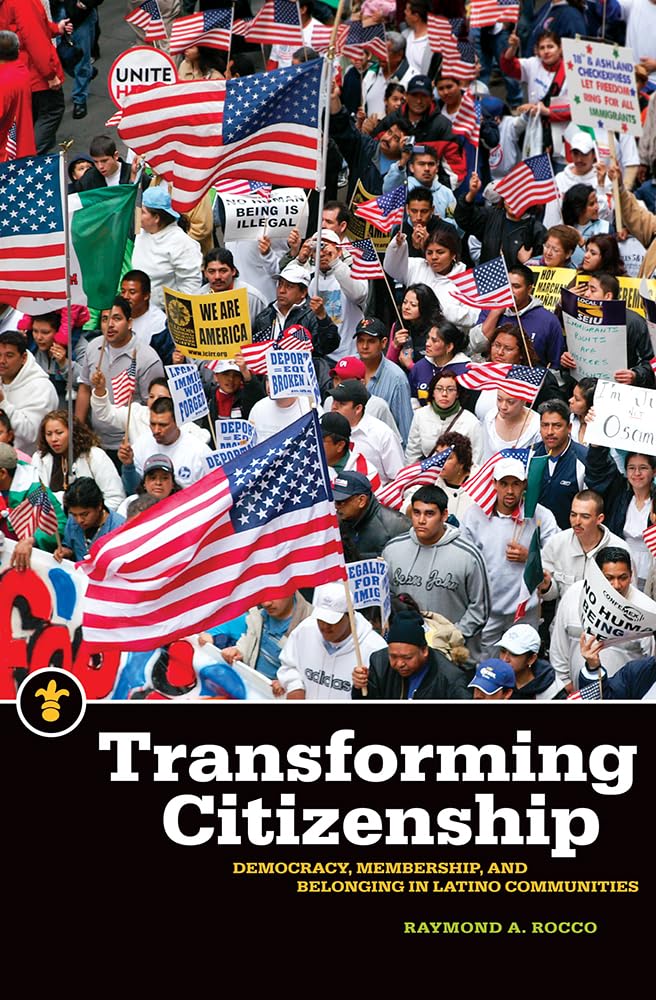
Transforming Citizenship: Democracy, Membership, and Belonging in Latino Communities (Latinos in the United States)
$13.13
by Raymond A. Rocco



In Transforming Citizenship Raymond Rocco studies the “exclusionary inclusion” of Latinos based on racialization and how the processes behind this have shaped their marginalized citizenship status, offering a framework for explaining this dynamic. Contesting this status has been at the core of Latino politics for more than 150 years. Pursuing the goal of full, equal, and just inclusion in societal membership has long been a major part of the struggle to realize democratic normative principles. This illuminating research demonstrates the inherent limitations of the citizenship regime in the United States for incorporating Latinos as full societal members and offers an alternative conception, “associative citizenship,” that provides a way to account for and challenge the pattern of exclusionary belonging that has defined the positions of the Latinos in U.S. society. Through a critical engagement with key theorists such as Rawls, Habermas, Kymlicka, Walzer, Taylor, and Young, Rocco advances an original analysis of the politics of Latino societal membership and citizenship, arguing that the specific processes of racialization that have played a determinative role in creating and maintaining the pattern of social and political exclusions of Latinos have not been addressed by the dominant theories of diversity and citizenship developed in the prevalent literature in political theory. In this important new book, Raymond Rocco explores with conceptual clarity and originality the meaning of Latino politics and multicultural citizenship. Rocco’s intervention revitalizes the study of Chicano/Latino politics as social critique. This is a timely contribution to political theory and citizenship studies―lucid, informed, and insightful. ―Rodolfo D. Torres, University of California, Irvine Raymond A. Rocco is Associate Professor of Political Science at the University of California at Los Angeles. Transforming Citizenship Democracy, Membership, and Belonging in Latino Communities By Raymond A. Rocco Michigan State University Press Copyright © 2014 Raymond A. Rocco All rights reserved. ISBN: 978-1-61186-133-4 Contents TRANSNATIONAL WORKERS AND THE POLITICS OF CITIZENSHIP, by Rubén O. Martinez, FOREWORD, by Suzanne Oboler, PREFACE, INTRODUCTION, CHAPTER 1. Framing the Question of Citizenship: Membership, Exclusionary Inclusion, and Latinos in the National Political Imaginary, CHAPTER 2. Political Theory and Constructs of Membership: Difference and Belonging in Liberal Democracies, CHAPTER 3. Reconceptualizing Citizenship: Membership, Belonging, and the Politics of Racialization, CHAPTER 4. Associative Citizenship: Civil Society, Rights Claims, and Expanding the Public Sphere, CHAPTER 5. Grounded Rights Claims: Contesting Membership and Transforming Citizenship in Latino Urban Communities., CHAPTER 6. Critical Theory and the Politics of Solidarity: Contradictions, Tensions, and Potentiality., CONCLUSION, APPENDIX. Methodology: Case Studies, Life Histories, and Ethnographies, NOTES, REFERENCES, INDEX, CHAPTER 1 Framing the Question of Citizenship Membership, Exclusionary Inclusion, and Latinos in the National Political Imaginary It's great now that they're calling Jose Antonio a hero. But when he was up crossing the border they called him a wetback.... In my mind, he was a hero when he chose to leave the streets. The rest is just politics and window dressing. —Bruce Harris, Director of Casa Alianza, in "From Illegal Immigrant to Marines, Soldier's Death Spotlights Immigrants" Whatever their legal citizenship status, and however many generations of American citizens they can trace in their ancestry, Hispanics/Latinos in the United States are liable to be treated as foreigners. —Iris Young, Justice and the Politics of Difference On Wednesday, April 2, 2003, The U.S. Bureau of Citizenship and Immigration Services awarded citizenship status posthumously to two young Latino immigrants, Jose Garibay and Jose Gutierrez, who were serving in the Marines and were killed during the first few days of the U.S. invasion of Iraq. The official reason given for bestowing citizenship was that it was meant to reward them for losing their lives in the service of "their" country. However, given the rise in anti-immigrant sentiment during the last few years, and the charges that Latino immigrants in particular have undermined the "American way of life" and drained our resources, and that the 37,000 noncitizens in the military pose a problem of "dual loyalty," these events presented an awkward situation for the government. Is it possible that the granting of citizenship was intended to reconcile the tension inherent in the fact that non-citizens died while performing duties normally associated with the highest loyalties of citizenship? Clearly citizenship has no meaning for these two Latinos now, so granting it to them posthumously was a symbolic act addressed to appeal to a national audience. Immig