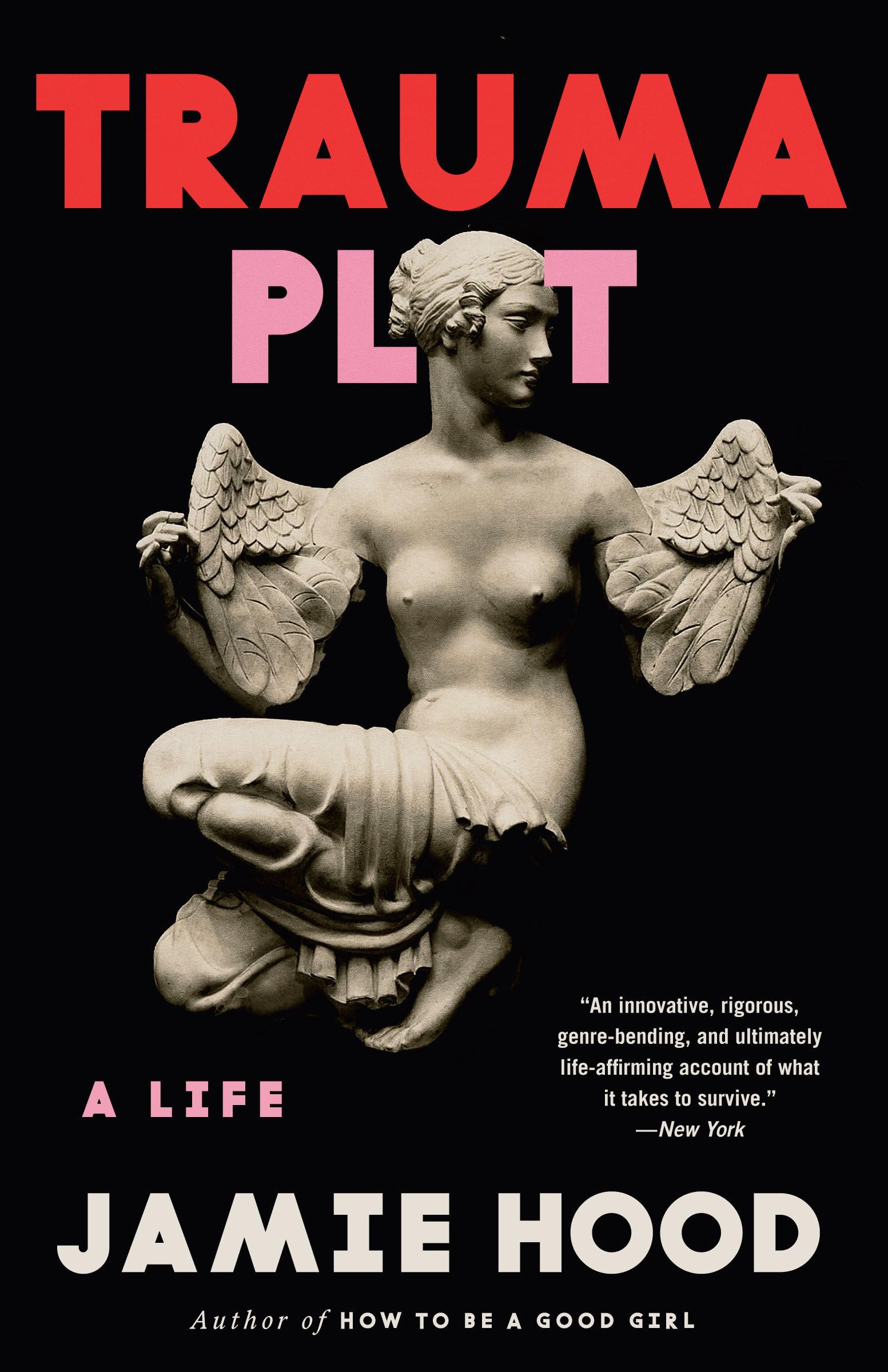



From a rising literary star and the author of h ow to be a good girl comes a brilliant, biting, and beautifully wrought memoir of trauma and the cost of survival A VULTURE NOTABLE BOOK OF THE YEAR "Piercing . . . . Trauma Plot flips the confessional memoir on its head." —The Cut "An innovative, rigorous, genre-bending, and ultimately life-affirming account of what it takes to survive." —Vulture In the thick of lockdown, 2020, poet, critic, and memoirist Jamie Hood published her debut, how to be a good girl , an interrogation of modern femininity and the narratives of love, desire, and violence yoked to it. The Rumpus praised Hood’s “bold vulnerability,” and Vogue named it a Best Book of 2020. In Trauma Plot , Hood draws on disparate literary forms to tell the story that lurked in good girl’s margins—of three decades marred by sexual violence and the wreckage left behind. With her trademark critical remove, Hood interrogates the archetype of the rape survivor, who must perform penitence long after living through the unthinkable, invoking some of art’s most infamous women to have played the role: Ovid’s Philomela, David Lynch’s Laura Palmer, and Artemisia Gentileschi, who captured Judith’s wrath. In so doing, she asks: What do we as a culture demand of survivors? And what do survivors, in turn, owe a world that has abandoned them? Trauma Plot is a scalding work of personal and literary criticism. It is a send-up of our culture's pious disdain for “trauma porn,” a dirge for the broken promises of #MeToo, and a paean to finding life after death. "An innovative, rigorous, genre-bending, and ultimately life-affirming account of what it takes to survive." — Vulture "Piercing . . . . Trauma Plot flips the confessional memoir on its head." — Grace Byron, The Cut “Hood doesn’t indicate whether she feels like she has healed from her past, or what it would look like if she had. But Trauma Plot unambiguously demonstrates her growth as a writer. Like Philomela, Hood alchemizes her suffering into something new.” — Bekah Walkes, The Atlantic “Awe-inspiring.” —Defector "Jamie Hood is not only an uncommon thinker, but a world-class explorer of unthought. She descends into the terrifying dark of the unsayable with the dimmest of flashlights and returns bearing verbal gems, treasures, and marvels." —Torrey Peters, bestselling author of Detransition, Baby and Stag Dance "Rendered with raw-nerve clarity . . . . Hood’s writing is exceptional for its own sake." —The Telegraph "This book devastated me. I found my whole being thrumming with the energy of Hood's refusals, her intense thinking and feeling, the formal play with the modernist novel, and her clear-eyed reporting in the wake of trauma." —Kate Zambreno, author of Heroines "Hood has been vulnerable and she has been strong, and it’s the strong Hood who emerges victorious from Trauma Plot . You’ll be rooting for her through every page of this searing memoir." —Vogue "Hood’s unflinching prose ultimately serves as a bright herald to guide us through the battles that lie ahead." —Harper's Bazaar "Kaleidoscopic . . . . Trauma Plot is a refusal of the silence around sexual violence, a tapestry woven by bloody fingers." — Erin Vachon, The Rumpus "Hood is one of the most interesting literary critics writing today, and her excavation of trauma and survival is a wonder. Moving, thought-provoking, at once intellectual and deeply personal." —LitHub "Trauma Plot is an ode to the wrecked woman, the bloody battle of survivorship, and the act of writing itself—not because writing can save us, but because it reminds us we're still alive." — Melissa Lozada-Oliva, author of Dreaming of You and Candelaria "A candid, at times hard to read recounting of sexual abuse." —Bustle “ Trauma Plot is a sophisticated kind of life writing, and does something far more interesting than claim authenticity through the immediacy of experience." —McKenzie Wark, e-flux Jamie Hood is the author of how to be a good girl , one of Vogue ’s Best Books of 2020, and regards, marcel , a monthly newsletter on Proust and other miscellany. Her essays and criticism have appeared in The Baffler , Bookforum , The Nation , Los Angeles Review of Books , The New Inquiry , The Drift , and elsewhere. She lives in Brooklyn. She came to in the kitchen and found the oven on. She didn’t remember igniting it, but then, she couldn’t seem to remember rising from bed that morning at all, not dressing, nor plodding—barefooted, she saw now—down the hall from the bedroom. This was not a shock. For months she’d been losing time. Losing time, she’d say, as if time were an object, a set of keys, say, or a passport, a thing one held and could, in turn, misplace, though it felt rather that time had lost her, had slipped its noose somehow and fled somewhere she could no longer see. Her head was wooly; her limbs stiff. She stooped to peer thr