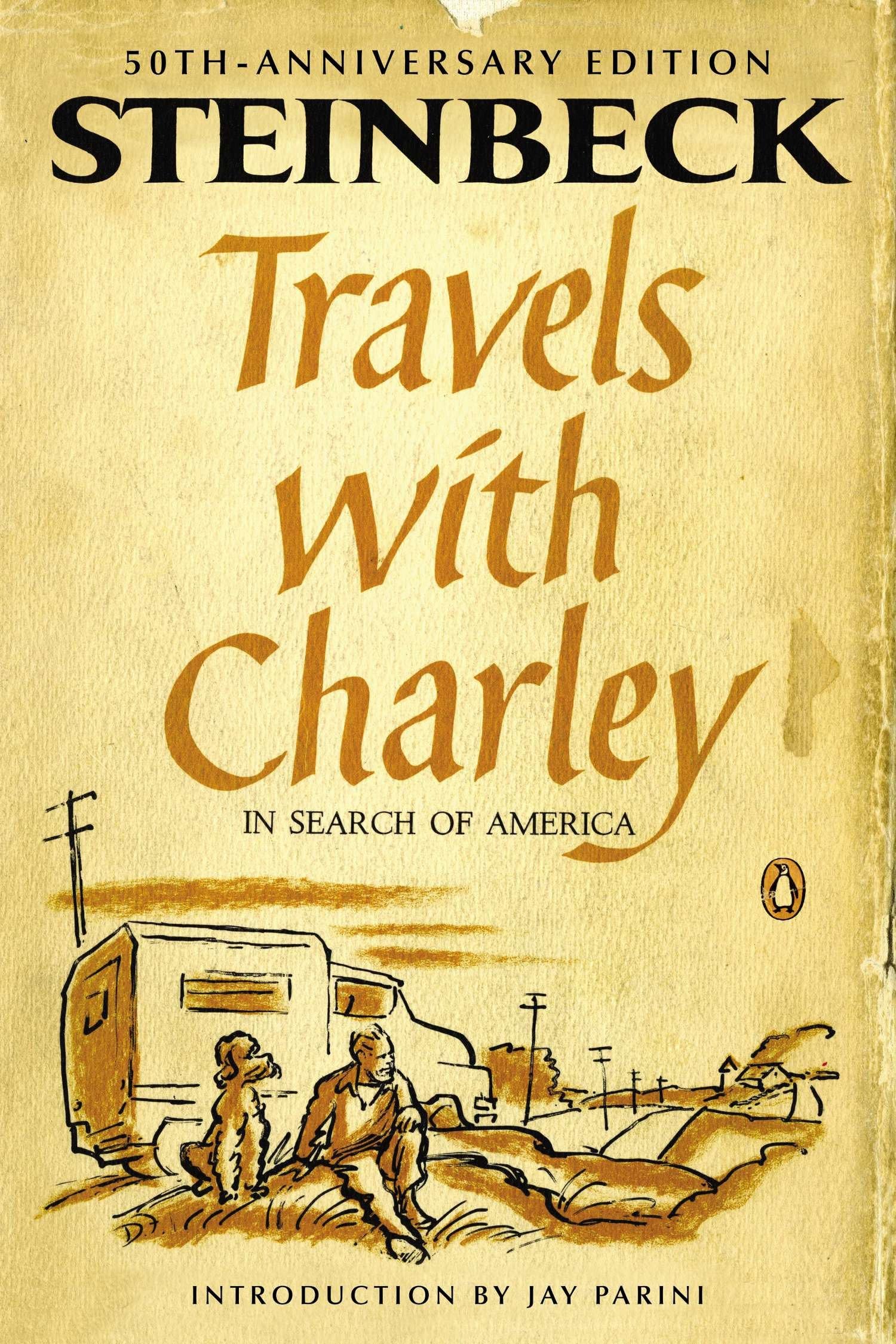
Travels with Charley in Search of America: (Penguin Classics Deluxe Edition)
$11.64
by John Steinbeck



A collectible 50th anniversary deluxe edition featuring an updated introduction by Jay Parini and first edition cover art and illustrated maps of Steinbeck’s route by Don Freeman A Penguin Classic In September 1960, John Steinbeck embarked on a journey across America. He felt that he might have lost touch with the country, with its speech, the smell of its grass and trees, its color and quality of light, the pulse of its people. To reassure himself, he set out on a voyage of rediscovery of the American identity, accompanied by a distinguished French poodle named Charley; and riding in a three-quarter-ton pickup truck named Rocinante. His course took him through almost forty states: northward from Long Island to Maine; through the Midwest to Chicago; onward by way of Minnesota, North Dakota, Montana (with which he fell in love), and Idaho to Seattle, south to San Francisco and his birthplace, Salinas; eastward through the Mojave, New Mexico, Arizona, to the vast hospitality of Texas, to New Orleans and a shocking drama of desegregation; finally, on the last leg, through Alabama, Virginia, Pennsylvania, and New Jersey to New York. Travels with Charley in Search of America is an intimate look at one of America's most beloved writers in the later years of his life—a self-portrait of a man who never wrote an explicit autobiography. Written during a time of upheaval and racial tension in the South—which Steinbeck witnessed firsthand— Travels with Charley is a stunning evocation of America on the eve of a tumultuous decade. This Penguin Classics Deluxe Edition also features French flaps and deckle-edged paper. For more than seventy years, Penguin has been the leading publisher of classic literature in the English-speaking world. With more than 1,700 titles, Penguin Classics represents a global bookshelf of the best works throughout history and across genres and disciplines. Readers trust the series to provide authoritative texts enhanced by introductions and notes by distinguished scholars and contemporary authors, as well as up-to-date translations by award-winning translators. By the Winner of the Nobel Prize in Literature "Pure delight, a pungent potpourri of places and people interspersed with bittersweet essays on everything from the emotional difficulties of growing old to the reasons why giant sequoias arouse such awe." — The New York Times Book Review "Profound, sympathetic, often angry . . . an honest, moving book by one of our great writers." — The San Francisco Examiner "The eager, sensuous pages in which he writes about what he found and whom he encountered frame a picture of our human nature in the twentieth century which will not soon be surpassed." — The Atlantic Monthy John Steinbeck (1902–1968) was born in Salinas, California. He worked as a laborer and a journalist, and in 1935, when he published Tortilla Flat , he achieved popular success and financial security. Steinbeck wrote more than twenty-five novels and won the Nobel Prize in 1962. Jay Parini teaches English at Middlebury College and is the author of five novels, including The Last Station . He lives in Vermont. PENGUIN CLASSICS DELUXE EDITION TRAVELS WITH CHARLEY IN SEARCH OF AMERICA Born in Salinas, California, in 1902, John Steinbeck grew up in a fertile agricultural valley about twenty-five miles from the Pacific Coast—and both valley and coast would serve as settings for some of his best fiction. In 1919 he went to Stanford University, where he intermittently enrolled in literature and writing courses until he left in 1925 without taking a degree. During the next five years he supported himself as a laborer and journalist in New York City, all the time working on his first novel, Cup of Gold (1929). After marriage and a move to Pacific Grove, he published two California fictions, The Pastures of Heaven (1932) and To a God Unknown (1933), and worked on short stories later collected in The Long Valley (1938). Popular success and financial security came only with Tortilla Flat (1935), stories about Monterey’s paisanos. A ceaseless experimenter throughout his career, Steinbeck changed courses regularly. Three powerful novels of the late 1930s focused on the California laboring class: In Dubious Battle (1936), Of Mice and Men (1937), and the book considered by many his finest, The Grapes of Wrath (1939). Early in the 1940s, Steinbeck became a filmmaker with The Forgotten Village (1941) and a serious student of marine biology with Sea of Cortez (1941). He devoted his services to the war, writing Bombs Away (1942) and the controversial play-novelette The Moon Is Down (1942). Cannery Row (1945), The Wayward Bus (1947), The Pearl (1947), A Russian Journal (1948), another experimental drama, Burning Bright (1950), and The Log from the Sea of Cortez (1951) preceded publication of the monumental East of Eden (1952), an ambitious saga of the Salinas Valley and his own family’s histor