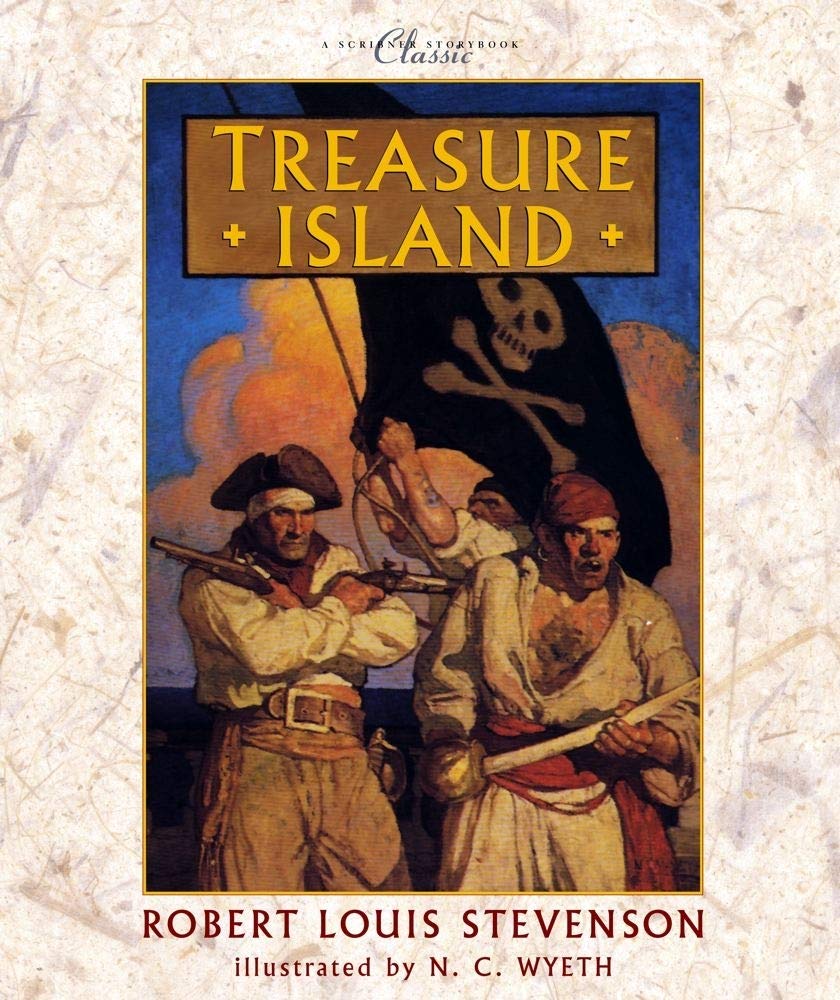



Robert Louis Stevenson’s classic pirate adventure that has thrilled readers for over a hundred years. Masterfully crafted, Treasure Island is a stunning yarn of piracy on the fiery tropic seas—an unforgettable tale of treachery that embroils a host of legendary swashbucklers, from honest young Jim Hawkins, to sinister, two-timing Israel Hands, to evil incarnate, blind Pew. But above all, Treasure Island is a complex study of good and evil, as embodied by that hero-villain Long John Silver, the merrily unscrupulous buccaneer-rogue whose greedy quest for gold cannot help but win the heart of every soul who ever longed for romance, treasure, and adventure. Gr. 5-9. This is one of the best in the picture-book-size Scribner Storybook Classic series. True to the spirit of Stevenson's timeless novel, Timothy Meis' abridged retelling captures the bloody action of mutiny on the high seas and the cutthroat quest for hidden treasure. The story is told through the eyes of brave cabin boy Jim, who fights off the murderous pirates and bonds with their one-legged leader, Long John Silver. Wyeth's thrilling, handsomely reproduced paintings, originally done in 1911, will attract a variety of readers, including some older high-schoolers. In dark shades of brown and red, the pictures focus on the grim, exciting struggle on board the ship and on the island. At the same time, there's a burning golden glow in the background of almost every scene, keeping readers in mind of the treasure that drives the wild action. The most unforgettable painting--and one of Wyeth's most famous--is the melancholy scene of Jim leaving home as his mother weeps in the background. It's the elemental adventure. Hazel Rochman Copyright © American Library Association. All rights reserved Robert Louis Stevenson (1850–1894) spent his childhood in Edinburgh, Scotland, but traveled widely in the United States and throughout the South Seas. He was author of many novels, including The Strange Case of Dr. Jekyll and Mr. Hyde , Kidnapped , The Black Arrow , and Treasure Island . N.C. Wyeth (1882–1945) began his artistic career as a young adult. Born in Needham, Massachusetts, Wyeth traveled the American West extensively and drew what he saw. His prolific career includes three thousand works and more than one hundred book illustrations, including those for a majority of the Scribner Illustrated Classics series. 1 The Old Sea-Dog at the “Admiral Benbow” Squire Trelawney, Dr. Livesey, and the rest of these gentlemen having asked me to write down the whole particulars about Treasure Island, from the beginning to the end, keeping nothing back but the bearings of the island, and that only because there is still treasure not yet lifted, I take up my pen in the year of grace 17—, and go back to the time when my father kept the “Admiral Benbow” inn, and the brown old seaman, with the sabre cut, first took up his lodging under our roof. I remember him as if it were yesterday, as he came plodding to the inn door, his sea-chest following behind him in a handbarrow; a tall, strong, heavy, nut-brown man; his tarry pigtail falling over the shoulders of his soiled blue coat; his hands ragged and scarred, with black, broken nails; and the sabre cut across one cheek, a dirty, livid white. I remember him looking round the cove and whistling to himself as he did so, and then breaking out in that old sea-song that he sang so often afterwards: “Fifteen men on the dead man’s chest— Yo-ho-ho, and a bottle of rum!” in the high, old tottering voice that seemed to have been tuned and broken at the capstan bars. Then he rapped on the door with a bit of stick like a handspike that he carried, and when my father appeared, called roughly for a glass of rum. This, when it was brought to him, he drank slowly, like a connoisseur, lingering on the taste, and still looking about him at the cliffs and up at our signboard. “This is a handy cove,” says he, at length; “and a pleasant sittyated grog-shop. Much company, mate?” My father told him no, very little company, the more was the pity. “Well then,” said he, “this is the berth for me. Here you, matey,” he cried to the man who trundled the barrow; “bring up alongside and help up my chest. I’ll stay here a bit,” he continued. “I’m a plain man; rum and bacon and eggs is what I want, and that head up there for to watch ships off. What you mought call me? You mought call me captain. Oh, I see what you’re at—there”; and he threw down three or four gold pieces on the threshold. “You can tell me when I’ve worked through that,” says he, looking as fierce as a commander. And, indeed, bad as his clothes were, and coarsely as he spoke, he had none of the appearance of a man who sailed before the mast; but seemed like a mate or skipper, accustomed to be obeyed or to strike. The man who came with the barrow told us the mail had set him down the morning before at the “Royal George”; that he had inquired what inns there were along the