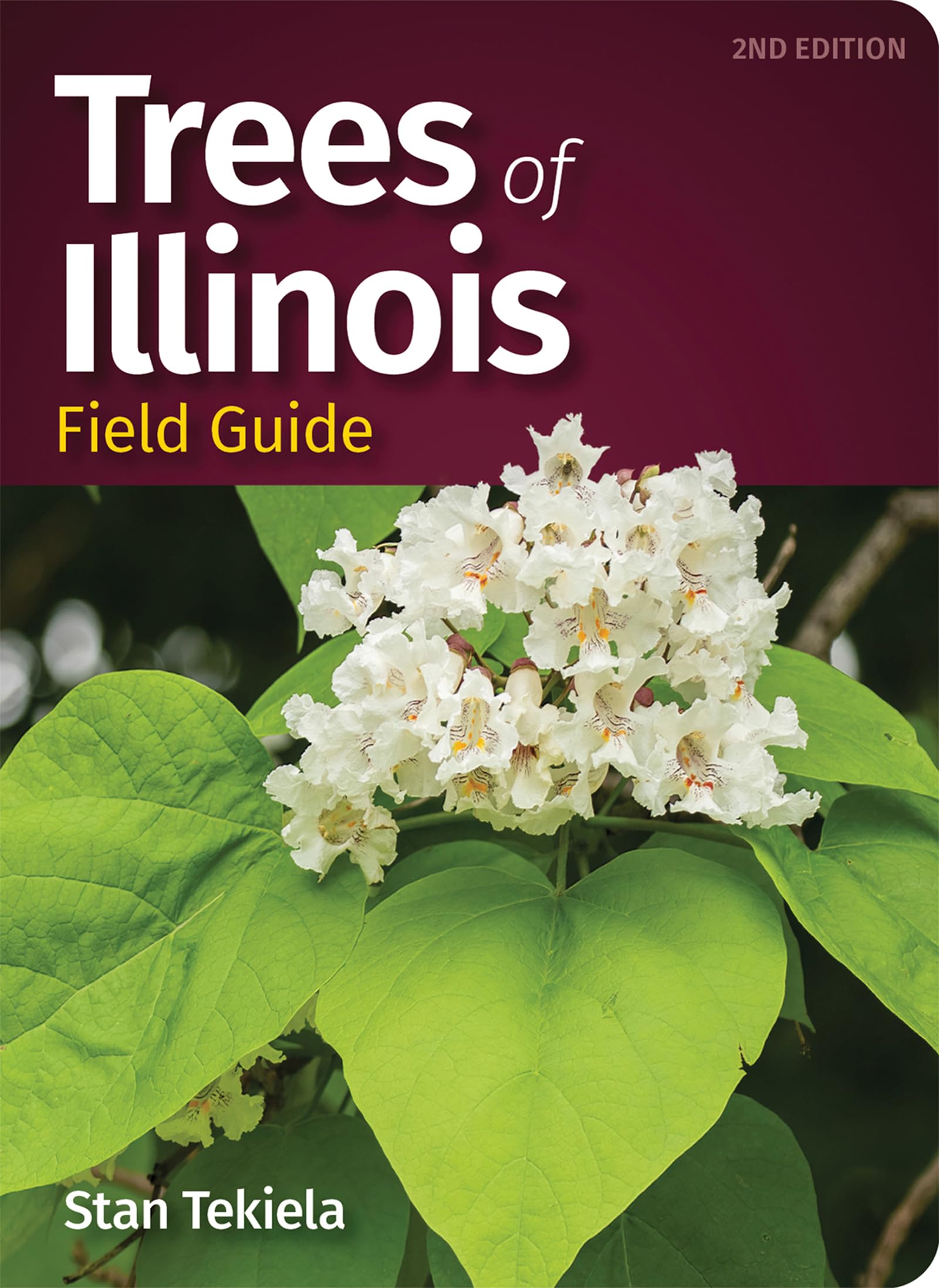



Learn to identify Illinois trees with this handy field guide, organized by leaf type and attachment. With this famous field guide by award-winning author and naturalist Stan Tekiela, you can make tree identification simple, informative, and productive. There’s no need to look through dozens of photos of trees that don’t grow in Illinois. Learn about 124 species found in the state (every native tree plus common non-natives), organized by leaf type and attachment. Just look at a tree’s leaves, then go to the correct section to learn what it is. Fact-filled information contains the particulars that you want to know, while full-page photographs provide the visual detail needed for accurate identification. Book Features 124 species: Every native tree plus common non-natives - Easy to use: Thumb tabs show leaf type and attachment - Compare feature: Decide between look-alikes - Stan’s Notes: Naturalist tidbits and facts - Professional photos: Crisp, stunning full-page images This new edition includes updated photographs; expanded information; a Quick Compare section for leaves, needles, and silhouettes; and even more of Stan’s expert insights. So grab the Trees of Illinois Field Guide for your next outing—to help ensure that you positively identify the trees that you see. Naturalist, wildlife photographer, and writer Stan Tekiela is the author of more than 190 field guides, nature books, children’s books, and playing cards, presenting many species of birds, mammals, reptiles, amphibians, trees, wildflowers, and cacti in the United States. With a Bachelor of Science degree in Natural History from the University of Minnesota and as an active professional naturalist for more than 30 years, Stan studies and photographs wildlife throughout the United States and Canada. He has received various national and regional awards for his books and photographs. Also a well-known columnist and radio personality, his syndicated column appears in more than 25 newspapers and his wildlife programs are broadcast on a number of Midwest radio stations. Red Maple Acer rub-rum Family: Maple (Aceraceae) Height: 40–60' (12–18 m) Tree: single trunk, narrow dense crown Leaf: lobed, 3–4" (7.5–10 cm) long, oppositely attached, 3–5 lobes (usually 3), shallow notches in between lobes, double-toothed margin, light green color, red leafstalk Bark: gray, smooth, broken by narrow irregular cracks Flower: tiny red hanging flower, .25" (.6 cm) wide, on a 1–2" (2.5–5 cm) long red stalk, growing in clusters, 1–3" (2.5–7.5 cm) wide Fruit: pair of winged seeds (samara), red in springtime, .5–1" (1–2.5 cm) long Fall Color: red to orange Origin/Age: native; 75–100 years Habitat: wet to moist soils, along swamps or depressions that hold water, sun to partial shade Range: southern half of Illinois Stan’s Notes: One of the most drought-tolerant species of maple in Illinois. Often planted as an ornamental, it can be identified by its characteristic leaves, which have three pointed lobes and red stalks. The common name comes from the obvious red flowers that bloom early in spring, but the flowers and leafstalks are not the only red colors it has. New leaves, fall color and spring seeds are also red. Produces one of the smallest seeds of any of the maples. Also called Swamp Maple, Water Maple or Soft Maple, the latter being used to refer to the Silver Maple (pg. 179) as well. Even though it is sometimes called Soft Maple, its wood is very hard and brittle.