Trends in Development of Accelerated Testing for Automotive and Aerospace Engineering
$120.00
by Lev M. Klyatis PhD Habilitated Dr.-Ing. Sc.D



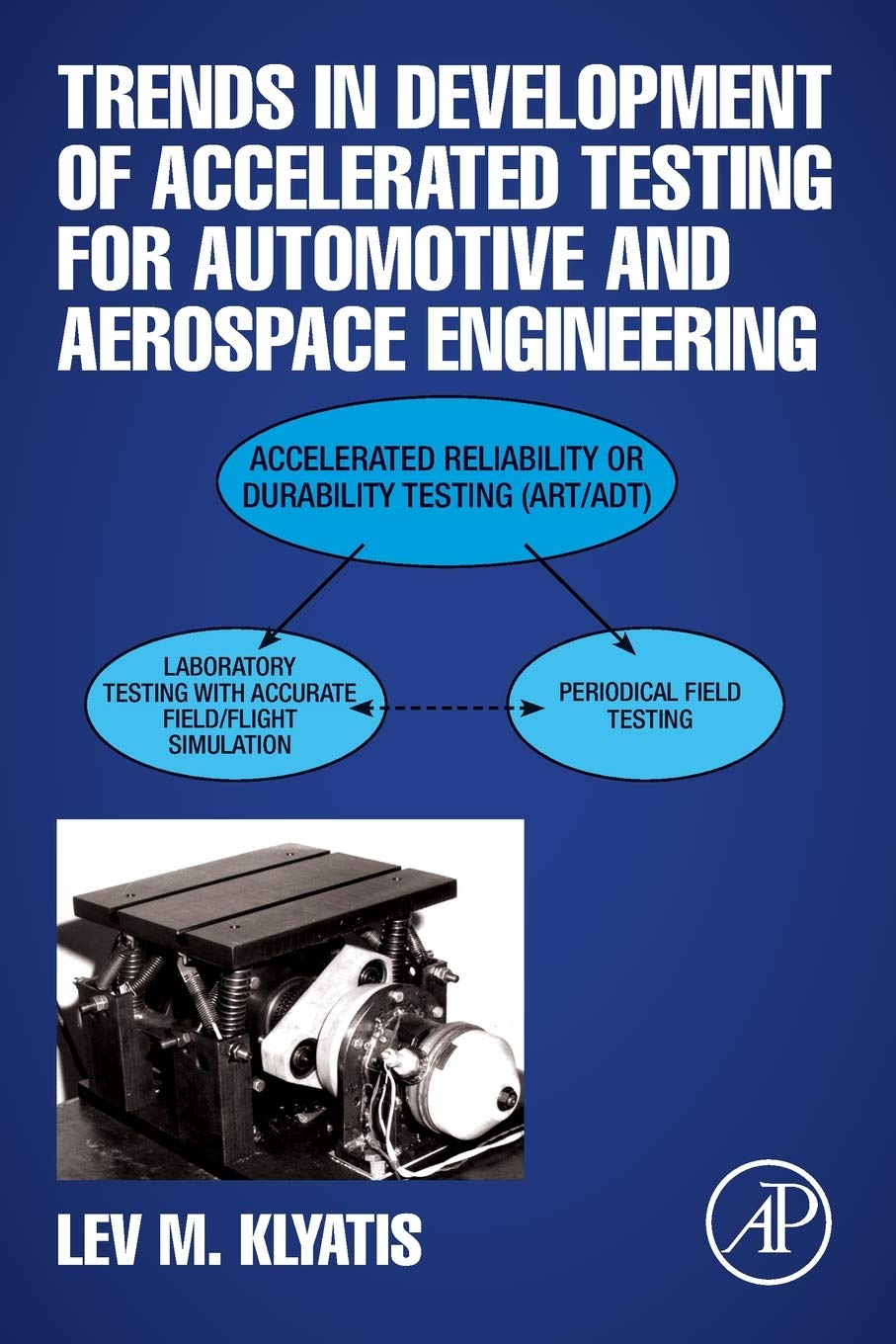
Accelerated testing (most types of laboratory testing, proving ground testing, intensive field/flight testing, any experimental research) is increasingly a key component for predicting of product’s/process performance. Trends in Development Accelerated Testing for Automotive and Aerospace Engineering provides a completely updated analysis of the current status of accelerated testing, including the basic general directions of testing (methods and equipment) development, how one needs to study real world conditions for their accurate simulation and successful accelerated testing, describes in details the role of accurate simulation in the development of automotive and aerospace engineering, shows that failures are most often found in the interconnections, step-by-step instructions and examples. This is the only book presently available that considers in detail both the positive and negative trends in testing development for prediction quality, reliability, safety, durability, maintainability, supportability, profit, and decreasing life-cycle cost, recalls, complaints and other performance components of the product. The author presents new ideas and offers a unique strategic approach to obtaining solutions which were not possible using earlier. His methodology has been widely implemented, continue to be adopted throughout the world, and leads to advance society through product improvement that can reduce loss of life, injuries, financial losses, and product recalls. It also covers new ideas in development positive and cost- effective trends in testing development, especially accelerated reliability and durability testing (ART/ADT), which includes integration accurate simulation of field/flight influences, safety, human factors, and leads to successful prediction of product performance during pre-design, design, manufacturing, and usage for the product’s service life. Engineers, researchers, teachers and postgraduate/advanced students who are involved in automotive and aerospace engineering will find this a useful reference on how to apply the accelerated testing method to solve practical problems in these areas. Explains the similarities and differences between accelerated testing technologies used in automotive, aerospace, and other engineering fields - Provides a step-by-step guide for the accurate physical simulation of field conditions for test subjects - Includes case studies of accelerated testing in automotive and aerospace engineering Explains the latest advances in accelerated testing for research, design, manufacturing acceleration and quality improvement Trends in Development of Accelerated Testing for Automotive and Aerospace Engineering explains how these technologies are leading to improvements in design, manufacturing, quality, safety, reliability, and cost. This book also provides: Analysis of the current situation, with examples, in accelerated testing of automotive and aerospace engineering; - The positive and negative aspects of trends in development testing - Step-by-step accurate physical simulation of field conditions for the test subject - How to use this for accelerating the product (technology) quality and reliability development - How one could use the above simulation for accurate prediction and reducing complaints and recalls. Reliability engineers, researchers, teachers, and postgraduate/advanced student who are involved in automotive and aerospace engineering will find this reference useful on how to apply the accelerated testing method to solve practical problems in these areas. Lev M. Klyatis, PhD, Habilitated Dr.-Ing., Sc.D., Head of Reliability Department Eccol, Inc., has been Professor of Engineering Technology at Moscow State Agricultural University, research leader and chairman of State Enterprise TESTMASH, and served on the USA Technical Advisory Group for the International Electrotechnical Commission, the ISO/IEC Joint Study Group in Safety Aspects of Risk Assessment, the United Nations European Economical Commission, and World Quality Council.