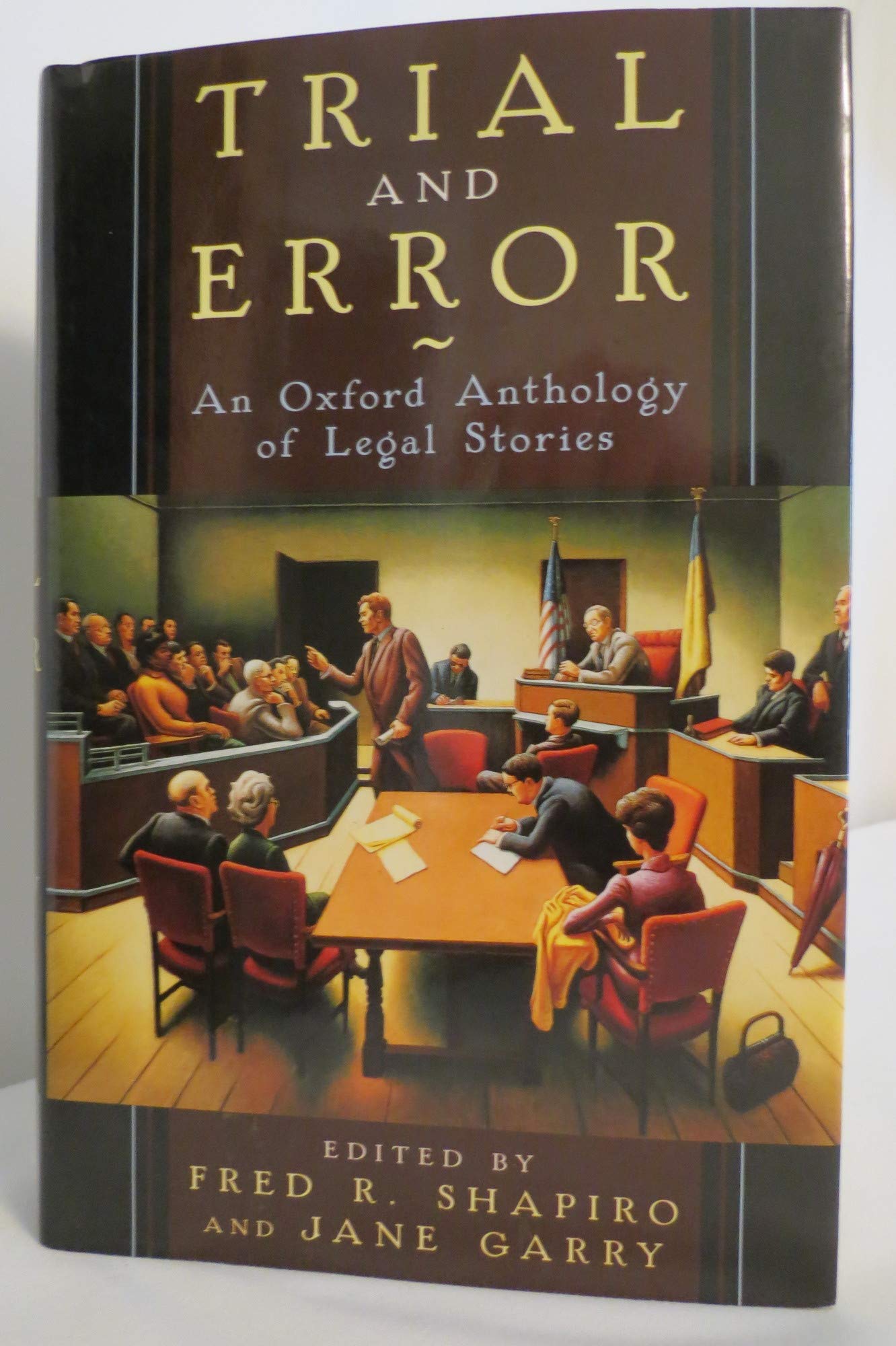



The courtroom has always contained many of the elements of great literature--conflict, suspense, high drama, and human tragedy. Indeed, the courtroom is a stage on which the noblest passions and basest instincts are played out before a jury who, much like the readers of a story or a novel, must interpret the evidence and formulate a judgment. It is not surprising, then, that law has attracted writers from Sophocles to Joyce Carol Oates, and that some of the most compelling moments in fiction arise from legal conflicts, for the law raises many of the most fundamental human issues: How can we know the truth? How do we decide between mercy and punishment? How can the impersonal machinery of the legal system protect the rights of the individual? In Trial and Error: An Oxford Book of Legal Stories , Fred R. Shapiro and Jane Garry bring together thirty-two riveting stories, excerpts from novels, and nonfiction essays about the human dimensions of the law. From Sir Walter Scott's "The Two Drovers" (1827), to Ernest J. Gaines's A Lesson Before Dying (1993), the selections gathered here vividly dramatize the legal process. We see the law as a vehicle of frustration and inertia in Dickens's Bleak House , as a baffling affront to common sense in Mark Twain's Roughing It , as a forum for humiliation and cruelty in Robert Louis Stevenson's Weir of Hermiston , as a cynical and racist form of expediency in James Alan McPherson's "An Act of Prostitution," and as a battleground for the possession of a child in Sue Miller's The Good Mother . Here we find lawyers, criminal defendants, litigants, clients, judges, police, jurors, and witnesses, all of them depicted with veracity and insight. Many of the writers in this anthology either practiced or studied law, or were themselves involved in litigation; those who weren't, apply powers of observation to a process that affects us all. Thus, from George Eliot, Herman Melville,Anthony Trollope, and Frank O'Connor to William Faulkner, George Orwell, Nadine Gordimer, Louis Auchincloss, Phillip Roth, Elizabeth Jolley, and many others, this collection allows us to grasp more clearly the inner workings of the law, its effect on the human psyche, and the enormous tensions created by mankind's attempt to impose order and justice on social relations that often remain chaotic, defiant, and ungovernable. With a sharply illuminating preface that explores the connections between literature and law, and with a helpful headnote for each selection, Trial and Error puts readers in the jury box as some of the greatest writers in the English language make their cases. With the recent spate of high-profile trials, it's nice to have a compilation that offers a broader perspective on the thematic issues of justice. Shapiro, a law librarian and lecturer in legal research at Yale Law School, and acquisitions editor Garry have done an especially good job of introducing each of the 32 stories with an examination of the author, his or her connection to the legal world, and the context for the story. Arranged chronologically from an 1827 tale by Walter Scott to a work written by Ernest J. Gaines in 1993, this anthology ranges from Dickens, Trollope, and Twain through Orwell, Faulkner, and West to Barth, Fowles, and Oates. The stories treat the human dimension of the law, focusing on the institutions, legal rules, and legal actors. Whether the plaintiff is guilty and gets off, as in Agatha Christie's selection, innocent but sentenced as guilty, as in Harper Lee's, shown as trivial by John Barth or serious by Somerset Maugham, the wide range of situations, predicaments, and interpretation make this a fascinating compilation. Essential for all law libraries and literary collections.?Joshua Cohen, Mid-Hudson Lib. System, Poughkeepsie, N.Y. Copyright 1997 Reed Business Information, Inc. At first glance, this compendium of stories and snippets of novels and nonfiction pieces seems like a bad idea. After all, what good are pieces of out-of-context novels? But editors Shapiro and Garry make it work by choosing segments from Bleak House , Billy Budd , To Kill a Mockingbird , and other novels that stand alone and truly highlight the idiosyncrasies and vagaries of the criminal court system. Walter Scott's "Two Drovers" is a marvelous example of his work; other entries range from a classic curio (Agatha Christie's "Witness for the Prosecution"), to a twisted southern detective yarn (William Faulkner's "Tomorrow"), to Quentin Crisp's personal account of his persecution simply for being homosexual, to Susan Glaspell's brief but bloodcurdling "A Jury of Her Peer's." This compilation distinguishes itself in the docket and is worthwhile reading for any legal buff. Joe Collins "Shaprio and Garry have done an especially good job of introducing each of the 32 stories with an examination of the author, his or her conection to the legal world, and the context for the story.... Whether the plaintiff is guilty and g