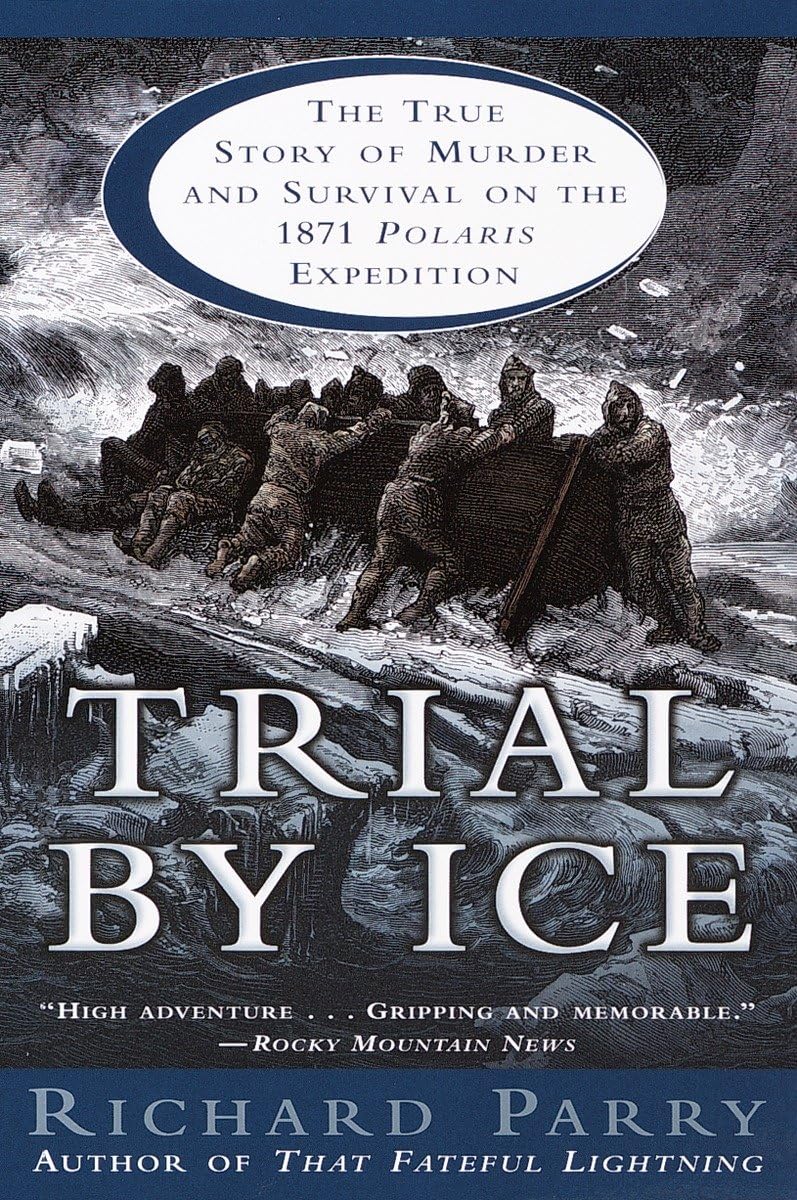
Trial by Ice: The True Story of Murder and Survival on the 1871 Polaris Expedition
$44.00
by Richard Parry



“An extraordinary real-life adventure of men battling the elements and themselves, told with ice-cold precision.” – Kirkus Reviews (starred review) In the dark years following the Civil War, America’s foremost Arctic explorer, Charles Francis Hall, became a figure of national pride when he embarked on a harrowing, landmark expedition. With financial backing from Congress and the personal support of President Grant, Captain Hall and his crew boarded the Polaris , a steam schooner carefully refitted for its rigorous journey, and began their quest to be the first men to reach the North Pole. Neither the ship nor its captain would ever return. What transpired was a tragic death and whispers of murder, as well as a horrifying ordeal through the heart of an Arctic winter, when men fought starvation, madness, and each other upon the ever-shifting ice. Trial by Ice is an incredible adventure that pits men against the natural elements and their own fragile human nature. In this powerful true story of death and survival, courage and intrigue aboard a doomed ship, Richard Parry chronicles one of the most astonishing, little known tragedies at sea in American history. “ABSORBING . . . Suspense builds as Parry describes the events leading up to Hall’s ‘murder,’ then climaxes in horrifying detail.” –Publishers Weekly “RIVETING.” –Library Journal “Gripping and memorable.” – Rocky Mountain News ;An extraordinary real-life adventure of men battling the elements and themselves, told with ice-cold precision. Kirkus Reviews (starred review) In the dark years following the Civil War, America s foremost Arctic explorer, Charles Francis Hall, became a figure of national pride when he embarked on a harrowing, landmark expedition. With financial backing from Congress and the personal support of President Grant, Captain Hall and his crew boarded the Polaris , a steam schooner carefully refitted for its rigorous journey, and began their quest to be the first men to reach the North Pole. Neither the ship nor its captain would ever return. What transpired was a tragic death and whispers of murder, as well as a horrifying ordeal through the heart of an Arctic winter, when men fought starvation, madness, and each other upon the ever-shifting ice. Trial by Ice is an incredible adventure “Gripping and memorable.” – Rocky Mountain News Richard Parry is a retired surgeon who practiced in Anchorage, Alaska. He now lives in Sun City, Arizona. He is the author of three acclaimed novels on Wyatt Earp, as well as That Fateful Lightning: A Novel of Ulysses S. Grant. A Grand Beginning Under a general appropriations act "for the year ending the thirteenth of June, eighteen hundred and seventy-one," we find the Congressional authority for the outfit of the "United States North Polar Expedition." Be it enacted, That the President of the United States be authorized to organize and send out one or more expeditions toward the North Pole, and to appoint such person or persons as he may deem most fitted to the command thereof; to detail any officer of the public service to take part in the same, and to use any public vessel that may be suitable for the purpose; the scientific operations of the expeditions to be prescribed in accordance with the advice of the National Academy of Sciences. --Congress, July 9, 1870 Executive Mansion, Washington, D.C., July 20, 1870 Captain C. F. Hall: Dear Sir: You are hereby appointed to command the expedition toward the North Pole, to be organized and sent pursuant to an Act of Congress approved July 12, 1870, and will report to the Secretary of the Navy and the Secretary of the Interior for detailed instructions. --U.S. Grant Sixteen months before, things were quite different. By 1870 the United States was ready for something new. To be the first to reach the North Pole fit the bill. Doing so would meld national pride with hard-nosed business. Such an expedition transcended politics and touched Southern and Northern hearts alike. Here was something to raise the spirits of everyone: an American expedition. With eyes fixed northward, those on both sides of the Mason-Dixon Line could forget the slaughter of five years before, the carpetbaggers plundering their property, and the legions of shattered bodies that had littered their hometowns. Grasping the unknown land to their bosom once more gave Rebel and Yankee a noble ideal, a worthy one that fit them both. Here was an especially worthwhile endeavor, especially since the British had failed so miserably at attaining the same goal. There was little love for England in either Dixie or the North at this time. After all, John Bull had failed to enter the war on the side of the South yet had managed to extract an embarrassing apology from President Abraham Lincoln over the Trent affair. If the Americans were to succeed where England had failed, it was only just. Besides, there was money to be made. W