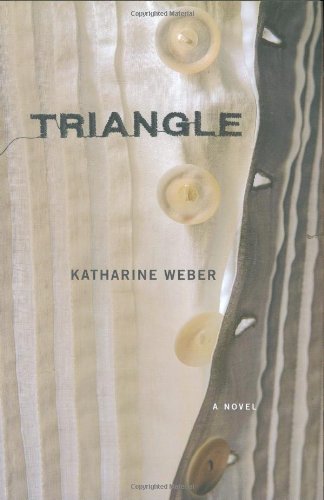



Esther Gottesfeld is the last living survivor of the notorious 1911 Triangle Shirtwaist fire and has told her story countless times in the span of her lifetime. Even so, her death at the age of 106 leaves unanswered many questions about what happened that fateful day. How did she manage to survive the fire when at least 146 workers, most of them women, her sister and fiancé among them, burned or jumped to their deaths from the sweatshop inferno? Are the discrepancies in her various accounts over the years just ordinary human fallacy, or is there a hidden story in Esther’s recollections of that terrible day? Esther’s granddaughter Rebecca Gottesfeld, with her partner George Botkin, an ingenious composer, seek to unravel the facts of the matter while Ruth Zion, a zealous feminist historian of the fire, bores in on them with her own mole-like agenda. A brilliant, haunting novel about one of the most terrible tragedies in early-twentieth-century America, Triangle forces us to consider how we tell our stories, how we hear them, and how history is forged from unverifiable truths. Adult/High School–The 1911 fire at the Triangle Shirtwaist Company in New York City killed almost 150 people. Weber blends that fact with an interesting and believable fictional premise in this novel about Esther Gottesfeld, the oldest living survivor of the disaster. How did she survive while her fiancé and twin sister, Pauline, perished? Esther's granddaughter, Rebecca, and Rebecca's partner, George, are caught in the middle of a battle of wills as Ruth Zion, a Triangle historian, shows a dogged determination to uncover the truth about that fatal day that sends her beyond investigative journalism into obsession. George is a renowned composer whose works are based on science, like the molecular sequences of an individual's DNA. Triangle is a series of complex, multilayered, triangular connections with links as tight as the threads in a shirt–Esther, Pauline, and the fiancé; Esther, Rebecca, and George; Rebecca, George, and Ruth–the permutations go on and on. Branching off into music theory and chemistry, this is a challenging and somewhat esoteric read that should appeal to mathematically and scientifically inclined teens as well as those who enjoy the mystery of the human heart and its relationships. –Charli Osborne, Oxford Public Library, MI Copyright © Reed Business Information, a division of Reed Elsevier Inc. All rights reserved. Katharine Weber, whose grandmother worked for the Triangle Shirtwaist Company in 1909, explores one woman's unreliable retelling of that experience. While this clever, haunting, and playful story works on multiple levels (with triangles the leitmotif), at core it functions as a mystery: Why didn't Esther help her fiancé and sister escape the fire? "Weber's primary concern is not what Esther did but how she lived with it," says the Los Angeles Times . Most critics praised the novel's plotting and deep characterizations, if some questioned its contrivances (composer George Botkin wants to develop a composition from Sierpinski triangles). But at its "sharpest, Triangle affirms the often tricky relationship between fact and fiction and the subjectivity of all human experience" ( USA Today ). Copyright © 2004 Phillips & Nelson Media, Inc. Although the first pages of this novel might lead readers to believe they're embarking on a piece of historical fiction about the Triangle Shirtwaist fire, it soon becomes clear that Weber has something else in mind. The initial chapter consists of the transcribed recollection of Esther Gottesfeld, a fire survivor. But Esther's granddaughter, Rebecca, is really at the center of the story. A genetics counselor, Rebecca is involved in a comfortable relationship with George Botkin, a composer famous for creating works based on patterns in nature. Her grandmother's death 90 years after the fire leaves Rebecca with the key to a safe-deposit box and the desire to probe into some long-held secrets. Esther's memories of that terrible day in 1911, when she lost a sister, are woven throughout the novel like a piece of music accompanying Rebecca's own life, with variations on themes of love, loss, sacrifice, survival, and identity. An elegant novel of ideas, then, rather than a re-creation of a historical event. Mary Ellen Quinn Copyright © American Library Association. All rights reserved Advance Praise for Triangle : “Katharine Weber’s Triangle is a marvel of ingenuity, bridging history and imagination, astonishing musical inventiveness and genuine social tragedy. It is a wide-awake novel as powerful as it is persuasive, probing and capturing human verities.”—Cynthia Ozick “Katharine Weber has always been a brilliant and ingenious formalist; at last she has found a subject deep and durable enough to bear the jeweled precision of her gaze. Here one of our most irresistible writers meets one of the most immovable events of our history. Triangle is an incandescent nove