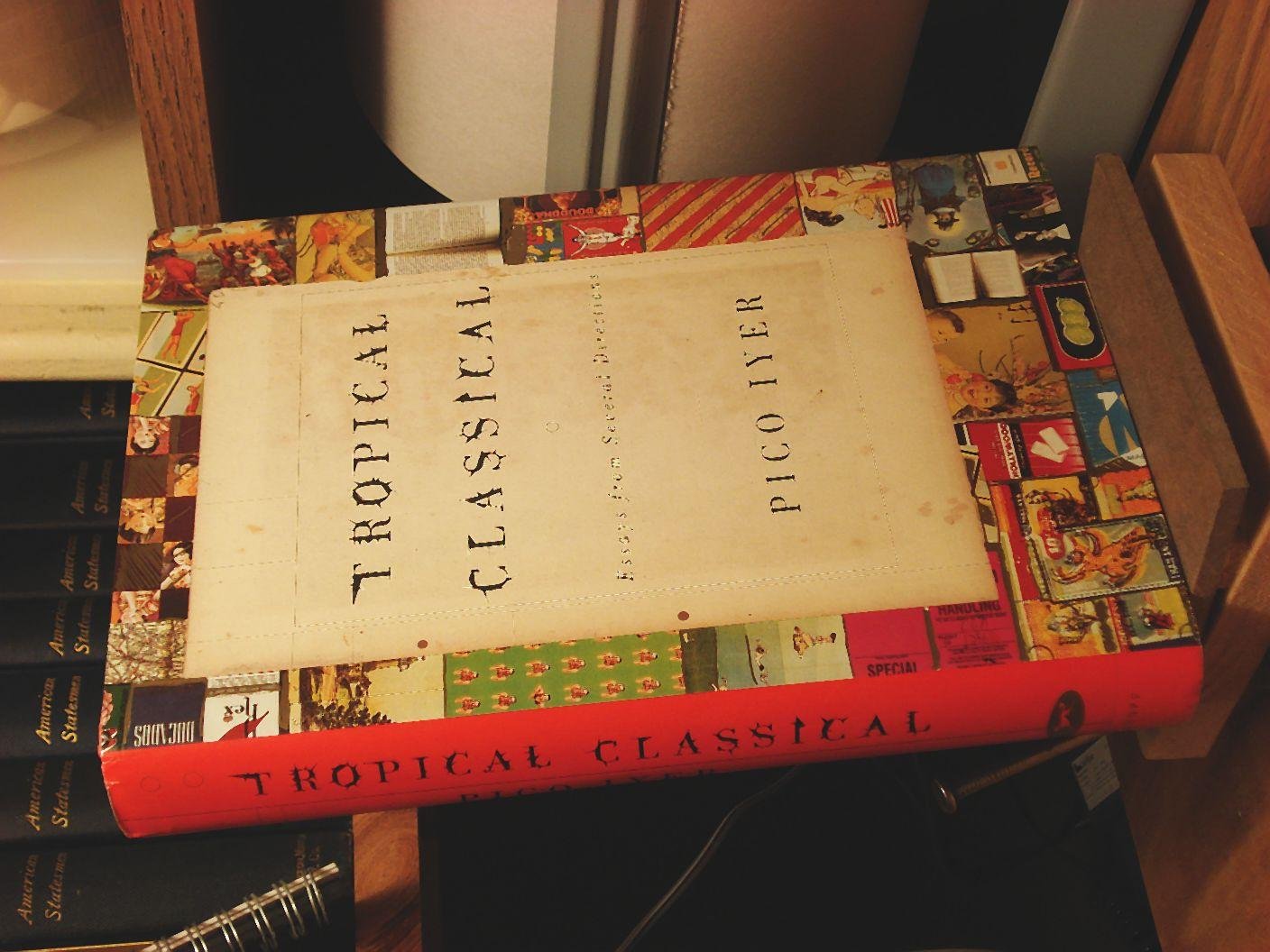



In Tropical Classical the author of Video Nights in Katmandu and The Lady and the Monk visits a holy city in Ethiopia, where hooded worshippers practice a Christianity that has remained unchanged since the Middle Ages. He follows the bewilderingly complex route of Bombay's dabbawallahs , who each day ferry 100,000 different lunches to 100,000 different workers. Iyer chats with the Dalai Lama and assesses the books of Salman Rushdie and Cormac McCarthy. And he brings his perceptive eye and unflappable wit to bear on the postmodern vogues for literary puffery, sexual gamesmanship, and frequent-flier miles. Glittering with aphorisms, overflowing with insight, and often hilarious, Tropical Classical represents some of Iyer's finest work. From the Trade Paperback edition. As a respected and beloved journalist and travel writer, Pico Iyer has earned a reputation and a loyal following, and Tropical Classical is a good indication why. This "best of " collection of essays, book reviews, and articles is segmented into chapters entitled "Places," "People," "Books," "Themes," and "Squibs," covering topics as varied as Paddington Bear, the numeral 9, Tibet, and the accumulation of frequent-flyer miles. Iyer is particularly gifted in conveying incongruous and anachronistic events, cleverly sharing his fascination with the bizarre--and often hilarious--cultural hybrids born when worlds collide. By capturing the essence of such oddities, he gently pulls the reader closer to obscure locales, and in the process alters the way we look at familiar surroundings. Similarly, his coverage of other writers brings an appreciation of the subject as much as the art of writing itself. Iyer (Falling off the Map, LJ 5/1/93) again casts a wide net as he brings together a series of lyrical essays on travels to faraway lands. The different directions alluded to in his subtitle include isolated and forlorn Ethiopia; Lhasa, China; and Tibet and its omnipresent Potala Palace with its 10,000 chapels. He encounters people such as Norman Lewis and the 14th Dalai Lama, called a "down-to-earth kind of guy." Iyer writes about books such as Paul Theroux's The Happy Isles of Oceania and Ann Beattie's The Burning House and a number of titles by non-Western authors. Some of the themes in which Iyer delves are the growth of American pop culture worldwide and subtleties of language and numbers. Iyer's unusual choices and beautiful writing earn his work a special niche among first-person travel memoirs. Recommended for large public and academic libraries or where Iyer's works are popular.?David Schau, Kanawha Cty. P.L., Charleston, W. Va. Copyright 1997 Reed Business Information, Inc. You can open it at random, as you would an atlas, and turn up something fascinating. This substantial essay collection covers a dozen years of Iyer's writing life. In books such as Cuba and the Night (1995), he has proven himself to be an undaunted and philosophical traveler, and he is at his keenly observant and zestfully descriptive best in the "Places" essays here, writing with animation and discernment about the sacred sites of Ethiopia and the making of Bertolucci's film Little Buddha in Nepal. Irony is Iyer's touchstone, and it fuels his incisive takes on California and New York, but his fluency in history dominates his complex pieces about India, his homeland "once removed." As devoted a reader as he is a traveler, Iyer is an adept literary essayist, paying homage to such luminaries as Henry Miller and the three writers he associates with a new voice in the global village that he calls "Tropical Classical": Derek Walcott, Michael Ondaatje, and Richard Rodriguez. Whatever his focus may be, Iyer's forte is chronicling the intermingling of cultures, an infinitely significant and fascinating reality. Donna Seaman Cond Nast Traveler contributing editor Iyer submits a disparate collection of meditations that, taken together, offer a fascinating portrait of the turbulent and tentative emergence of a truly global culture. Travel assumes many guises in this compilation, and while Iyer (Cuba and the Night, 1995, etc.) does indeed take us to far-off exotic lands in several essays (including a trip to the empty spaces of Ethiopia, where he discovers a vibrant form of Christendom and churches filled with white-robed priests), he also profiles literary figures, foreign and domestic, whose work transcends--or is emblematic of--a national identity. He also ruminates more broadly on the cross-border influences of popular culture. An essay on the filming of Bernardo Bertolucci's Little Buddha in a village in Nepal points out how some of the more peculiar attributes of ordinary Nepalese life are made even more bizarre under the sway of the film crew. Visiting Bombay, his ancestral homeland, Iyer writes of the zanily complicated and teeming city as a ``pressure point for an archetypal global struggle between a multicultural future and a tribal past.'' Iyer profiles th