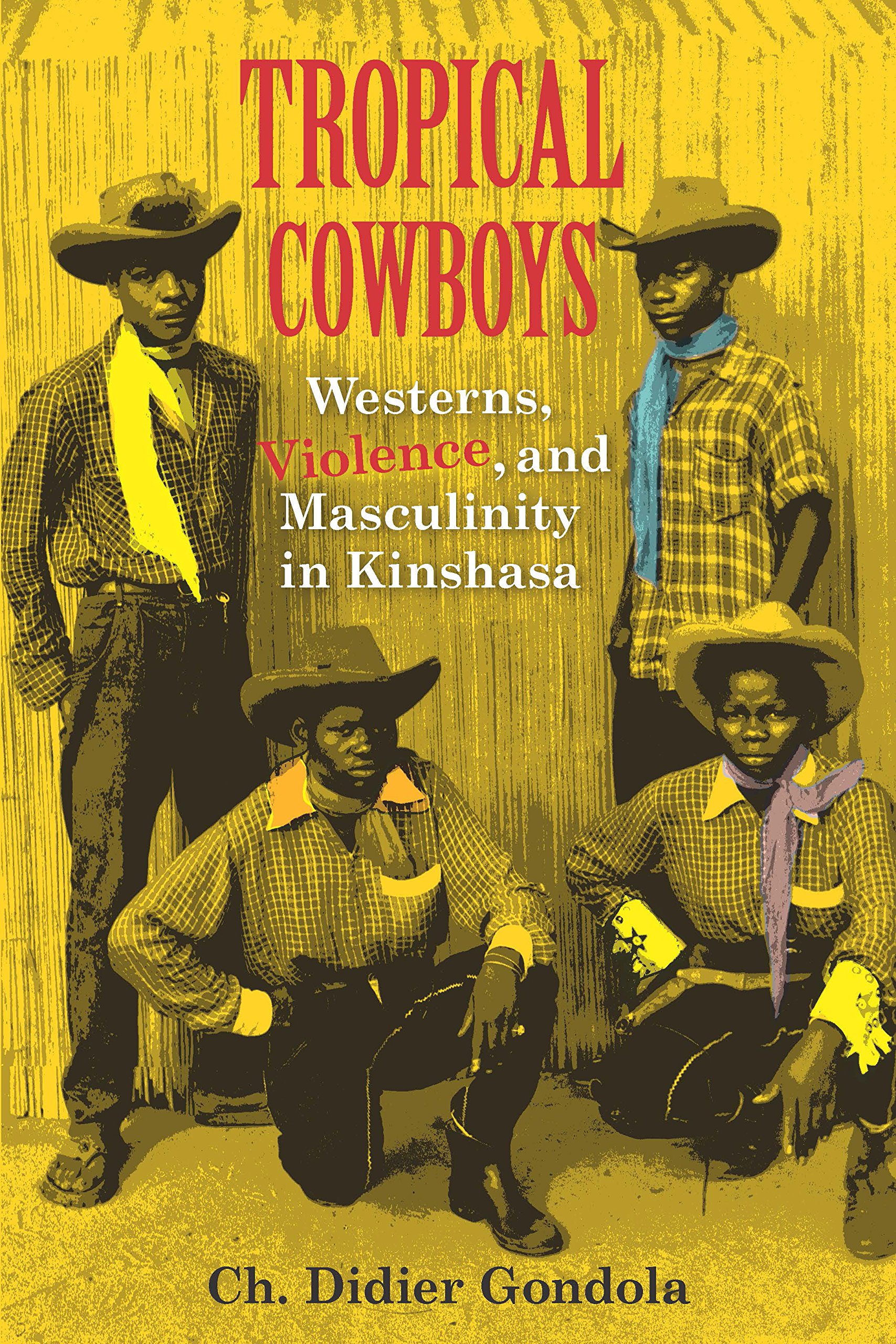
Tropical Cowboys: Westerns, Violence, and Masculinity in Kinshasa (African Expressive Cultures)
$23.46
by Ch. Didier Gondola



During the 1950s and 60s in the Congo city of Kinshasa, there emerged young urban male gangs known as "Bills" or "Yankees." Modeling themselves on the images of the iconic American cowboy from Hollywood film, the "Bills" sought to negotiate lives lived under oppressive economic, social, and political conditions. They developed their own style, subculture, and slang and as Ch. Didier Gondola shows, engaged in a quest for manhood through bodybuilding, marijuana, violent sexual behavior, and other transgressive acts. Gondola argues that this street culture became a backdrop for Congo-Zaire's emergence as an independent nation and continues to exert powerful influence on the country's urban youth culture today. "Its approach in terms of poverty and unemployment combined with a subtle interest in performance and the creation of an original culture makes this book an eye-opener. Both the dramatic subject and the author's vivid style make it a pleasure to read and also food for thought regarding issues that haunt not only Africa but also the world at large."― American Historical Review "In conclusion, both undergraduate and graduate students of African history, urban history, women's sexuality, gender studies, and even transnational film studies would benefit from this book. . . . Additionally, as the provocative title suggests, American undergraduate students―even those unfamiliar or new to Central African literatures―will find this book both engaging and accessible because of parallels and differences drawn between the American Far West and Kinshasa."― Research in African Literatures "An innovative and original study that sheds light on masculinity, youth culture, performative violence, and the circuit of global imagery in the townships of Kinshasa."―Stephan F. Miescher, author of Making Men in Ghana and Modernization as Spectacle in Africa "Aligns social banditry with popular cultural formations and subcultures. This has been a longstanding feature of Didier Gondola's scholarship that is of great interest."―Peter J. Bloom, University of California, Santa Barbara Aligns social banditry with popular cultural formations and subcultures. This has been a longstanding feature of Didier Gondola's scholarship that is of great interest. -- Peter J. Bloom ― University of California, Santa Barbara Ch. Didier Gondola is Chair of the History Department and Professor of African History at Indiana University-Purdue University, Indianapolis. He is editor (with Peter J. Bloom and Charles Tshimanga) of Frenchness and the African Diaspora: Identity and Uprising in Contemporary France (IUP). Tropical Cowboys Westerns, Violence, and Masculinity in Kinshasa By Didier Gondola Indiana University Press Copyright © 2016 Ch. Didier Gondola All rights reserved. ISBN: 978-0-253-02077-2 Contents Acknowledgments, Introduction, Part I. Falling Men, 1 "Big Men", 2 A Colonial Cronos, 3 Missionary Interventions, Part II. Man Up!, 4 Tropical Cowboys, 5 Performing Masculinities, 6 Protectors and Predators, Part III. Metamorphoses, 7 Père Buffalo, 8 Avatars, Glossary, Notes, Bibliography, Index, CHAPTER 1 "Big Men" In every age, not just our own, manhood was something that had to be won. Leonard Kriegel (cited by Gilmore 1990: 19) The purpose of this chapter is to follow the threads of manhood and violence back in time — to when Kinshasa, and more generally the area around the lakelike expansion of the Congo River now known as Malebo Pool, displayed different geographic and social configurations — and to draw some parallels with the changes that would occur later, during colonization. The fact that manhood has been a constant quest in all human societies, if a difficult and precarious one, is something that is now well established. In all societies, boys are meant to become men, yet the meaning of becoming and being men varies considerably from one society to another. Thus, to borrow from Michael Kimmel (1996: 5), "manhood means different things at different times to different people." Even within the same society, the ways in which manhood and masculinity are constructed tend to vary as social, cultural, and economic changes unfold. Yet those differences and variations should not obfuscate the fact that some patterns remain the same. In other words, it is quite conceivable that similar cultural notions may inform constructions of manhood over several generations. That is to say that young men may keep fragments from past experiences in each generation to reorder the puzzle that they have inherited from their immediate forebears. Indeed, using cipher, puzzle, and enigma as metaphors for unresolved gender identity (see Gilmore 1990: 5) is an astute way to capture its vexing and labile nature. It tells us something that we have known for some time: that we know little about how men and women form their gender identity, how they pick up pieces from a variety of sources so as to arrange and r