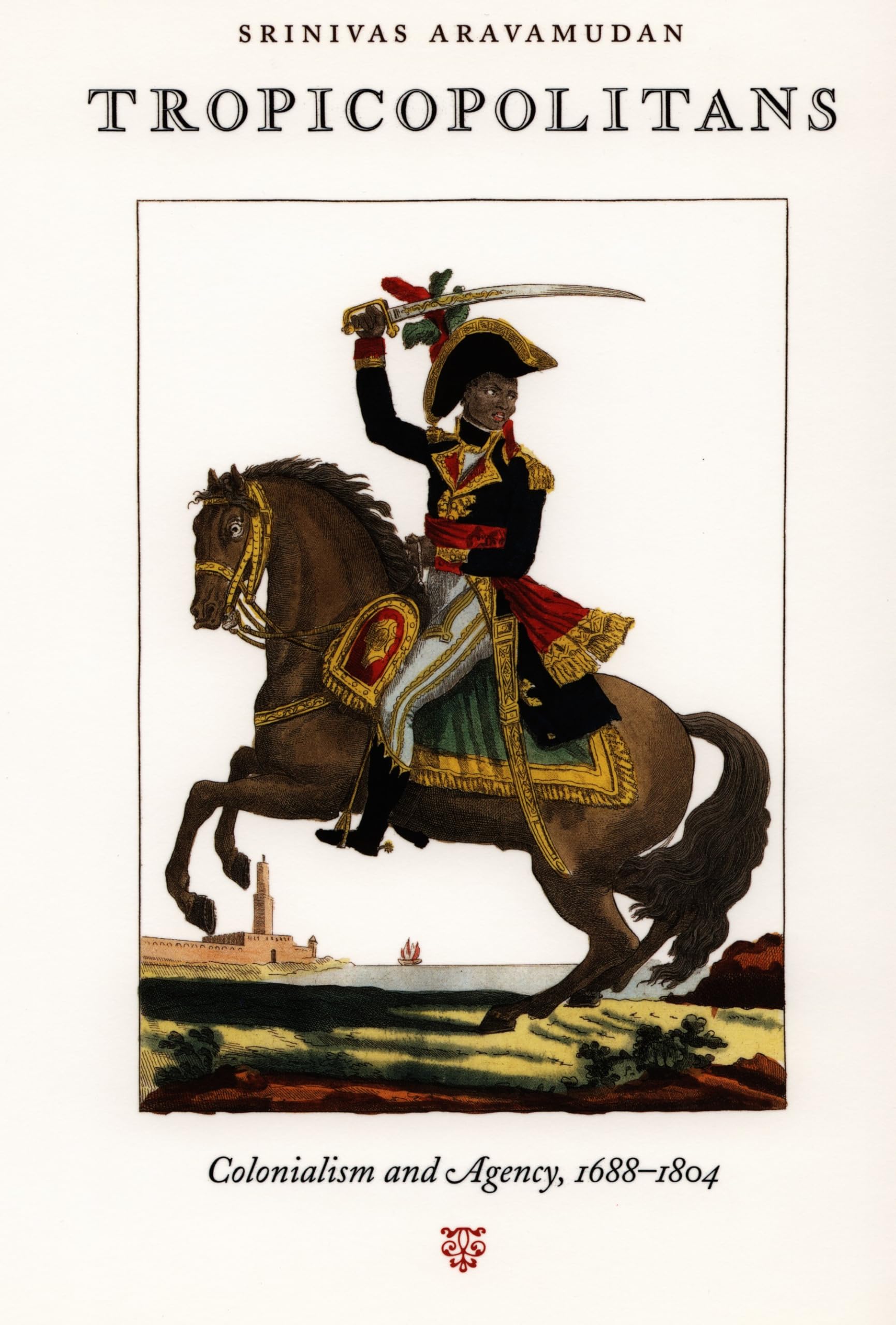
Tropicopolitans: Colonialism and Agency, 1688–1804 (Post-Contemporary Interventions)
$39.95
by Srinivas Aravamudan



In Tropicopolitans Srinivas Aravamudan reconstructs the colonial imagination of the eighteenth century. By exploring representations of peoples and cultures subjected to colonial discourse, he makes a case for the agency—or the capacity to resist domination—of those oppressed. Aravamudan’s analysis of texts that accompanied European commercial and imperial expansion from the Glorious Revolution through the French Revolution reveals the development of anticolonial consciousness prior to the nineteenth century. “Tropicalization” is the central metaphor of this analysis, a term that incorporates both the construction of various dynamic tropes by which the colonized are viewed and the site of the study, primarily the tropics. Tropicopolitans, then, are those people who bear and resist the representations of colonialist discourse. In readings that expose new relationships between literary representation and colonialism in the eighteenth century, Aravamudan considers such texts as Behn’s Oroonoko , Defoe’s Robinson Crusoe and Captain Singleton , Addison’s Cato , and Swift’s Gulliver’s Travels and The Drapier’s Letters . He extends his argument to include analyses of Johnson’s Rasselas , Beckford’s Vathek , Montagu’s travel letters, Equiano’s autobiography, Burke’s political and aesthetic writings, and Abbé de Raynal’s Histoire des deux Indes . Offering a radical approach to literary history, this study provides new mechanisms for understanding the development of anticolonial agency. Introducing eighteenth-century studies to a postcolonial hermeneutics, Tropicopolitans will interest scholars engaged in postcolonial studies, eighteenth-century literature, and literary theory. “ Tropicopolitans might initiate a school of “tropicalization” studies. In the emerging field of what we have learned to name Black Atlantic writing, Aravamudan has made substantial contributions in his chapters on Equiano and Toussaint Louverture, in which each figure is richly, contextually read. The wrenching from a Euro-Christian framework into a tropicalizing one opens up these figures to new critical investigations instead of merely freezing their heroic status for all time. Aravamudan’s book should go some way toward helping us maintain our vigil against premature orthodoxies.”— Donna Landry , author of The Muses of Resistance: Laboring Class Women’s Poetry in Britain, 1739–1796 “ Tropicopolitans is the most theoretically sophisticated study yet of colonialist texts in the eighteenth century.”— James Thompson , author of Models of Value: Eighteenth-Century Political Economy and the Novel ""Tropicopolitans" might initiate a school of "tropicalization" studies. In the emerging field of what we have learned to name Black Atlantic writing, Aravamudan has made substantial contributions in his chapters on Equiano and Toussaint Louverture, in which each figure is richly, contextually read. The wrenching from a Euro-Christian framework into a tropicalizing one opens up these figures to new critical investigations instead of merely freezing their heroic status for all time. Aravamudan's book should go some way toward helping us maintain our vigil against premature orthodoxies."--Donna Landry, author of "The Muses of Resistance: Laboring Class Women's Poetry in Britain, 1739-1796" Srinivas Aravamudan is Associate Professor of English and Comparative Literature at the University of Washington. Tropicopolitans Colonialism and Agency, 1688–1804 By Srinivas Aravamudan Duke University Press Copyright © 1999 Duke University Press All rights reserved. ISBN: 978-0-8223-2315-0 Contents Acknowledgments, Introduction: Colonialism and Eighteenth-Century Studies, Virtualizations, Chapter One Petting Oroonoko, Chapter Two Piratical Accounts, Chapter Three The Stoic's Voice, Chapter Four Lady Mary in the Hammam, Chapter Five The Despotic Eye and the Oriental Sublime, Chapter Six Equiano and the Politics of Literacy, Chapter Seven Tropicalizing the Enlightenment, Conclusion, Notes, Index, CHAPTER 1 Petting Oroonoko A book on colonialism and eighteenth-century literature cannot begin without invoking Oroonoko. In fact, recent critical attention has bordered on the obsessional. Why this figure? What animates recent fixations on Behn's Oroonoko, or The Royal Slave (1688), especially as Southerne's play Oroonoko (1695) and then Hawkes-worth's adaptation of that play (1759) were better known in the eighteenth century than Behn's novella? With the inclusion of Oroonoko in the Norton Anthology of British Literature and the subsequent release of a Norton critical edition in 1997 as well as several other competing editions in print, Behn's story of the transportation, resistance, and execution of the enslaved prince has truly arrived. There are good explanations for this interest. According to Janet Todd, the Behn revival demonstrates the affinity of her texts with the concerns of many contempo