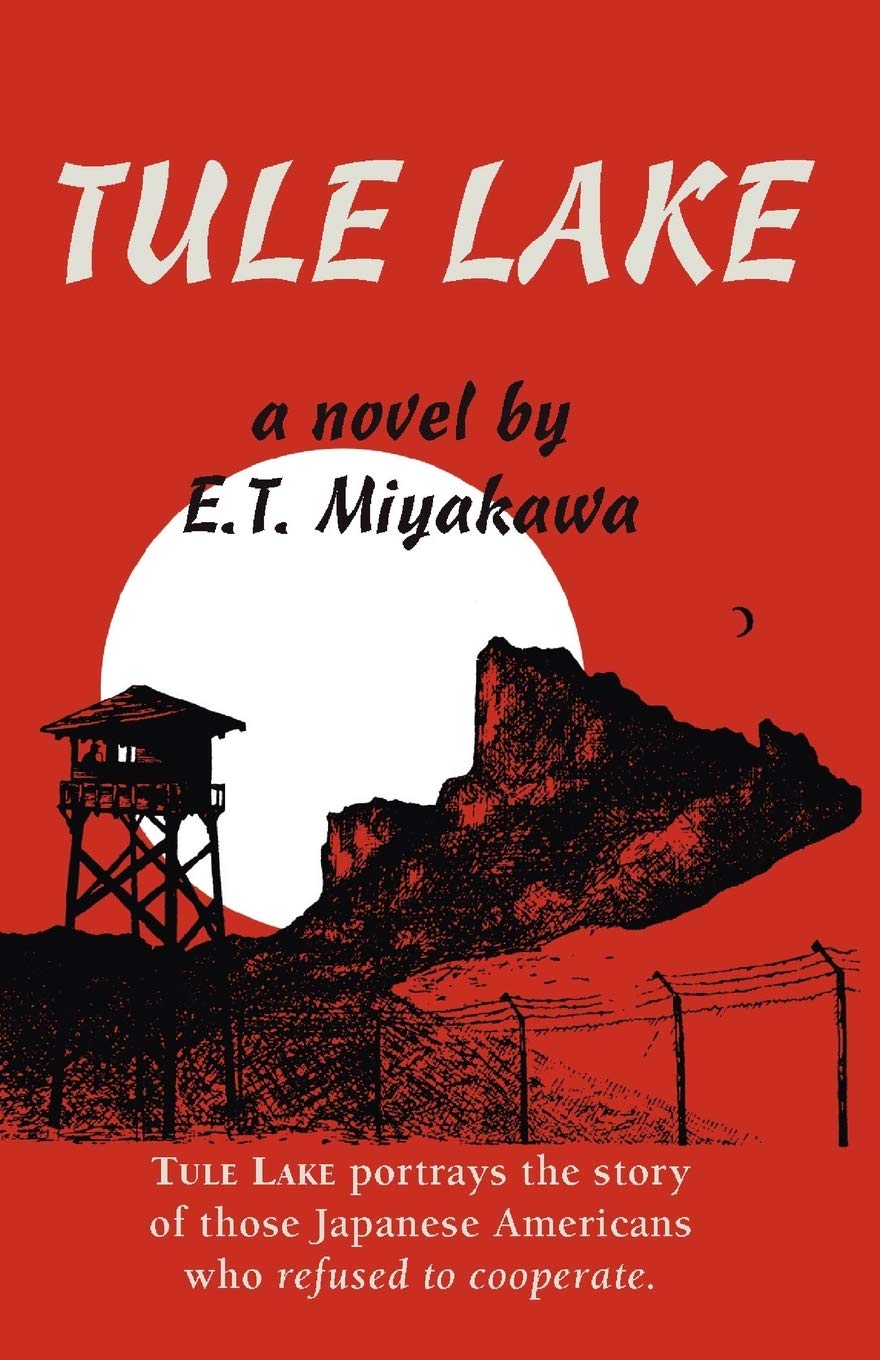



First Japanese-American novel to portray the passionate, desperate struggle for justice and freedom from within the confines of America's concentration camps by those who refused to cooperate with the internment of 120,000 of their fellow Americans. TULE LAKE should be read in every American history class -- Barbara Fryer LOS ANGELES HERALD EXAMINER, Sept. 7, 1980 Prologue On the morning of December 7, 1941, the Japanese bombed Pearl Harbor. Subsequently, the United States military evacuated 110,000 persons of Japanese ancestry from the West Coast into ten relocation centers in isolated regions of the United States. They were Manzanar and Tule Lake in California; Poston and Gila River in Arizona; Minidoka in Idaho; Rohwer and Jerome in Arkansas. My family and our friends and relatives were sent to Tule Lake in Northern California, where many of us lived from mid 1942 until 1946. For Father it was a period of turmoil and change as drastic as the years when he first came to America in 1908 as a young man of twenty-two. Had he been born a few hundred years ago, he would have been a samurai. But he bridges the span of three contemporary generations. He was a teacher turned farmer turned merchant. He is my father and I know him, but I do not. For the first ten years of my life he and mother were names only, existing as emigrants in a distant America. To whom I owe myself, I am not sure, but I do know I am the last extension tying me back several hundred years. I am the first born in America, a country that my ancestors, dead and decayed, never knew existed. I am an American citizen by birth, a privilege Father and Mother can never experience: the Oriental Exclusion Act prevented all Asians from becoming naturalized citizens. Mother and Father returned to Japan with me when I was a year old to be adopted by my maternal grandparents. In Japan when there is no male offspring, families often adopt a boy to carry on their name. I was destined to live out a transition of my own. I lived in Japan for nine years. Therefore, I have not shared Father's hardships in changing from one country to another, moving from one time in history to another time into another history. Although I never saw the blur of his legs on pedals, I know the wheels of Father's bicycle have tracked thousands of miles of the San Joaquin Valley, delivering medical supplies to farm laborers for four or five years, summer and winter, in freezing cold and withering heat. Only depleted supplies or sickness or occasional exhaustion were reasons for turning homeward. During the years in Japan, I learned who I was, what I was supposed to be and how I would uphold what I was taught to be truth and honor. There was love and order. When I become fragmented, I retreat to these early memories. Around the table, I see the faces of my adopted family, feet inserted in a square hole in the floor where there is a hibachi for warmth. Always it is the same -- my exercise in faith. I close my eyes, again and again. I see the peaceful furrows of my grandfather's face; my grandmother, an aura of serenity surrounding her; two half sisters or aunts; two half sisters or aunts; and my great grandmother. My grandfather is at the head of the table; I am seated opposite him. My grandmother and her mother are on the side toward the kitchen with my aunts opposite them. It has been fifteen years since I last seated myself at that table. Since that day, change has become as much a part of my life as was the permanence during my first ten years. I had to leave the only family I had ever known to live with strangers in a new country with different customs and dress and language. In the house the wind was a gentle one, wafting across the garden, flowing though the pink of spring through needles of pines, along the corridors, through opened sliding doors. For a while I did not see my parents' faces, for I moved downwards, my eyes staring at the earth as I touched my forehead to my hands, palms outstretched upon the mat. I moved slowly up, their head perpendicular to my vision. I bowed and righted myself over and over. Never have I seen such sadness, hidden behind deceptive smiles, as on that day. Beneath the roof, between walls, in the house where I have lived, we sat forever. I was told that I would depart the home of my grandparents and return to America with my mother and father. I was immune to their words. All I could see were the squares in the shoji door cast by an angle of afternoon sun into flattened shapes half on the wall and half on the tatami. The filtered light through rice paper was translucent and soft white, so the lamella shadows of the thin wood frames were not in a single plane but in many. My last day of school in Japan was set aside to bestow upon me honor and love. I arose to give the speech expected of me by my classmates and instructors. I felt no weight, no movement, as my legs carried me across he stage. I stood voiceless -- one minute -- two minute