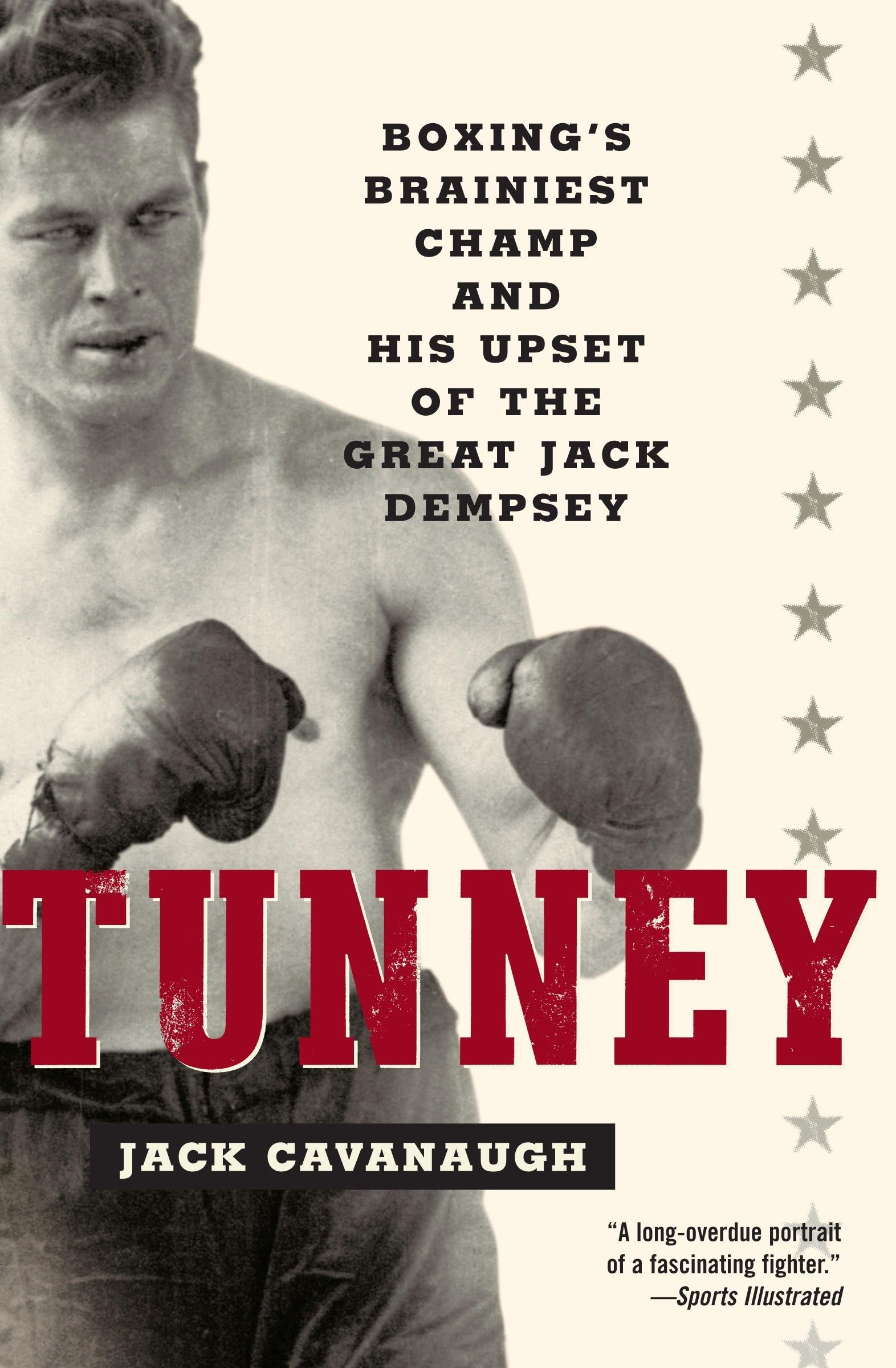
Tunney: Boxing's Brainiest Champ and His Upset of the Great Jack Dempsey
$17.00
by Jack Cavanaugh



Among the legendary athletes of the 1920s, the unquestioned halcyon days of sports, stands Gene Tunney, the boxer who upset Jack Dempsey in spectacular fashion, notched a 77—1 record as a prizefighter, and later avenged his sole setback (to a fearless and highly unorthodox fighter named Harry Greb). Yet within a few years of retiring from the ring, Tunney willingly receded into the background, renouncing the image of jock celebrity that became the stock in trade of so many of his contemporaries. To this day, Gene Tunney’s name is most often recognized only in conjunction with his epic “long count” second bout with Dempsey. In Tunney , the veteran journalist and author Jack Cavanaugh gives an account of the incomparable sporting milieu of the Roaring Twenties, centered around Gene Tunney and Jack Dempsey, the gladiators whose two titanic clashes transfixed a nation. Cavanaugh traces Tunney’s life and career, taking us from the mean streets of Tunney’s native Greenwich Village to the Greenwich, Connecticut, home of his only love, the heiress Polly Lauder; from Parris Island to Yale University; from Tunney learning fisticuffs as a skinny kid at the knee of his longshoreman father to his reign atop boxing’s glamorous heavyweight division. Gene Tunney defied easy categorization, as a fighter and as a person. He was a sex symbol, a master of defensive boxing strategy, and the possessor of a powerful, and occasionally showy, intellect–qualities that prompted the great sportswriters of the golden age of sports to portray Tunney as “aloof.” This intelligence would later serve him well in the corporate world, as CEO of several major companies and as a patron of the arts. And while the public craved reports of bad blood between Tunney and Dempsey, the pair were, in reality, respectful ring adversaries who in retirement grew to share a sincere lifelong friendship–with Dempsey even stumping for Tunney’s son, John, during the younger Tunney’s successful run for Congress. Tunney offers a unique perspective on sports, celebrity, and popular culture in the 1920s. But more than an exciting and insightful real-life tale, replete with heads of state, irrepressible showmen, mobsters, Hollywood luminaries, and the cream of New York society, Tunney is an irresistible story of an American underdog who forever changed the way fans look at their heroes. Jack Cavanaugh is a veteran sportswriter who has covered scores of major boxing bouts, along with the Olympics, the World Series, Super Bowl games, the Masters golf tournament, and both the U.S. golf and tennis opens. His work has appeared most notably on the sports pages of The New York Times , for which he has covered hundreds of varied sports assignments. In addition, he has been a frequent contributor to Sports Illustrated and written for R eader’s Digest, Tennis and Golf magazines, and other national publications. He is also a former reporter for both ABC and CBS News. Cavanaugh currently is an adjunct writing professor at Fairfield University. He and his wife, Marge, live in Wilton, Connecticut. ONE The Longshoreman's Son John Tunney always liked a good fight-from afar. From the days of his boyhood in Ireland's County Mayo, where he grew up idolizing John L. Sullivan, the bare-knuckled and blustering heavyweight champion from Boston, to the years after he arrived in New York, where he came to worship another American-born Irish boxer, James J. Corbett, whose victory over Sullivan with padded gloves ushered in a new era in boxing, Tunney's favorite diversion was watching, reading about, or talking about boxing bouts. This was especially true if a bout involved Irish boxers, which in that era many, if indeed not most, did. After emigrating to the United States around 1880 (although he claimed to have made a stopover years before as a boy sailor aboard a windjammer), Tunney reveled in observing two men go at it in the ring at "smokers," which abounded in New York from the 1880s until shortly after World War I. Usually staged in smoke-filled Knights of Columbus halls capable of seating several hundred patrons and in large basements of other fraternal organizations, smokers were designed to circumvent New York state laws against professional boxing, which at the time was held in disrepute in the United States and most of the world, except for England. Generally held on Friday and Saturday nights, smokers tended to attract a rowdy crowd of men, a large percentage of them Irish and Italian immigrants, most of whom placed bets with one another. Often raucous, the spectators at times produced fights as good as if not better than the ones in the ring. The police virtually never interfered and, indeed, promoters often hired off-duty officers to try to prevent the frequent disorders that erupted during bouts and that usually stemmed from excessive drinking. As a stevedore on the Hudson River docks in the western part of Greenwich Village, known later as the West Village