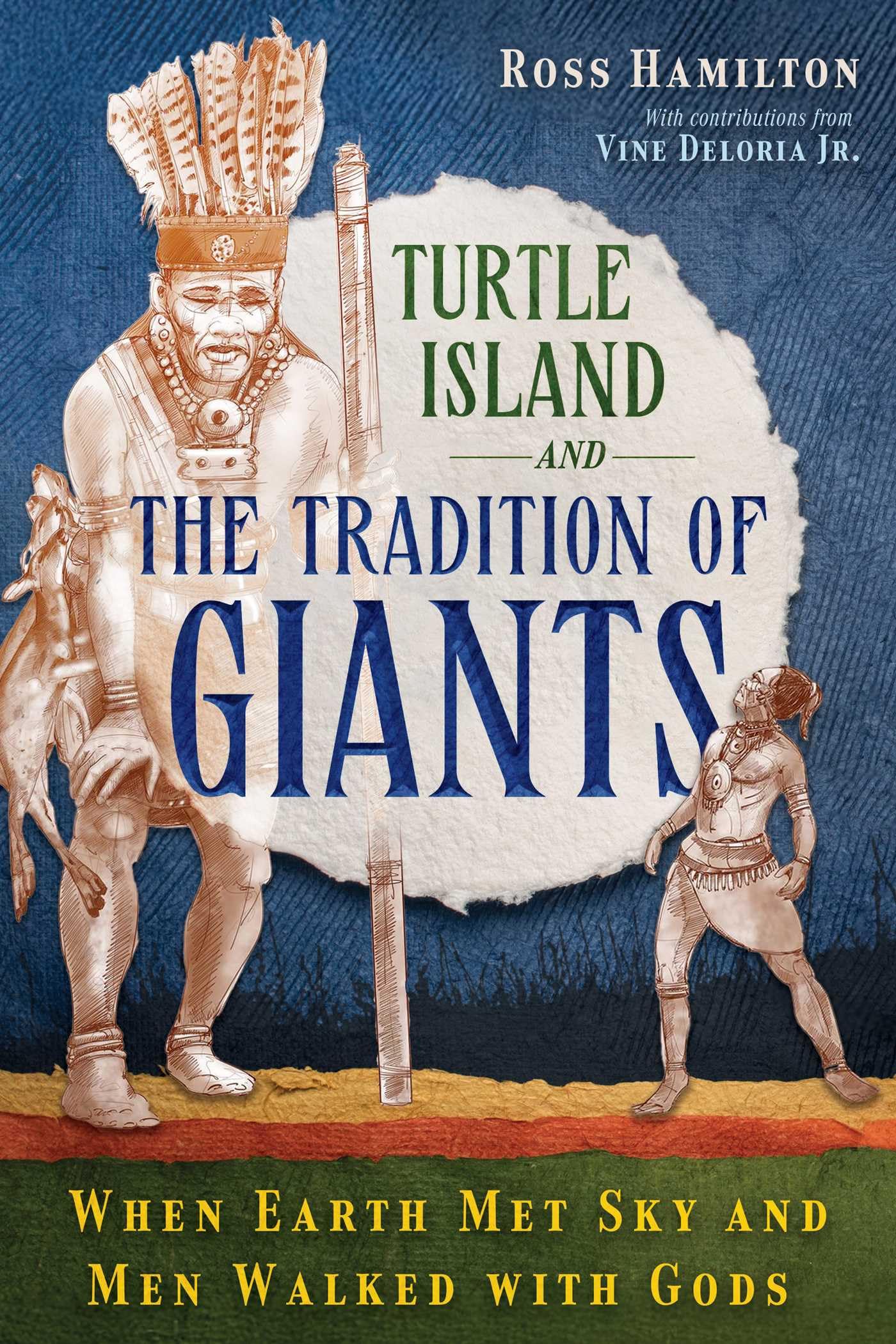
Turtle Island and the Tradition of Giants: When Earth Met Sky and Men Walked with Gods
$24.00
by Ross Hamilton



The story of giants in the Indigenous prehistory of the Americas • Covers the secret history of an ancient race of giants that inhabited the Americas long before European contact • Presents accounts of these beings from Native American sources, legends, and oral traditions, correlated with archeological reports • Examines the Smithsonian’s role in covering up records of the skeletal remains of giants in the Americas, looking particularly at John Wesley Powell and Aleš Hrdlička Writer and researcher Ross Hamilton uses Indigenous voices, beliefs, and oral traditions to reconstruct the origin and secret history of an ancient race of giants that inhabited the continent long before European contact with the Americas. Hamilton reaches deep into North American antiquity to identify a people originally from the Arctic known as the Tall Ones. These beings lived alongside the tribes of the Americas and even bred with them. As he uncovers the story, Hamilton presents the ancient Turtle Island culture of the nation of Manitouba, a once-great civilization that stretched across much of the contemporary United States and Canada and maintained an advanced system of arts and sciences before being called back to the mysterious North. Along with examining the ways in which archaeological history was suppressed by premier American institutions such as Harvard and the Smithsonian, Hamilton revisits critical primary sources, including the Lenape accounts made by early American missionary John Heckewelder. With this research and the contributions of tribal elder Vine Deloria Jr., Hamilton unpacks long-misunderstood Indigenous myths and history to reveal a time when Earth met sky and men walked with gods. “Ross Hamilton’s latest book is an extraordinary journey into the deep past of North America. He explores rare primary sources that describe a highly advanced race of giants, the mysterious Adena people of Turtle Island in the region of Manitouba. In spite of the destruction of many valuable remains of this culture in ancient mounds excavated by the Smithsonian, Hamilton, assisted by Native people, salvaged enough evidence to propose that this culture flourished 7,000 to 8,000 years ago, with their ancestors extending as far back as 40,000 years ago. This delightful book beamed sparkling light on legends my Cherokee grandfather shared with me when I was a child growing up in the Great Lakes region. This book is a must-read for every person seeking authentic Native American history.” ― Barbara Hand Clow, author of Alchemy of Nine Dimensions and Awakening the Planetary Mind Ross Hamilton is a writer and researcher specializing in ancient North American prehistory and the hidden heritage of the American continent. His previous books include The Mystery of the Serpent Mound and Star Mounds: Legacy of a Native American Mystery . He lives in Cincinnati, Ohio. 1 Problems for Anthropology When the famous European natural philosopher Georges-Louis Leclerc, the Comte de Buffon (1707–1788),* began to publicize his new idea of “the tendency of nature to belittle her productions” on the American side of the Atlantic, one man quickly silenced him through the method of example. The Americans knew Buffon for his provocative messages, and so elected to defend the New World against further foreign intrusions, intellectual and otherwise; then–US president Thomas Jefferson invited certain prominent gentry among the native people of the great Ozark region to Washington. On this subject of Jefferson versus Buffon, Joyce Appleby writes: “Among the many tribes that Lewis and Clark encountered, the Osages and the Mandans were the most impressive. Lewis had extended an invitation to the Osage nation to send a delegation to Washington, and Jefferson rejoiced to witness the men’s considerable height, no doubt thinking of his protracted challenge to Buffon’s theory of New World degeneracy . . .”1 Heralded by other invited tribes from July of 1804, the arrival of the Osage delegation in December of 1805 was described by Mrs. Margaret Bayard Smith in these words: “Tall, erect, finely proportioned and majestic in their appearance, dignified, graceful and lofty in their demeanor, they seem to be nature’s own nobility.”2 Had these Osage people not been seen by the early French, Jeffersonian society, and others, including the frontier painter George Catlin, we might today have no authentic record of their venerable lineage. A number were said to have been 7 feet tall and robust. Yet with the passage of time, the ghost of Buffon’s reductionist thought seems to have established its haunt within the halls of human study throughout the West and the globe. SIX REASONS FOR LOSS As it was in those days, antinative sentiment grew and grew until, by 1850, it became virtually illegal to be an American Indian east of the Mississippi without belonging to a reservation. By then, and spurred on by Andrew Jackson’s decision to go against the Supreme Court wh