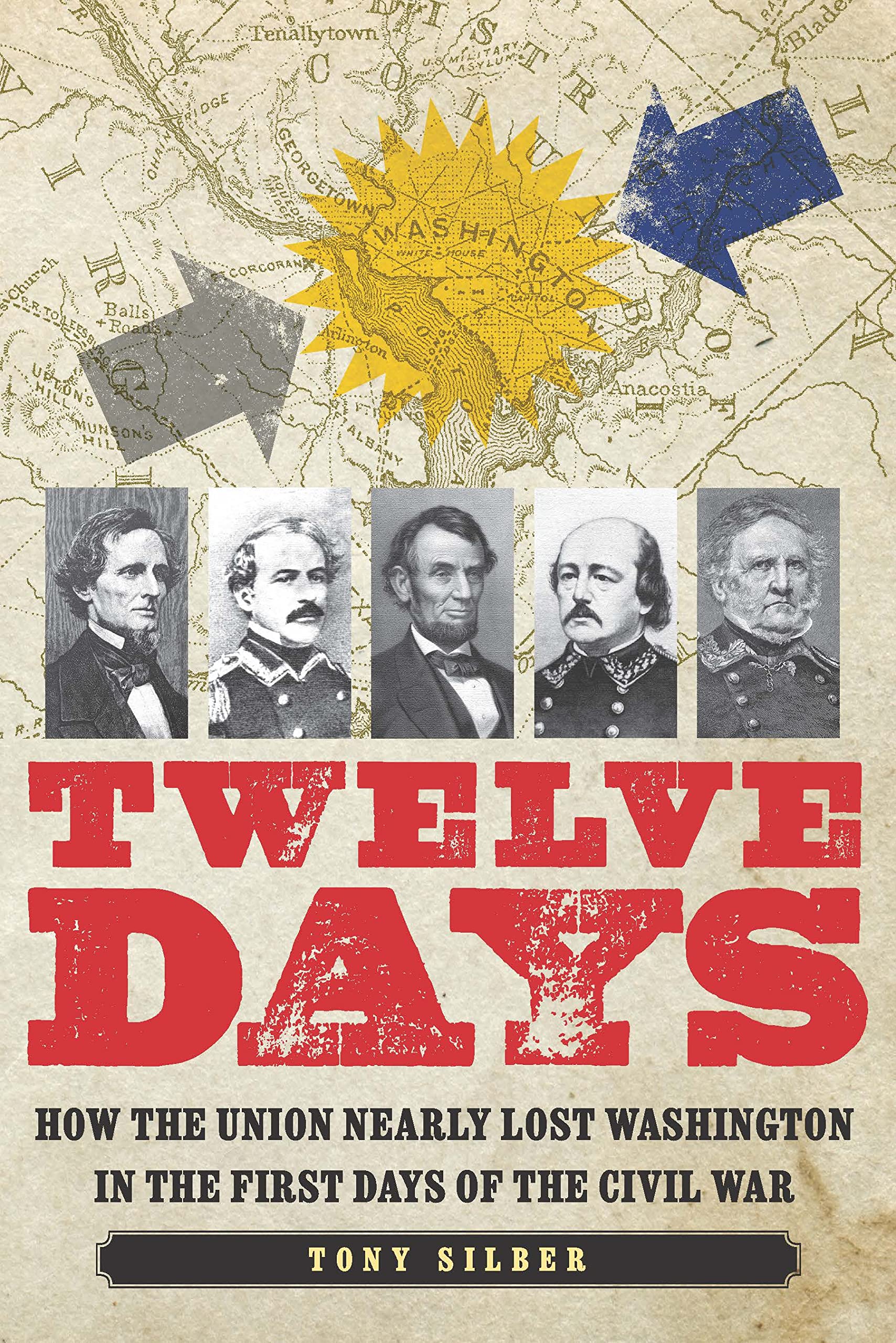
Twelve Days: How the Union Nearly Lost Washington in the First Days of the Civil War
$19.01
by Tony Silber



In the popular literature and scholarship of the Civil War, the days immediately after the surrender at Fort Sumter are overshadowed by the great battles and seismic changes in American life that followed. The twelve days that began with the federal evacuation of the fort and ended with the arrival of the New York Seventh Militia Regiment in Washington were critically important. The nation’s capital never again came so close to being captured by the Confederates. Tony Silber’s riveting account starts on April 14, 1861, with President Lincoln’s call for seventy-five thousand militia troops. Washington, a Southern slaveholding city, was the focal point: both sides expected the first clash to occur there. The capital was barely defended, by about two thousand local militia troops of dubious training and loyalty. In Charleston, less than two days away by train, the Confederates had an organized army that was much larger and ready to fight. Maryland’s eastern sections were already reeling in violent insurrection, and within days Virginia would secede. For half of the twelve days after Fort Sumter, Washington was severed from the North, the telegraph lines cut and the rail lines impassable, sabotaged by secessionist police and militia members. There was no cavalry coming. The United States had a tiny standing army at the time, most of it scattered west of the Mississippi. The federal government’s only defense would be state militias. But in state after state, the militia system was in tatters. Southern leaders urged an assault on Washington. A Confederate success in capturing Washington would have changed the course of the Civil War. It likely would have assured the secession of Maryland. It might have resulted in England’s recognition of the Confederacy. It would have demoralized the North. Fortunately, none of this happened. Instead, Lincoln emerged as the master of his cabinet, a communications genius, and a strategic giant who possessed a crystal-clear core objective and a powerful commitment to see it through. Told in real time, Twelve Days alternates between the four main scenes of action: Washington, insurrectionist Maryland, the advance of Northern troops, and the Confederate planning and military movements. Twelve Days tells for the first time the entire harrowing story of the first days of the Civil War. "Civil War buffs will relish the wealth of new historical insights."— Publishers Weekly "Combining meticulous research, clear expository writing, and authoritative documentation, Silber offers a clear account of the events of this surprisingly overlooked period in the Civil War."—David Marshall, NYMAS Review "With Twelve Days: How the Union Nearly Lost Washington in the First Days of the Civil War, author Tony Silber offers readers a thorough examination of the first days of the war, when things were far from certain and much hung in the balance. . . . His work is a valuable addition to an often neglected part of the Civil War story."—Doug Crenshaw, emergingcivilwar.com Published On: 2023-07-13 “This is not sci-fi alternative history but a remarkable new book of narrative history by decorated journalist and entrepreneur Tony Silber. He has unearthed some of America’s most deeply hidden history and written a swift, powerfully documented narrative of twelve days that enriches our understanding of our nation, its bloodiest war, and a president whose heroism, as Silber shows us, we are only beginning to understand.”—Michael Capuzzo, New York Times best-selling author of Close to Shore and The Murder Room “In riveting and fascinating detail, Tony Silber captures one of the most significant moments in American history. This page-turner is a must-read for anyone who has a passion for American democracy and the bold and extraordinary leadership of Abraham Lincoln during those twelve turbulent days in 1861.”—Michael Clinton, former president, marketing, and publishing director of Hearst Magazines “Tony Silber achieves something remarkable here. He takes a 160-year-old war that you thought you knew everything about, grabs you by the lapels, and pulls you to the edge of your seat. With spare, exciting prose and a reporter’s eye for vivid detail, he gives the first two weeks after the outbreak of the Civil War the freshness and immediacy of a breaking news story.”—Charles Slack, author of Liberty’s First Crisis: Adams, Jefferson, and the Misfits Who Saved Free Speech “Tony Silber has vividly captured a moment of astonishing peril, one in which the preservation of the Union and the very future of the nation hung in the balance. Deeply researched and compellingly told, it’s a gripping tale offering a fresh look at the leaders, decisions, and events that continue to resonate today.”—Ellen B. Meacham, author of Delta Epiphany: Robert F. Kennedy in Mississippi “A remarkably evocative story of our Union at a moment of profound peril. Reading Twelve Days , one can feel the ominous cracklin