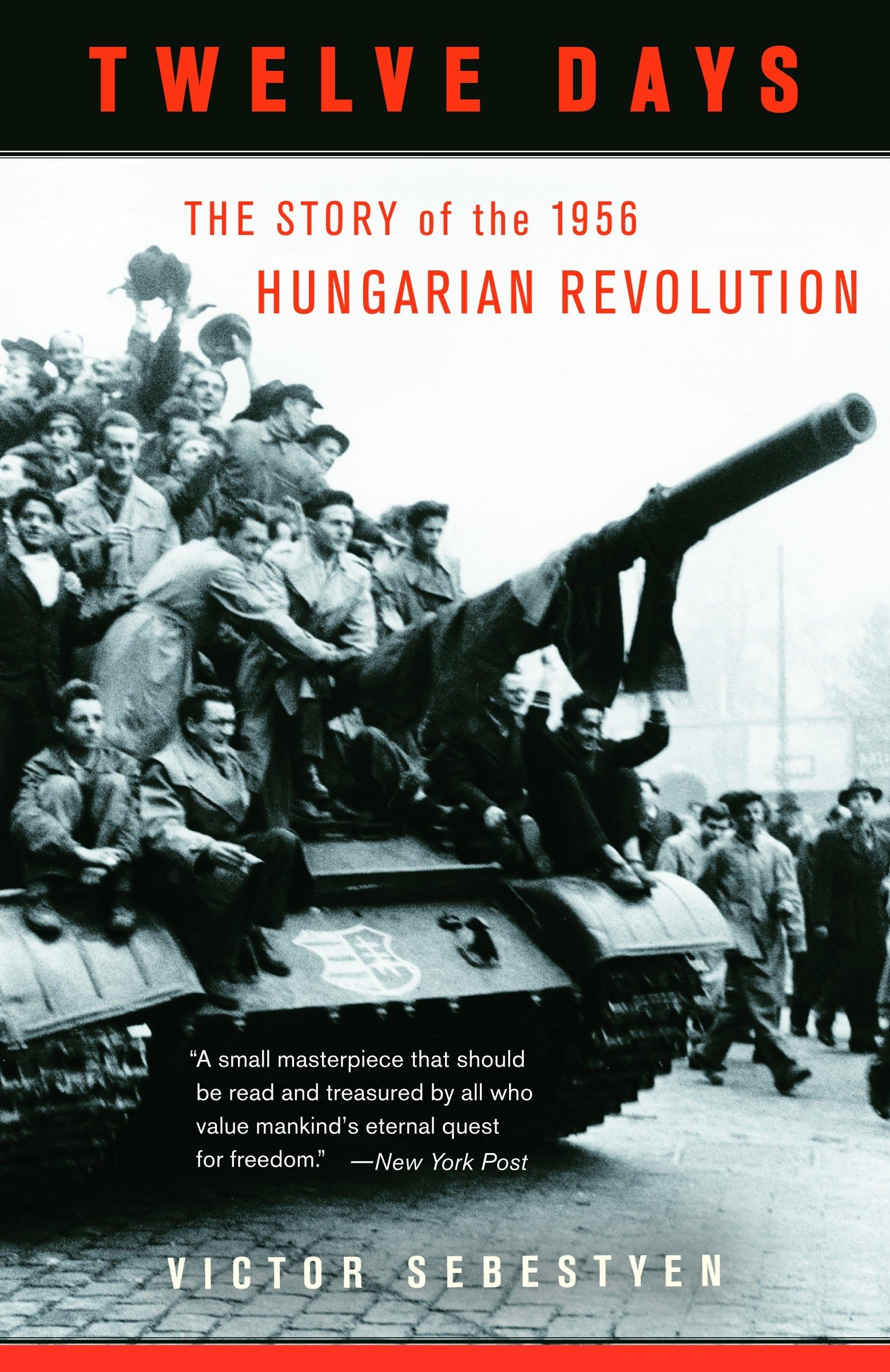



Twelve Days is a riveting day-by-day account of the defining moment of the Cold War—the inspiring but brutally crushed Hungarian Uprising. Victor Sebestyen, a journalist whose own family fled Hungary, gives us a totally fresh account, incorporating newly released official documents, his family's diaries, and eyewitness testimony. We witness the thrilling first days when—armed only with a few rifles, petrol bombs, and desperate courage—the people of Budapest rose up against their Soviet masters and nearly succeeded. As the world watched in amazement, it looked as though the Hungarians might humble the Soviet empire. But the Soviets were willing to resort to brutal lengths—and, sadly, the West was prepared to let them. Dramatic, vivid, and authoritative, Twelve Days adds immeasurably to our understanding of this historic event and reminds us of the unquenchable human desire for freedom. “This is a vivid, heartbreaking account of the brutal crushing of the first armed insurrection against Soviet occupation. Twelve Days is essential reading for understanding the great risks people will take for freedom.” –Kati Marton, author of The Great Escape: Nine Hungarians Who Fled Hitler and Changed the World “On the anniversary of 1956, wielding a vast array of newly released archives and completely new eyewitness testimony, Victor Sebestyen has written a magisterial but also totally gripping and fresh account of the noble, violent, and doomed Hungarian revolution: a tale of murder and battles on the streets of Budapest and in the dungeons of the KGB, and of high-level intrigue from the White House to the Kremlin. Above all, it is a story of courage and decency among ordinary Hungarians. The result is a tour de force.” –Simon Sebag Montefiore, author of Stalin: The Court of the Red Tsar Victor Sebestyen was born in Budapest and was an infant when his family left Hungary. As a journalist, he has worked on numerous British newspapers: he reported widely from Eastern Europe when Communism collapsed in 1989, and covered the war in the former Yugoslavia. At the London Evening Standard he was foreign editor, media editor, and chief lead writer. He writes frequently for The Times and The New Statesman. ONE 9 October 1944, Moscow In his apartment in the Kremlin, Joseph Stalin hosted a war summit with Winston Churchill. Both men knew it was only a matter of months before Germany would be defeated. They wanted an understanding about the future of Europe after the conflict ceased. Much to the annoyance of the British Prime Minster, who kept slightly more conventional hours, Stalin slept during the day and worked at night. The leaders met at 10 p.m., with only their Foreign Ministers, Vyacheslav Molotov and Anthony Eden, and two interpreters present. Churchill later described the scene: 'The moment was apt for business so I said "Let us settle our affairs in the Balkans. Your armies are in Romania and Bulgaria. We have interests, missions, agents there. Don't let us get at cross purposes in small ways. So far as Britain and Russia are concerned how would it do for you to have 90 per cent predominance in Romania, for us to have 90 per cent of the say in Greece and go 50/50 about Yugoslavia?"' Churchill picked up some paper and wrote down on a half-sheet the deal he proposed. 'Hungary was another country to be split 50/50. Casting an eye over the paper, Stalin took his blue pencil and made a large tick upon it and passed it back to us. It was all settled in no more time than it takes to set down. After this there was a long silence. The pencilled paper lay in the centre of the table. At length I said "Might it not be thought rather cynical if it seemed we had disposed of these issues, so fateful to millions of people, in such an offhand manner? Let us burn the paper?" "No, you keep it," said Stalin.' The next day Soviet troops crossed the border from Ukraine into eastern Hungary and they did not leave for a further forty-five years. Diplomats and historians still argue about the significance of the 'percentage deal', or as Churchill called it, 'the naughty document'. Many say it was unimportant and simply recognised the reality of Russian troops on the ground. But taken together with US agreement at the Yalta Conference the following year, the post-war division of Europe had a massive psychological effect in Hungary. 'After the war we felt abandoned by the West,' Eva Walko, a well-informed and astute young woman who had travelled widely in the west between the wars noted. 'And our feeling proved to be right.' Eden minuted his Permanent Secretary, Alexander Cadogan, after the 'percentage deal' was struck: 'I expect the Russians will want to be very hard on the Hungarians.' He was a master of understatement. First, though, the Russians had to win their victory. The next six months in Hungary saw some of the most bitter ghting of the entire war. Two Soviet armies commanded by Marshal Rodion Malinowsky slow