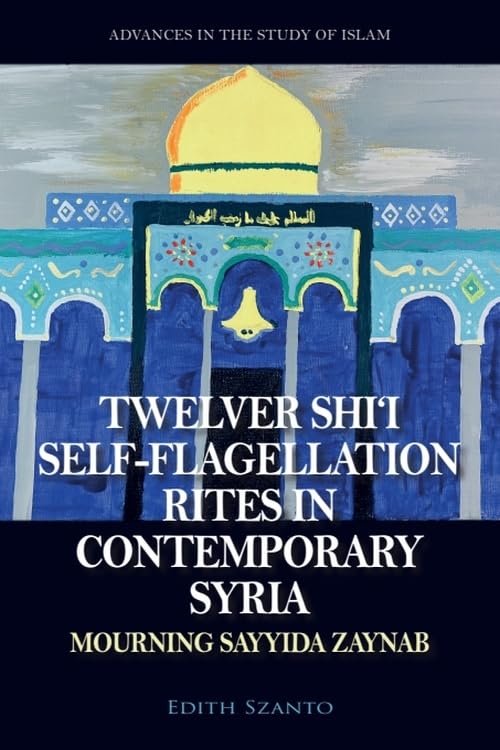
Twelver Shi’i Self-flagellation Rites in Contemporary Syria: Mourning Sayyida Zaynab (Advances in the Study of Islam)
$96.52
by Dr Edith Szanto



This book examines contested Muharram practices, as well as the institutions and authorities that promoted or condemned them until 2011, when most Shi‘is fled Syria. For 40 years, the Syrian shrine town of Sayyida Zaynab was a place of miracles, where violence engendered healing. To experience miraculous healing, Shi‘is attended mourning gatherings, studied at seminaries, self-flagellated, and frequented spiritual healers. Supported by the political establishment, Shi‘i institutions arose to serve Iraqi refugees and Iranian pilgrims. Seminaries promoted various practices, some highly controversial. Wounded, traumatized, impoverished, and oppressed, asylum seekers from Iraq who performed flagellations sought salvation - a worldly restoration requiring saintly beneficence. In Syria, where Shi‘is were often asylum seekers from Iraq, daily concerns centred on the here and now, on survival, and on the bitterness they felt. They prayed for justice and retribution, as much as for physical and psychological healing. At several points reading this text I experienced what I can only describe as joy. This is the model of an academic work. As associate editor for a journal in North Africa, I read a great deal of current academic work in English and French: this is the best of the best. The fieldwork is exemplary and the book is well worth reading on this basis alone. In addition, references to Foucault’s heterotopia, Michael Fischer’s “Karbala Paradigm” and Bakhtin’s notion of the carnival are enlightening and send a thoughtful reader back to the original texts. -- Elizabeth Bishop, American University of Iraq - Baghdad Edith Szanto is Assistant Professor in the Department of Religion at the University of Alabama. She received her PhD in Religious Studies from the University of Toronto in 2012. She has written several articles on Syria and Iraqi Kurdistan, ranging from Shi‘i ritual and seminaries, jinn and magical healing, to interfaith dialogue, Zoroastrianism conversions, as well as Kurdish film.