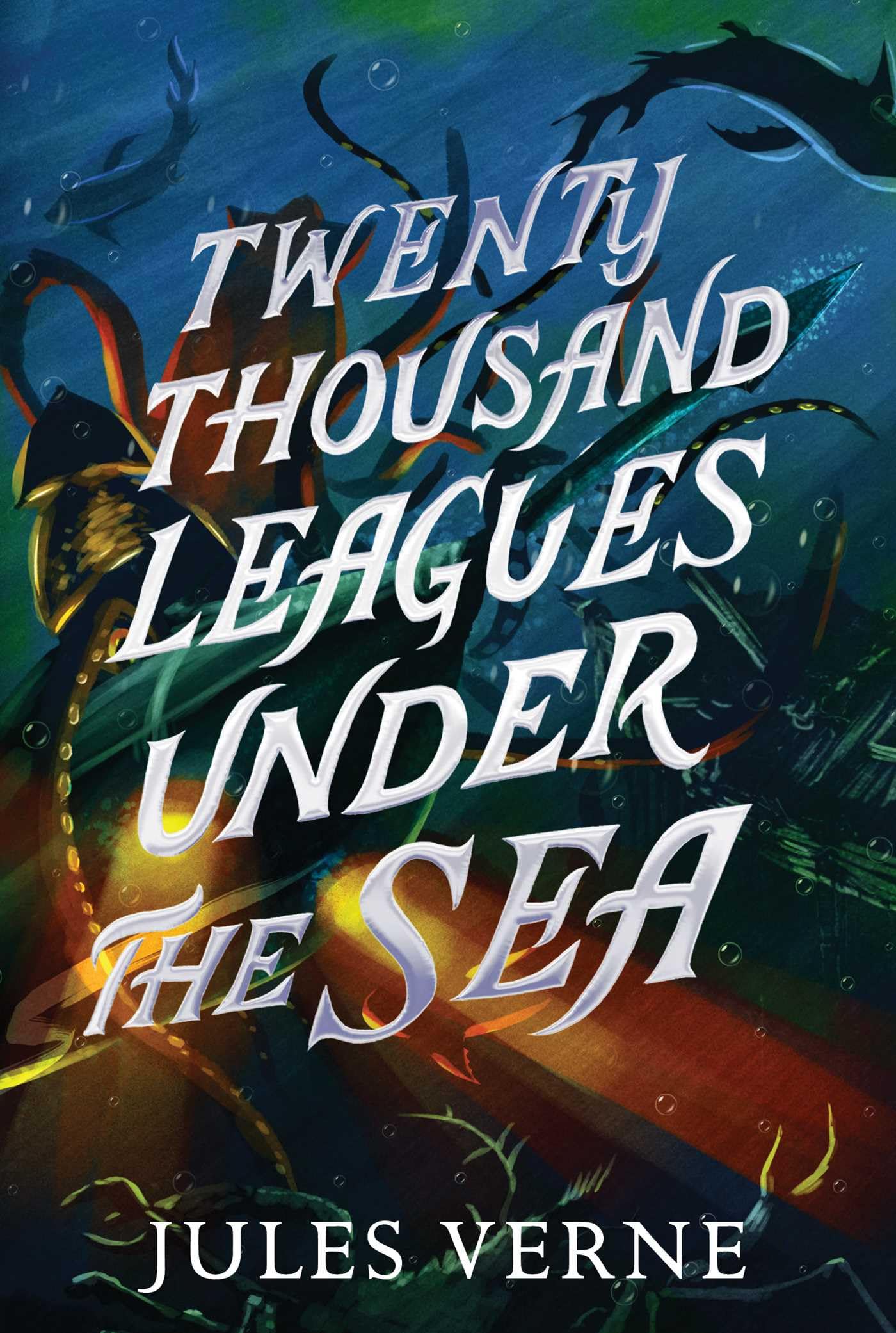



Climb aboard the Nautilus with Captain Nemo and embark on an undersea journey around the world in this Jules Verne classic with an arresting new look! When word about sightings of a sea monster spread, three men embark on a journey to find the creature. But when they get thrown overboard, they soon find themselves in the belly of the beast—the underwater vessel named the Nautilus , manned by Captain Nemo. Having discovered his secret submarine, the sailors are taken as Nemo’s captives. The trio’s expedition shifts to an entirely new adventure beneath the vast ocean with giant sea creatures, sunken treasure, and even the lost world of Atlantis. Though the voyage is wondrous, they are still Captain Nemo’s prisoners and seek freedom from their mysterious kidnapper. Jules Verne (1828–1905) was a prolific French author whose writing about various innovations and technological advancements laid much of the foundation of modern science fiction. Verne’s love of travel and adventure, including his time spent sailing the seas, inspired several of his short stories and novels. Chapter I: A Shifting Reef Chapter I A SHIFTING REEF The year 1866 was marked by a bizarre development, an unexplained and downright inexplicable phenomenon that surely no one has forgotten. Without getting into those rumors that upset civilians in the seaports and deranged the public mind even far inland, it must be said that professional seamen were especially alarmed. Traders, shipowners, captains of vessels, skippers, and master mariners from Europe and America, naval officers from every country, and at their heels the various national governments on these two continents, were all extremely disturbed by the business. In essence, over a period of time several ships had encountered “an enormous thing” at sea, a long spindle-shaped object, sometimes giving off a phosphorescent glow, infinitely bigger and faster than any whale. The relevant data on this apparition, as recorded in various logbooks, agreed pretty closely as to the structure of the object or creature in question, its unprecedented speed of movement, its startling locomotive power, and the unique vitality with which it seemed to be gifted. If it was a cetacean, it exceeded in bulk any whale previously classified by science. No naturalist, neither Cuvier nor Lacépède, neither Professor Duméril nor Professor de Quatrefages, would have accepted the existence of such a monster sight unseen—specifically, unseen by their own scientific eyes. Striking an average of observations taken at different times—rejecting those timid estimates that gave the object a length of two hundred feet, and ignoring those exaggerated views that saw it as a mile wide and three long—you could still assert that this phenomenal creature greatly exceeded the dimensions of anything then known to ichthyologists, if it existed at all. Now then, it did exist; this was an undeniable fact; and since the human mind dotes on objects of wonder, you can understand the worldwide excitement caused by this unearthly apparition. As for relegating it to the realm of fiction, that charge had to be dropped. In essence, on July 20, 1866, the steamer Governor Higginson , from the Calcutta & Burnach Steam Navigation Co., encountered this moving mass five miles off the eastern shores of Australia. Captain Baker at first thought he was in the presence of an unknown reef; he was even about to fix its exact position when two waterspouts shot out of this inexplicable object and sprang hissing into the air some hundred and fifty feet. So, unless this reef was subject to the intermittent eruptions of a geyser, the Governor Higginson had fair and honest dealings with some aquatic mammal, until then unknown, that could spurt from its blowholes waterspouts mixed with air and steam. Similar events were likewise observed in Pacific seas, on July 23 of the same year, by the Columbus from the West India & Pacific Steam Navigation Co. Consequently, this extraordinary cetacean could transfer itself from one locality to another with startling swiftness, since within an interval of just three days, the Governor Higginson and the Columbus had observed it at two positions on the charts separated by a distance of more than seven hundred nautical leagues. Fifteen days later and two thousand leagues farther, the Helvetia from the Compagnie Nationale and the Shannon from the Royal Mail line, running on opposite tacks in that part of the Atlantic lying between the United States and Europe, respectively signaled each other that the monster had been sighted at latitude 42°15' north and longitude 60°35' west of the meridian of Greenwich. From their simultaneous observations, they were able to estimate the mammal’s minimum length at more than three hundred fifty English feet; this was because both the Shannon and the Helvetia were of smaller dimensions, although each measured a hundred meters stem to stern. Now then, the