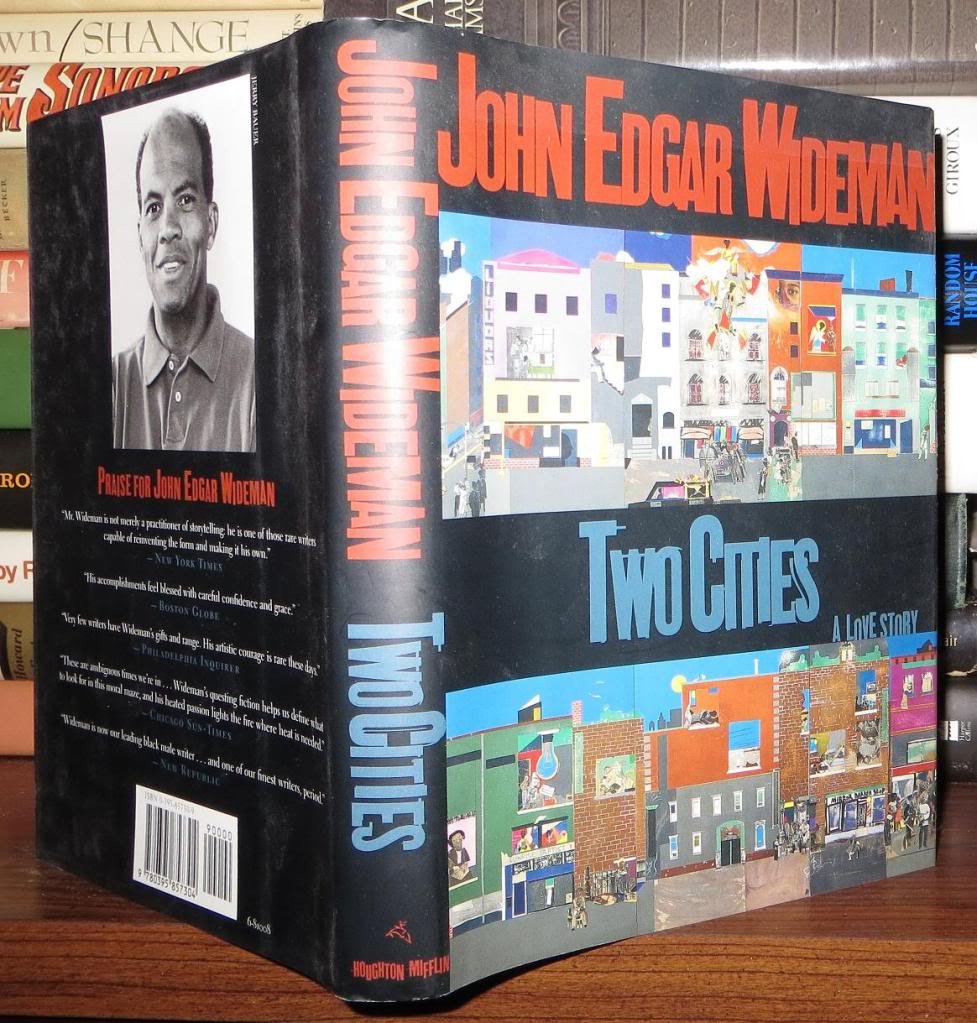



A young woman mourning the deaths of her husband and sons, victims of urban violence, Kassima finds redemption in a love affair with the gentle Robert Jones and in a collection of photographs, taken by her late, eccentric tenant, that document a half-century of African-American history. Tour. Most fiction built along musical rather than traditional narrative lines quickly sinks under the weight of its own pretensions. Not so Two Cities , John Edgar Wideman's multivoiced improvisation in the key of life. Ranging from funk to blues to jazz, Motown to gospel to pure high classical, these wise and gritty riffs tell the story of Kassima, who's had hard luck with her men--two drug-dealing sons shot dead and a husband downed by AIDS within ten months: "Just boys and men the whole time I been in this house. Men who act like boys, boys trying to be men. One run-ragged woman trying to teach them the difference between man and boy. As if I knew. As if they ever had a chance." As the novel opens, Kassima is stepping out for the first time since her bereavement, looking for considerably less than the good and sexy man she finds on a stool in the neighborhood bar. Her encounter with Robert Jones, told by both in lusty counterpoint, is delicious, but she is still too raw from her losses to love easily again and sends Robert packing. In the bluesy interlude that follows, we hear solos that blow across 50-odd years, linking Kassima's story to that of her aged tenant Mr. Mallory, who looks like a bum but takes multiple-exposure photographs and writes lofty, unanswered letters about aesthetics to the Italian sculptor Giacometti. All the while, echoing through the same grim streets, we hear the soundtrack of gangsta rap, punctuated by the sounds of real guns killing real young black men. The two cities of the title are literally Philadelphia and Pittsburgh, but here place swallows time, history, grief, violence, and love--giving us both an indelible experience of real people experiencing real pain and real joy and a shivery suspicion that in life as in art, a hundred different and contradictory realities coexist in any given moment. Does love or disappointment or anger conquer all? You know the old story about the big fish that got away. How the guy telling it keeps cheating, his hands getting wider and wider apart every time he shows how big the fish was. Well, here's a funny thing about the story. Something I never understood before I met and lost her. The guy's not lying. He feels the empty between his hands growing each time he tells the story, each time the damned fish gets away again. You see, the funny thing is the sorry motherfucker's right. No matter how far apart he spreads his lying hands, he's right. The story's true. Beautiful exaggeration, inspired sociology, and first-rate fiction, Two Cities reverberates with just such truth. Don't miss it. --Joyce Thompson "Beautifully structured, cunningly interlaced, and sensuously immediate," this novel by the highly regarded Wideman (The Cattle Killing, LJ 7/96) presents the story of an African American woman afraid to love after losing both husband and sons to street violence. Photographs documenting a half-century of black experience help call her back to life. Copyright 1998 Reed Business Information, Inc. Wideman is getting increasingly experimental, which is not necessarily good news, for he is also getting increasingly opaque. His latest novel is a series of vignettes about events in the lives of a small group of individuals, told in their voices, almost as confessions. The two main characters are Kassima, whose husband died of AIDS in prison and whose two boys were killed on the streets, and her tenant, Mr. Mallory, who roams their Pittsburgh neighborhood taking photographs with his camera, his "toy," his head crowded with memories of his past. Their words extract considerable poignancy from their hard lives; in their attitudes toward themselves and others are couched much pride, defensiveness, despair, and hope. But these are disembodied voices speaking to us; the speakers do not seem like clear-cut, rounded individuals, but more like actors lined up onstage reciting lines rather than acting out roles. Also, it is not always clear who is speaking, and once readers get used to a certain character's voice, that character may reappear later with a voice that sounds different, adding to the narrative confusion. Granted, much of Wideman's language is beautiful, but is that enough to compel the reader to work so hard to gain a feel for these characters, to recognize them as individuals and fully comprehend their plights? Wideman's numerous fans will have to determine for themselves how much effort they want to bring to the novel to make it a successful reading experience. Brad Hooper Two Cities is as enjoyable as it is important. -- The New York Times Book Review , Walter Mosely Reading Two Cities can be demanding.... But a novel easier to read might also