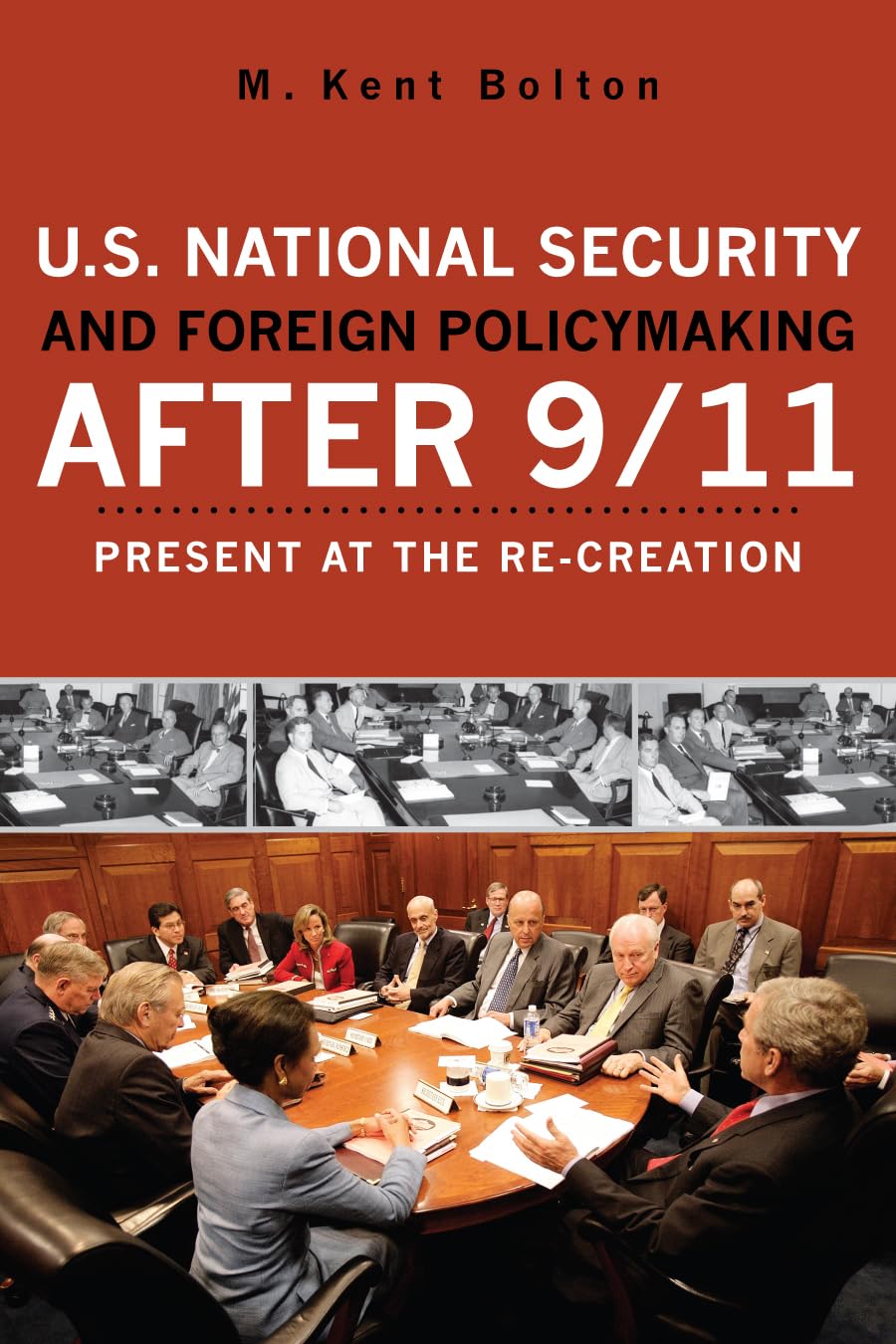
U.S. National Security and Foreign Policymaking After 9/11: Present at the Re-creation
$143.00
by Kent M. Bolton



In December 2004 the 109th Congress passed and President George W. Bush signed the Intelligence Reform and Intelligence Prevention Act (IRTPA). M. Kent Bolton argues that IRTPA represented a change in the trajectory of U.S. national-security policy-the first fundamental, demonstrable change since the 1947 National Security Act (1947 NSA) became law creating a unified U.S. Department of Defense, the Central Intelligence Agency, and the National Security Council, among other entities. As the 1947 NSA presaged a new era of U.S. policymaking, so too did the IRTPA. As such the IRTPA represents an extraordinarily important piece of legislation for students and scholars of U.S. foreign and national-security policy. The author documents how and why it became law and how it has affected policymaking. He further argues that the changes begun by 9/11 and memorialized by IRTPA will likely affect U.S. national-security policymaking for decades if not generations. The book is an excellent source....Highly recommended. (April 2008 Vol. 45 No. 08 Choice ) U.S. National Security and Foreign Policymaking After 9/11 deftly demonstrates the unique role of neoconservative thinkers in the George W. Bush administration who were "present at the recreation" of the national policymaking apparatus. Professor Bolton thoroughly explains the development of new post-9/11 bureaucracies, institutions, and procedures in a readable book that will be of great interest to anyone concerned about the future of U.S. national security policy. (Rodger A. Payne) M. Kent Bolton is professor of Political Science and Global Studies at California State University. He has authored articles and books on U.S. foreign and national security since 9/11 2001. He lives in Clarksbad, California.