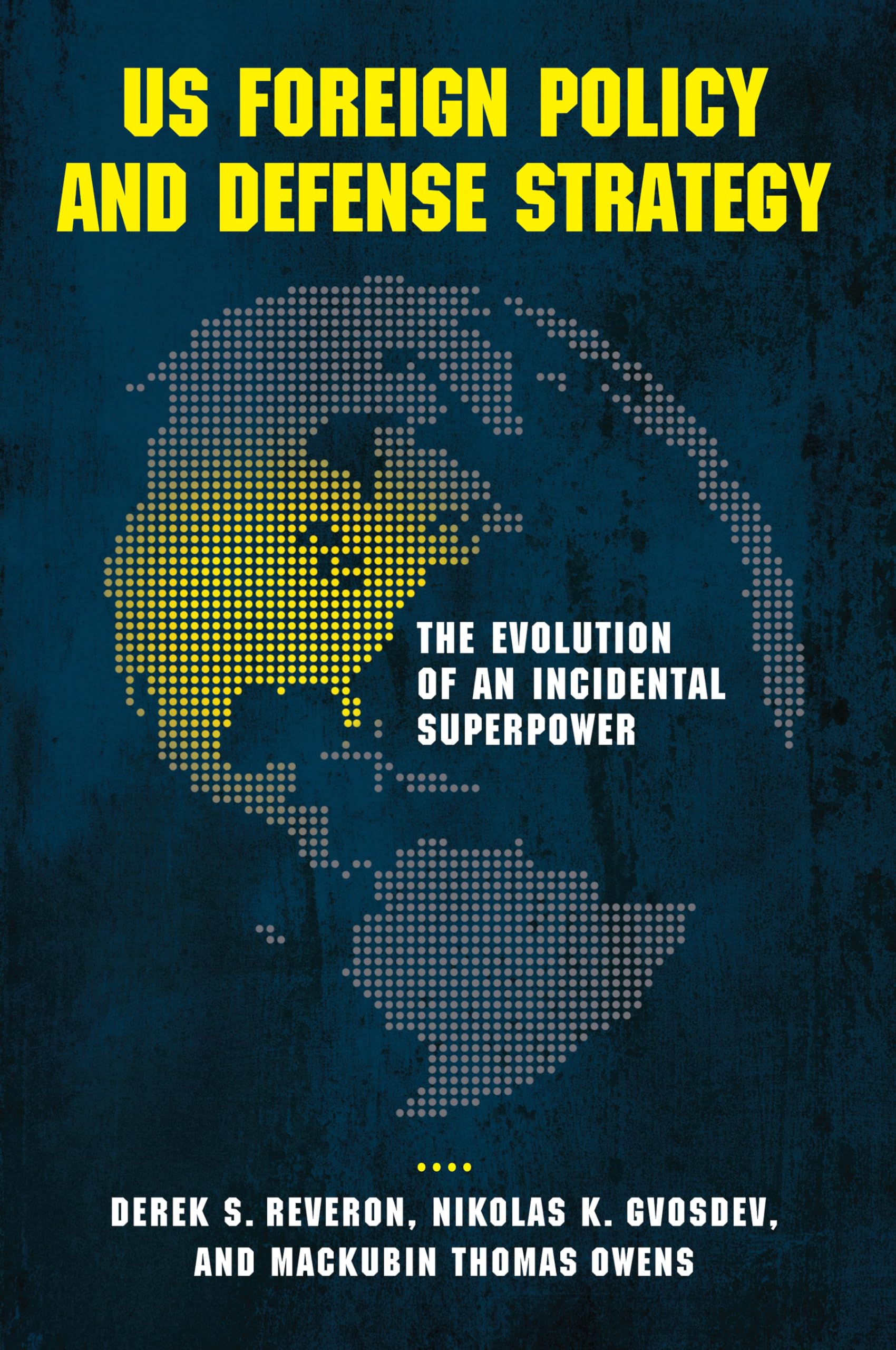
US Foreign Policy and Defense Strategy: The Evolution of an Incidental Superpower
$32.95
by Derek S. Reveron



Safe from the battlefields of Europe and Asia, the United States led the post–World War II global economic recovery through international assistance and foreign direct investment. With an ardent decolonization agenda and a postwar legitimacy, the United States attempted to construct a world characterized by cooperation. When American optimism clashed with Soviet expansionism, the United States started on a path to global hegemony. In US Foreign Policy and Defense Strategy , the authors analyze the strategic underpinnings of hegemony, assess the national security establishment that sustains dominance, consider the impact on civil-military relations, and explore the intertwining relationships between foreign policy, defense strategy, and commercial activities. Eschewing conventional analyses, the volume not only identifies drivers and continuities in foreign policy, but it also examines how the legacy of the last sixty-five years will influence future national security policy that will be characterized by US leadership in an increasingly competitive world. From civil-military relations to finance, and from competing visions of how America should make war to its philosophy of securing peace through reconstruction and reconciliation, US Foreign Policy and Defense Strategy offers unique insights into the links between military and commercial power as it charts the rise of a historical rarity: the incidental superpower. This accessibly written book is suitable for students and general readers as well as scholars. U.S. Foreign Policy and Defense Strategy is even- handed in its analysis and rigorous in its methodology. It also provides and impor- tant glimpse into how America attained its current place in the world, and just what it will entail if we hope to keep it. That makes it a valuable resource for stu- dents of international affairs and Ameri- can history, as well as for those who are involved in the shaping of U.S. security policy today, both today and tomorrow. - Todd Johnson, Journal of International Security Affairs "the book is perfect for both the undergraduate and graduate classroom, since all its chapters include comprehensive, unbiased, concise, and quite readable reviews of the major concepts and debates regarding the subjects they cover." H-Diplo networks.h-net.org/node/28443/discussions/626274/issf-review-essay-33-us-foreign-policy-and-defense-strategy Derek S. Reveron is a professor of national security affairs and the EMC Informationist Chair at the US Naval War College. He is the author or editor of several books including Cyberspace and National Security: Threats, Opportunities, and Power in a Virtual World. Nikolas K. Gvosdev is a professor of national security affairs at the US Naval War College and currently serves as the director of the Policy Analysis subcourse in the National Security Affairs Department. He is the author or editor of several books including Russian Foreign Policy: Interests, Vectors, and Sectors . Mackubin Thomas Owens is the editor of Orbis , the quarterly journal of the Foreign Policy Research Institute, and former professor of national security affairs at the US Naval War College. He is the author of US Civil-Military Relations after 9/11: Renegotiating the Civil-Military Bargain .