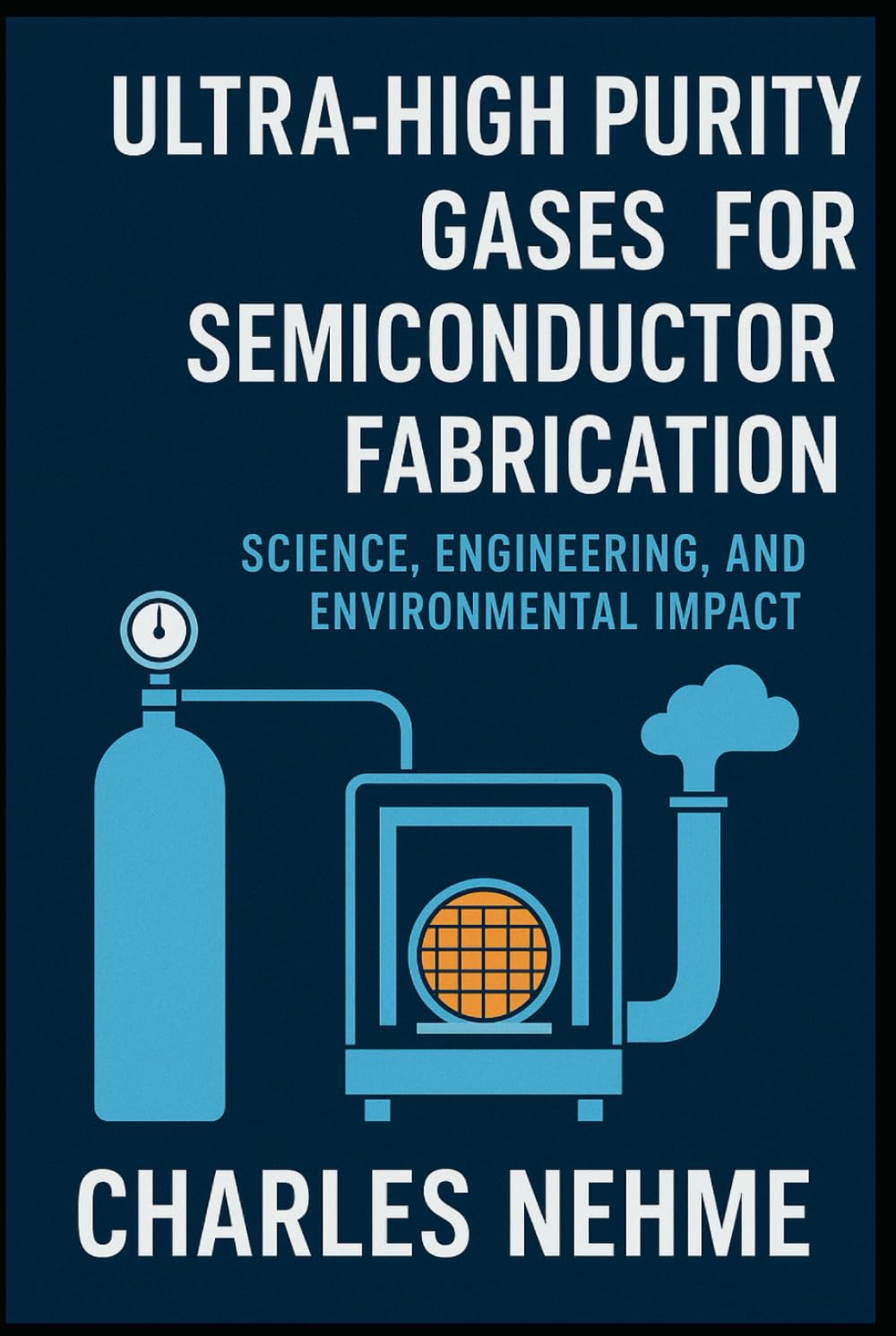
Ultra-High Purity Gases for Semiconductor Fabrication: Science, Engineering, and Environmental Impact
$59.99
by Charles Nehme



The relentless pace of innovation in the semiconductor industry—driving smaller feature sizes, more complex 3D architectures, and increased performance—is fundamentally dependent on a class of materials often taken for granted: Ultra-High Purity (UHP) gases . These gases are not merely auxiliary supplies; they are active chemical reagents and critical enablers of processes like deposition, etching, and cleaning. The difference between a high-yielding, cutting-edge chip and a failed batch often boils down to a few parts-per-billion of impurity in the gas supply or a slight deviation in flow control. This book aims to bridge the gap between process chemistry, materials science, and the demanding engineering required to handle these essential, yet often hazardous, substances. We delve into the foundational chemistry, the sophisticated delivery and control systems, and the critical aspects of safety and environmental responsibility. Given the industry's increasing focus on sustainability, a significant portion of this text is dedicated to understanding and mitigating the environmental impact of potent greenhouse gases, such as Perfluorinated Compounds (PFCs), used in the fab. Whether you are a seasoned engineer looking to optimize a process, a student seeking to understand the inner workings of a fabrication facility, or an environmental manager tasked with compliance, this comprehensive guide will serve as an indispensable resource. We hope to illuminate the complex, fascinating, and vital role that UHP gases play in shaping the digital world.