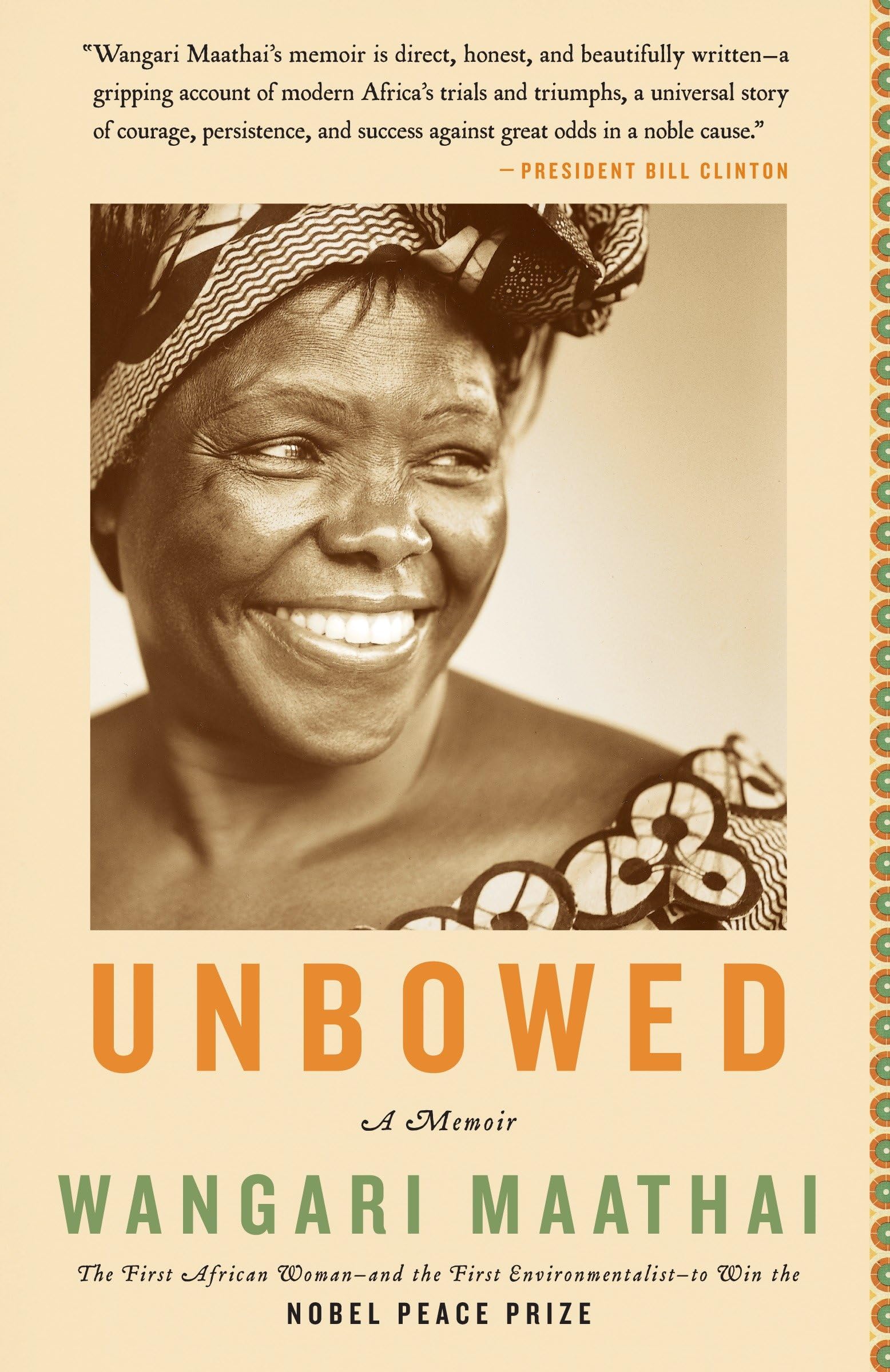



NOBEL PRIZE WINNER • A remarkable memoir of courage, faith, and the power of persistence about one woman's extraodinary journey from her childhood in rural Kenya to the world stage. “[Maathai’s] story provides uplifting proof of the power of perseverance—and of the power of principled, passionate people to change their countries and inspire the world.” — The Washington Post In Unbowed, Nobel Prize winner Wangari Maathai recounts her extraordinary life. When Maathai founded the Green Belt Movement in 1977, she began a vital poor people’s environmental movement, focused on the empowerment of women, that soon spread across Africa. Persevering through run-ins with the Kenyan government and personal losses, and jailed and beaten on numerous occasions, Maathai continued to fight tirelessly to save Kenya’s forests and to restore democracy to her beloved country . “Wangari Maathai’s memoir is direct, honest, and beautifully written—a gripping account of modern Africa’s trials and triumphs, a universal story of courage, persistence, and success against great odds in a noble cause.” —President Bill Clinton "Wangari Maathai is the rare leader who knows how to create independence, not dependence. On the page as in person, her example makes each of us a little stronger, wiser and braver than we ever thought we could be.” —Gloria Steinem “Compelling.... A striking reminder that the peace award, more than any other Nobel honor, recognizes success achieved through tremendous adversity.” — The Seattle Times “Inspirational.... Ms. Maathai will not be beaten down.” — The Economist “[Maathai’s] story provides uplifting proof of the power of perseverance—and of the power of principled, passionate people to change their countries and inspire the world.” — The Washington Post WANGARI MUTA MAATHAI was born in Nyeri, Kenya, in 1940. She is the founder of the Green Belt Movement, which, through networks of rural women, has planted over 30 million trees across Kenya since 1977. In 2002, she was elected to Kenya's Parliament in the first free elections in a generation, and in 2003, she was appointed Deputy Minister for the Environment and Natural Resources. The Nobel Peace Prize laureate of 2004, she has three grown children and lives and works in Nairobi. Beginnings I was born the third of six children, and the first girl after two sons, on April 1, 1940, in the small village of Ihithe in the central highlands of what was then British Kenya. My grandparents and parents were also born in this region near the provincial capital of Nyeri, in the foothills of the Aberdare Mountain Range. To the north, jutting into the sky, is Mount Kenya. Two weeks into mbura ya njahi , the season of the long rains, my mother delivered me at home in a traditional mud-walled house with no electricity or running water. She was assisted by a local midwife as well as women family members and friends. My parents were peasant farmers, members of the Kikuyu community, one of forty-two ethnic groups in Kenya and then, as now, the most populous. They lived from the soil and also kept cattle, goats, and sheep. At the time of my birth, the land around Ihithe was still lush, green, and fertile. The seasons were so regular that you could almost predict that the long, monsoon rains would start falling in mid-March. In July you knew it would be so foggy you would not be able to see ten feet in front of you, and so cold in the morning that the grass would be silvery-white with frost. In Kikuyu, July is known as mworia nyoni , the month when birds rot, because birds would freeze to death and fall from the trees. We lived in a land abundant with shrubs, creepers, ferns, and trees, like the mitundu , mukeu , and migumo , some of which produced berries and nuts. Because rain fell regularly and reliably, clean drinking water was everywhere. There were large well-watered fields of maize, beans, wheat, and vegetables. Hunger was virtually unknown. The soil was rich, dark red-brown, and moist. When a baby joined the community, a beautiful and practical ritual followed that introduced the infant to the land of the ancestors and conserved a world of plenty and good that came from that soil. Shortly after the child was born, a few of the women attending the birth would go to their farms and harvest a bunch of bananas, full, green, and whole. If any of the bananas had ripened and birds had eaten them, the women would have to find another full bunch. The fullness expressed wholeness and wellness, qualities the community valued. Along with the bananas, the women would bring to the new mother’s house sweet potatoes from her and their gardens and blue-purple sugarcane ( kigwa kia nyamuiru ). No ordinary sugarcane would do. In anticipation of the birth, the expectant mother would fatten a lamb that slept and ate inside her home. While the women were gathered the ritual foods, the child’s father would sacrifice the lamb and roast a piece of the flesh. The bana