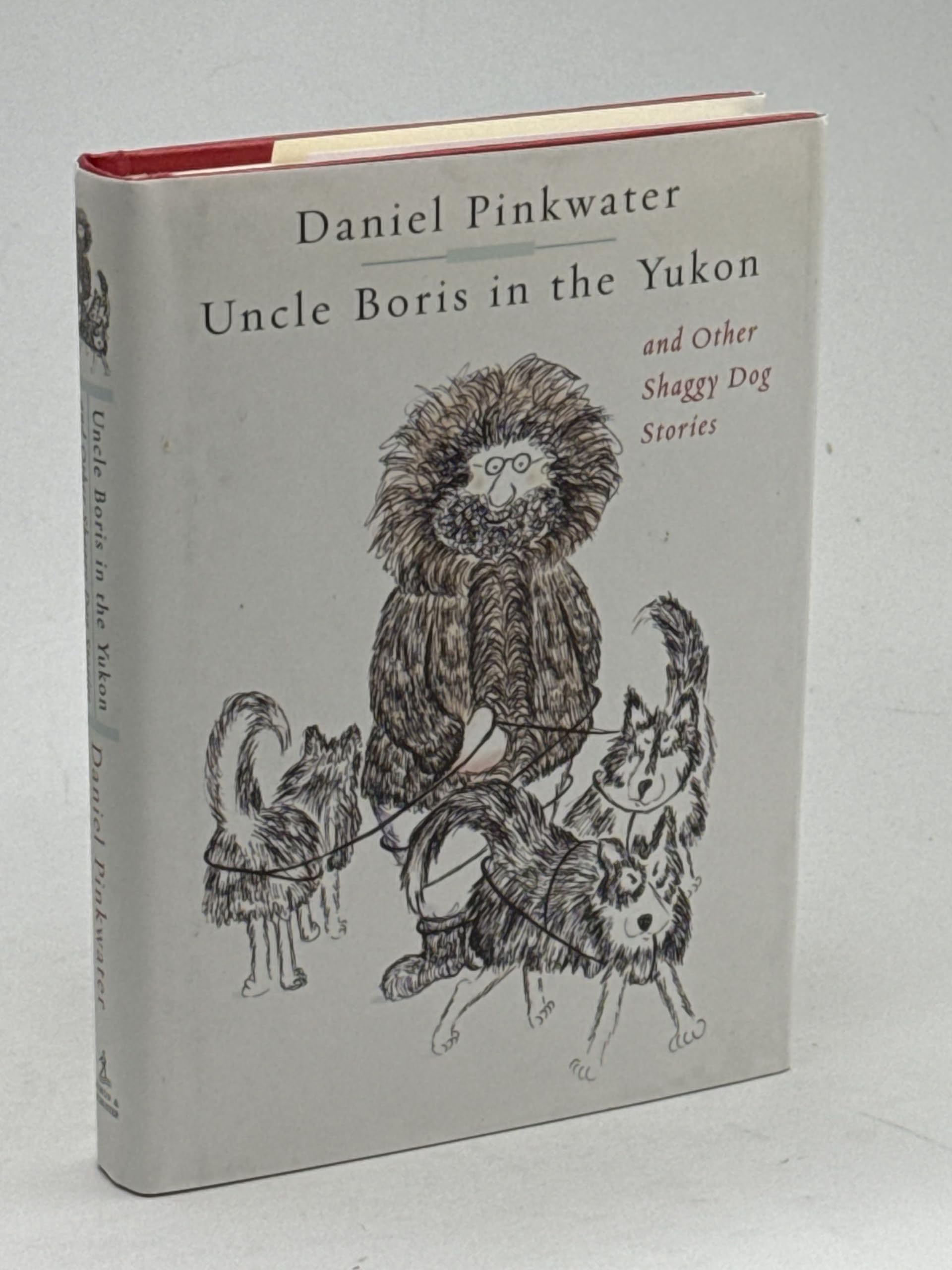



The humorist, children's book author, essayist, and NPR commentator shares hilarious true-life tales inspired by his sometimes dysfunctional relationships with the dogs in his life. 50,000 first printing. Is it any wonder that an author known for his comic and outrageously imaginative children's books would write about his experiences with man's best friend in an unconventional, albeit engaging, way? Pinkwater here remembers all the dogs that have passed through his life, from the shaggy Pekinese given to his family by Uncle Boris (who supposedly encountered Jack London in the tailor shop that Pinkwater's father once owned in Warsaw) and Stan the Irish setter, acquired without his father's knowledge, to Juno, the Alaskan malamute that Pinkwater bought after he was smitten by the sight of two large sled dogs in Manhattan, and Arnold, the puppy. Pinkwater does not intend this as a how-to-train book; he covered that base in Superpuppy, aimed at children, after reading hundreds of training manuals and deciding that much of what had been written about canines had no foundation in reality. The reader must decide how much of this humorous and creative reminiscence is fact and how much is fiction. Sure to be popular where dog books and the author's other works are enjoyed, this is recommended for larger public libraries and young adult collections. Edell M. Schaefer, Brookfield P.L., WI Copyright 2001 Reed Business Information, Inc. Add dog lover and trainer to Pinkwater's list of accomplishments. A children's author, NPR commentator, essayist, and novelist, he now reveals the secret to his success: he learned many of life's most crucial lessons from dogs, in spite of the fact that his early canine experiences were anything but felicitous. Pinkwater begins his mordantly funny and smartly entertaining mix of memoir and fancy with a hilarious account of his Jewish Polish father and his brothers, all cheerful Warsaw thugs, including Boris, who caught Klondike fever and made the long, arduous journey to Alaska, where he forged a profound friendship with a malamute named Jake. Years later, Pinkwater, an aspiring artist, became enamored of the same breed despite a series of disastrous pet skirmishes instigated by his immigrant father's peculiar "love of the grotesque." Moving from surreal boyhood anecdotes set in Chicago and California to charming tales of life in Upstate New York with his animal-crazy wife and their personable dogs, Pinkwater is at once diverting and slyly instructive regarding dogs, love, discipline, and happiness. Donna Seaman Copyright © American Library Association. All rights reserved Daniel Pinkwater is the author of several bestselling children's books as well as a popular commentator on National Public Radio. He writes regular reviews on Contentville.com. Daniel lives in Hyde Park, New York. Chapter 1 My father appeared to be pretty near illiterate -- anyway in English. It took him a couple of hours every night to struggle his way through the newspaper, and he spoke his adopted language atrociously. Sometimes, in order to give my father a taste of higher culture, I'd fill him in on what I was reading. Once, on a long car ride, I told him the story of Macbeth. It turned out he knew it as well as I did -- better, in fact, since he appeared to remember scenes left out of my edition of the collected plays -- like the one in which Macbeth's father gives his son advice, and the one in which he gives Lady Macbeth (still alive at the end of the play, as he is) a good talking-to, and she agrees to mend her ways. I tried Hamlet, Julius Caesar, and King Lear, and he knew them too, in recognizable form, but with variations that would have amazed the man from Stratford-upon-Avon. Hamlet gets married, settles down, and forgets all the nonsense; Julius Caesar retires to a resort on the Mediterranean; and Lear's children are surprised by the king's lively dance number at the end of the play. "Dose are Jewish shows. I saw dem in Varsaw." "You saw them in translation," I told him. "Naw, dey vas in Yiddish. Dey vas by a Jewish writer, name of Shakespeare. I tink I knew him. I used to go to deh café vhere all deh writers vas." "Dad, Shakespeare was English, and he lived around the end of the sixteenth century." "I don't tink he vas det old -- and English -- maybe he vas, maybe he vasn't. Even your uncle used to pretend he vas an Englishman." The uncle he referred to was Boris, the most colorful and cultured of my father's five gangster brothers from the old days in Warsaw. Boris, when he wasn't participating in holdups, dealt in objets d'art of dubious provenance. He was also the man to see if one needed documents, passports, bills of sale. And, as I said, Boris had culture. Boris had many wealthy and prominent acquaintances, owned paintings of zaftig women with extra-bright pink nipples and fanciful ceramic sculptures in vivid polychrome, played the cello, and, from time to time, might