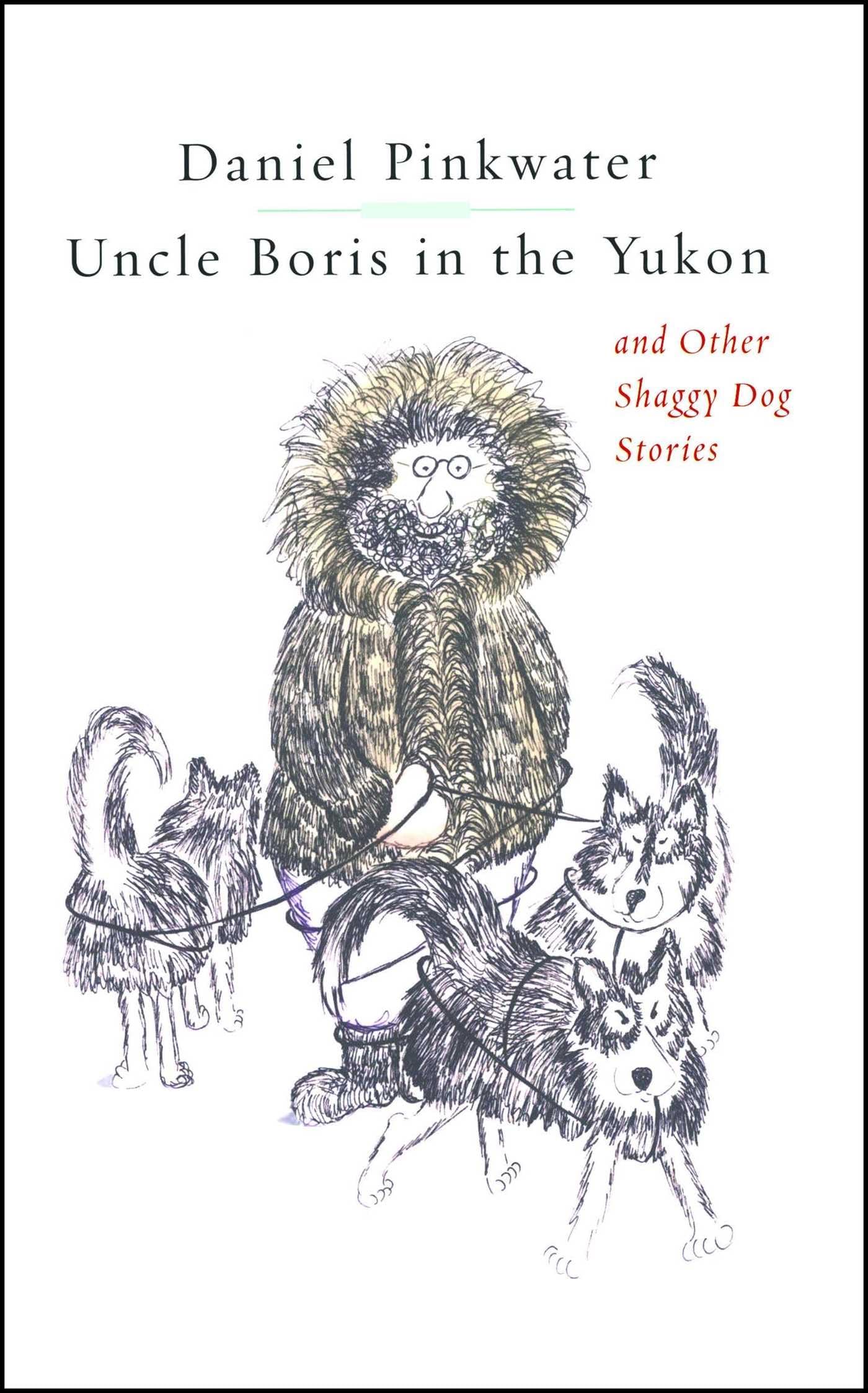



There have been books about dogs since books began -- manuals on training and raising them, stories featuring dogs, and memoirs seen through the eyes of dogs. Lately, there has been a rash of books that purport to tell us what dogs are thinking, such as the bestselling What Dogs Are Thinking. This is a book about a Jewish boy and his sled dogs -- also a couple of wolves, a parrot or two...and Pinkwater's uncle...and his father. Daniel Pinkwater, prodigious author of books for children, popular commentator on National Public Radio, and dog trainer to the stars, is unclear about what dogs are thinking. In fact, he appears to be completely baffled by them. He considers himself lucky that his dog does not foul the carpet, bite people, or run in traffic. Unlike every other dog book ever written, this one does not make the reader feel more stupid than the author. Daniel Pinkwater is the author of several bestselling children's books as well as a popular commentator on National Public Radio. He writes regular reviews on Contentville.com. Daniel lives in Hyde Park, New York. Chapter 1 My father appeared to be pretty near illiterate -- anyway in English. It took him a couple of hours every night to struggle his way through the newspaper, and he spoke his adopted language atrociously. Sometimes, in order to give my father a taste of higher culture, I'd fill him in on what I was reading. Once, on a long car ride, I told him the story of Macbeth. It turned out he knew it as well as I did -- better, in fact, since he appeared to remember scenes left out of my edition of the collected plays -- like the one in which Macbeth's father gives his son advice, and the one in which he gives Lady Macbeth (still alive at the end of the play, as he is) a good talking-to, and she agrees to mend her ways. I tried Hamlet, Julius Caesar, and King Lear, and he knew them too, in recognizable form, but with variations that would have amazed the man from Stratford-upon-Avon. Hamlet gets married, settles down, and forgets all the nonsense; Julius Caesar retires to a resort on the Mediterranean; and Lear's children are surprised by the king's lively dance number at the end of the play. "Dose are Jewish shows. I saw dem in Varsaw." "You saw them in translation," I told him. "Naw, dey vas in Yiddish. Dey vas by a Jewish writer, name of Shakespeare. I tink I knew him. I used to go to deh café vhere all deh writers vas." "Dad, Shakespeare was English, and he lived around the end of the sixteenth century." "I don't tink he vas det old -- and English -- maybe he vas, maybe he vasn't. Even your uncle used to pretend he vas an Englishman." The uncle he referred to was Boris, the most colorful and cultured of my father's five gangster brothers from the old days in Warsaw. Boris, when he wasn't participating in holdups, dealt in objets d'art of dubious provenance. He was also the man to see if one needed documents, passports, bills of sale. And, as I said, Boris had culture. Boris had many wealthy and prominent acquaintances, owned paintings of zaftig women with extra-bright pink nipples and fanciful ceramic sculptures in vivid polychrome, played the cello, and, from time to time, might be seen walking a borzoi, poodle, dalmatian, or some other fashionable dog in the Ogrod Saski, or Saxon Gardens, then the favorite resort of the aristocrats. He acquired, trained, and sold these dogs to the quality, and, like his other offerings, their authenticity was questionable. Even more than my father, Boris liked to hang out with writers, and he knew a lot of them. For a long time, I assumed it was merely another manifestation of my father's craziness that he imagined he had known Shakespeare personally, but it's possible that some translators of world literature then residing in Warsaw's Yiddish district might have put it about that they were in person those authors whose works they rendered. I could be wrong about this, but I am pretty sure that Jack London never lived upstairs over his father's tailor shop in the Stare Miasto with an angry wife and three children; nor did he pal around with my uncle Boris. But my father was convinced he had done just that. "Sure! Who else but det Jack London talked your uncle into going to Alyeska?" These were the serene days of a Warsaw now barely remembered, of lime trees and cafés on Ujazdowska Alesa Avenue, vendors, musicians, and street characters in Sigismund Square. I imagine my father, a healthy young hoodlum, promenading in the Krasinski Gardens. He and his brothers were Jewish thugs, and it was a point of pride that they were more cultivated and showed more style than the Poles who followed the same profession. I have a photograph of my father and his brothers in those days. They are manicured and pomaded, holding whangee canes and kidskin gloves, wearing flash neckties, and staring into the camera with the expression of cape buffalo contemplating a tourist. The enterprise of my father and