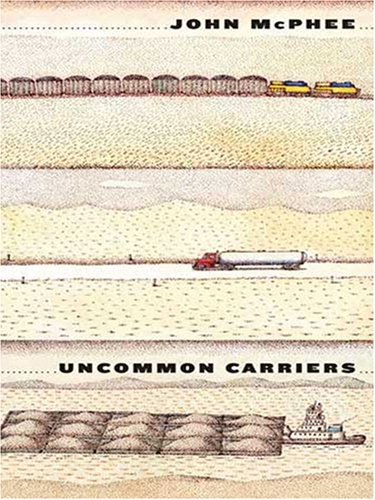



This is a book about people who drive trucks, captain ships, pilot towboats, drive coal trains, and carry lobsters through the air: people who work in freight transportation. John McPhee rides from Atlanta to Tacoma alongside Don Ainsworth, owner and operator of a sixty-five-foot, five-axle, eighteen-wheel chemical tanker carrying hazmats―in Ainsworth's opinion "the world's most beautiful truck," so highly polished you could part your hair while looking at it. He goes "out in the sort" among the machines that process a million packages a day at UPS Air's distribution hub at Louisville International Airport. And (among other trips) he travels up the "tight-assed" Illinois River on a towboat pushing a triple string of barges, the overall vessel being "a good deal longer than the Titanic ," longer even than the Queen Mary 2 . Uncommon Carriers is classic work by McPhee, in prose distinguished, as always, by its author's warm humor, keen insight, and rich sense of human character. Princeton University professor and essay writer John McPhee has a knack for spinning dull-sounding subjects into narrative gold. Innocuously titled tomes like the Pulitzer Prize?winning Annals of the Former World yield magnificent tales, baroque with exceptional details that make the curious giddy. The seven essays included in his 27th book (many first published in the New Yorker ) offer a rich portrait of the sundry methods and people that get things from there to here, from canoe (Thoreau's travel up the Concord in 1839) to 18-wheel tanker trunk. That McPhee's theme is not overtly deeper bothered a few reviewers, as did the excessive detail. Yet at the end of the road, there's no better tour guide to these often overlooked engines of American commerce. Copyright © 2004 Phillips & Nelson Media, Inc. Famed for his geology epics ( Annals of the Former World , 1998), the popular McPhee here enters the world of heavy freight. Acutely attentive, he watches what an interstate truck driver, a railroad engineer, a towboat captain, and shipmasters do to conduct safely tens of thousands of tons of conveyance and cargo to their destinations. In spare, efficient prose, McPhee indicates, rather than directs readers toward, the skill and experience of the workers. They contend with a magnitude of inertia, and their maneuvers must anticipate peril ahead by miles. McPhee admiringly evokes the balletic performance on the gears and brakes by a truck driver, and on the throttles by a towboat captain as he negotiates the constrictions of the Illinois River; unfortunately, the shipmasters seem accident-prone, grounding and colliding their vessels. Their miscues are more educational than disastrous, thankfully, occurring far from sea near the French Alps, where a maritime school teaches ship handling with models on a pond. Hitching rides to describe how coal is moved, McPhee imparts a sense of the special sociology within each transportation mode, drawing from readers both enlightenment and respect. Gilbert Taylor Copyright © American Library Association. All rights reserved Adult/High School–McPhee charms readers with an insiders look at various forms of freight carriers, including trucks, trains, and ocean tankers. He describes his personal experiences of traveling with a handful of people who transport bulk cargo. A self-proclaimed four wheeler with a tendency to ignore stop signs, he identifies the exceptional talents and quirky personality of each driver, seaman, and conductor and wonders at the expertise of these unknown mavens. The captain of the SS Stella Lykes can parallel park a 700-foot ship in a 750-foot space without assistance. Pilot Mel Adams maneuvers a fully loaded tugboat four times longer than the river is wide, with as little as 10 feet of clearance where the river turns. Dan Ainsworth, chemical tanker driver, factors the weight of his fuel, the distance between truck stops, and the weight of his load to avoid exceeding the limit at weigh stations. A pleasure to read, each of the seven chapters is an adventure waiting to be taken individually or collectively. Students will learn of the danger, the technology, and the precision required to bring coal to heat peoples houses, goods to their grocery stores, and imports to their harbors. –Brigeen Radoicich, Fresno County Office of Education, CA Copyright © Reed Business Information, a division of Reed Elsevier Inc. All rights reserved. John McPhee was born in Princeton, New Jersey, and was educated at Princeton University and Cambridge University. His writing career began at Time magazine and led to his long association with The New Yorker , where he has been a staff writer since 1965. Also in 1965, he published his first book, A Sense of Where You Are , with Farrar, Straus and Giroux, and in the years since, he has written nearly 30 books, including Oranges (1967), Coming into the Country (1977), The Control of Nature (1989), The Founding Fish (2002), and Silk Pa