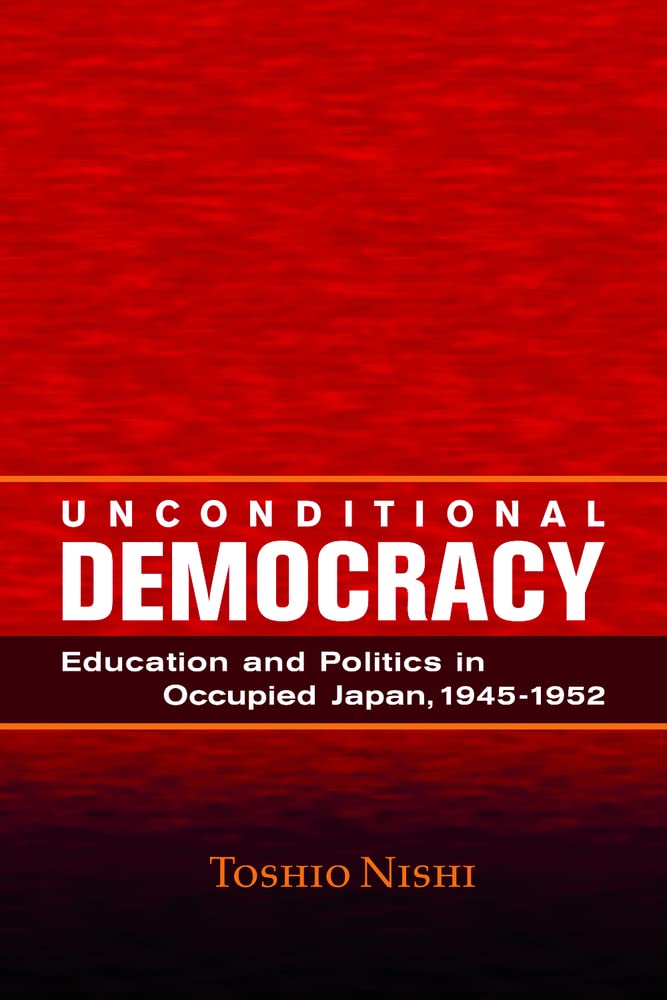
Unconditional Democracy: Education and Politics in Occupied Japan, 1945-1952 (Hoover Institution Press Publication) (Volume 244)
$15.00
by Toshio Nishi



The difficult mission of a regime change: Toshio Nishi gives an account of how America converted the Japanese mindset from war to peace following World War II. "A carefully reasearched survey of Japan under allied military occupation from August 1945 to the San Francisco Peace conference of 1952." Toshio Nishi is a research fellow at the Hoover Institution. From 1991 to the present, Nishi has been a distinguished guest professor at Reitaku University in Chiba, Japan, and from 2004 a graduate school professor at Nihon University in Tokyo. Unconditional Democracy Education and Politics in Occupied Japan 1945–1952 By Toshio Nishi Hoover Institution Press Copyright © 1982 Board of Trustees of the Leland Stanford Junior University All rights reserved. ISBN: 978-0-8179-7442-8 Contents Preface to the Paperback Edition, Editor's Foreword, Acknowledgments, Personal Introduction, PART ONE: FROM EMPIRE TO DEMOCRACY, Introduction to Part One, 1. An Overview of Prewar Japan, 2. Unconditional Surrender, 3. Mac Arthur's Japan, 4. Housecleaning, 5. Freedom of Thought in Public, 6. The New Constitution, PART TWO: FROM INDOCTRINATION TO EDUCATION, Introduction to Part Two, 7. The 1890 Rescript on Education, 8. Democracy Now or Never, 9. The United States Education Mission to Japan, 10. The Facade of Japanese Autonomy, PART THREE: THE PRICE OF PEACE, 11. The Red Purge, 12. The Peace Treaty, Summary and Conclusion, Notes, Selected Bibliography, Index, CHAPTER 1 An Overview of Prewar Japan The British industrial revolution of the eighteenth century precipitated the blossoming of state-supported capitalism in Europe. The American Revolution and the French Revolution triggered a profound ideological reorientation toward the governance of a nation state. But Japan under the Tokugawa Shoguns (1604–1867) chose to remain isolated from changes so drastic — and so hazardous. The western industrial nations, believing themselves enlightened, considered it their humanitarian obligation to propagate their new perspectives throughout the world. Although their intentions may have been virtuous, their behavior in Asia and Africa degenerated into European cultural chauvinism. The Western cultural superiority complex, supported by Western military superiority, served to justify imperialistic expansion. Aggressive Western mercantile activity along the Asian coastline disfigured the face of Asia. Many Japanese intellectuals were well aware of the British exploitation of India and China. The Japanese knew that they had no choice but to physically resist the West in order to avoid a debacle similar to the one their neighbors had suffered. The End of Isolation As early as 1844 King William II of the Netherlands (the only Western nation with which Japan traded during the nearly two hundred fifty years of isolation) warned of imminent Western gunboat diplomacy. He urged the Tokugawa Bakufu (Warrior Administration) to open the country. The Bakufu refused. In 1844, 1845, and 1846, British and French warships visited Nagasaki and requested commercial relations; so, too, did Commodore James Biddle of the American East Indian Fleet when he came to Uraga in 1846. Each time the Bakufu refused. Finally, in July 1853, Commodore Matthew C. Perry, special envoy of US president Millard Fillmore, arrived at Uraga with his imposing naval squadron. At gunpoint he demanded trade concessions from the Tokugawa Bakufu. The Bakufu, frightened by its own inability to fight back, asked Perry to return in a year for a formal reply, and then for the first time solicited opinions from local lords and officials. This action suggested the Bakufu's serious lack of confidence in its own ability to govern. Perry returned in January 1854 and successfully concluded the Treaty of Peace and Amity. Two ports were made accessible to American ships for fuel and provisions; and England, Russia, and the Netherlands soon acquired the same privileges. Four years later Townsend Harris, the first American consul, skillfully concluded the Treaty of Amity and Commerce with the Bakufu. This treaty introduced the concept of extraterritoriality to the Japanese people. England, the Netherlands, as well as this time France, and Russia, followed suit and concluded similar treaties. The Bakufu did not fully comprehend the practice of extraterritoriality. The differential treatment of foreigners, who were now immune from Japanese laws, and the resulting conflicts between Japanese and Westerners, soon caused bitter resentment among the Japanese. Extraterritoriality smacked of colonization. The Bakufu felt that the Western powers, by capitalizing upon Japanese ignorance of foreign affairs, had cheated. The series of concessions to the foreign powers revealed the Bakufu hegemony at bay. Such signs of weakness in turn encouraged the rebellious activities of young low-ranking samurai (the warrior class) who advocated the "restoration" of imperial rul