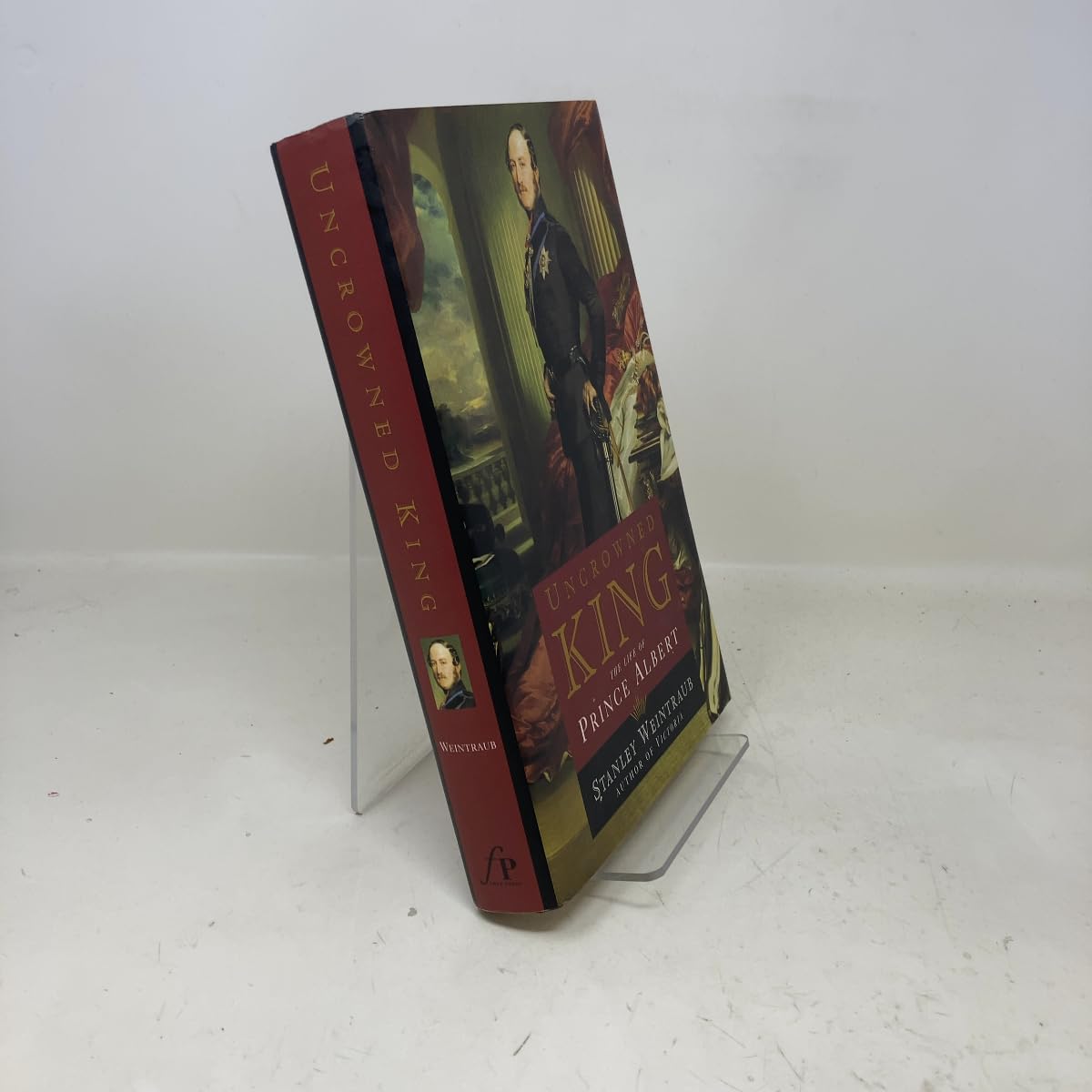



An author of Victoria: An Intimate Biography now turns to her often historically neglected husband, revealing his ambition and royal authority, significant political roles, and the marital strain between these two powerful rulers. 25,000 first printing. Tour. When the young, insignificant scion of an unremarkable German principality first came to England to serve as consort to the youthful Queen Victoria , no one could have guessed that he would grow to become one of Britain's great--if uncrowned--kings. Albert's life could not have been an easy one; a man of great intelligence, pride, and ambition, he was forced to move behind the scenes, playing major roles in running the Crimean War and working to keep Britain out of the Civil War being waged in the United States. He was interested in industry and technology, and worked to stage the Crystal Palace exhibition--the first World's Fair. Yet, while his wife adored him, his adopted people scorned him for his German accent, his foreign ways, and his covert activities as a surrogate ruler. Biographer Stanley Weintraub has penned acclaimed biographies on such renowned figures as Benjamin Disraeli and Queen Victoria, and in Uncrowned King he turns his attention to Prince Albert. Tapping previously unexplored sources, Weintraub chronicles every aspect of Albert's life--from the political to the sexual--in lively, accessible prose, sure to please even the most avid follower of the royal family. Weintraub (Shaw's People, LJ 5/15/96) is eminently qualified to write this book by virtue of his previous biographies of Victoria (LJ 1/87), Disraeli (LJ 9/1/93), and other important figures of Prince Albert's era. The depth and breadth of his knowledge inform this work throughout. There are no shocking revelations about Victoria's consort here but a well-researched and detailed portrait, which draws on accounts from Americans who met the prince and contemporary magazines and newspapers, including scandal sheets and satirical publications (Punch and others). The wealth of detail makes this more appropriate for the knowledgeable reader, but it is also accessible to the interested neophyte. A worthy addition to any library that does not have a recent biography of Prince Albert and for libraries that collect heavily in this area.?Jean E.S. Storrs, Enoch Pratt Free Lib., Baltimore Copyright 1997 Reed Business Information, Inc. A distinguished biographer of Queen Victoria demonstrates the political importance of her beloved husband. From the time of his marriage to Victoria in 1840 until his untimely death in 1861, Albert of Saxe-Coburg was never wholeheartedly accepted by the people of England. He always spoke German in private, and his public speeches were delivered in heavily accented English. A figure of fun in satirical periodicals such as Punch, he never received the civil or military honors that Victoria wanted for him. Weintraub (Disraeli, 1993; Victoria: An Intimate Biography, 1987; etc.) makes clear how much she adored him, how Albert bolstered her self-confidence, and how important their relationship was to the maintenance of the monarchy in the 19th century. Albert never usurped Victoria's role as monarch, but he took advantage of her repeated pregnancies, and of partisan shifts between Whig and Tory, to become acting monarch on occasion, and the most important adviser to the monarch on every occasion. A public figure who carved out a role as a promoter of science, technology, and educational reform, he achieved a public relations coup through his sponsorship of the famous Great Exhibition of 1851, a symbol of Britain's position as the world's dominant industrial nation. Albert's importance was underlined by Victoria's response after his death, when she put the monarchy in danger by virtually retiring from public life for nearly a decade. While establishing Albert's importance, Weintraub provides illuminating details of the private life and daily routine of the royal couple. Their strong physical attraction for each other and their mutual enthusiasm for eroticism in painting and sculpture were combined with a sincere commitment to higher moral standards at court and in public. While providing a window into the private lives of 19th- century royalty, Weintraub also makes a critical historical point about the adaptation of the monarchy to the demands of a more democratic age. -- Copyright ©1997, Kirkus Associates, LP. All rights reserved. Weintraub's book is as fascinating as his subject, partly because of what Albert did and partly because of what Weintraub doesn't do. He never claims too much. His Albert is human: he overworks, grumbles and makes mistakes. And Weintraub does not sentimentalize the royal romance.... Weintraub is at home in the period (his previous books include biographies of Victoria and Disraeli) and conveys nuances as easily as facts. -- The New York Times Book Review, Naomi Bliven Stanley Weintraub is Evan Pugh Professor Emeritus of Arts