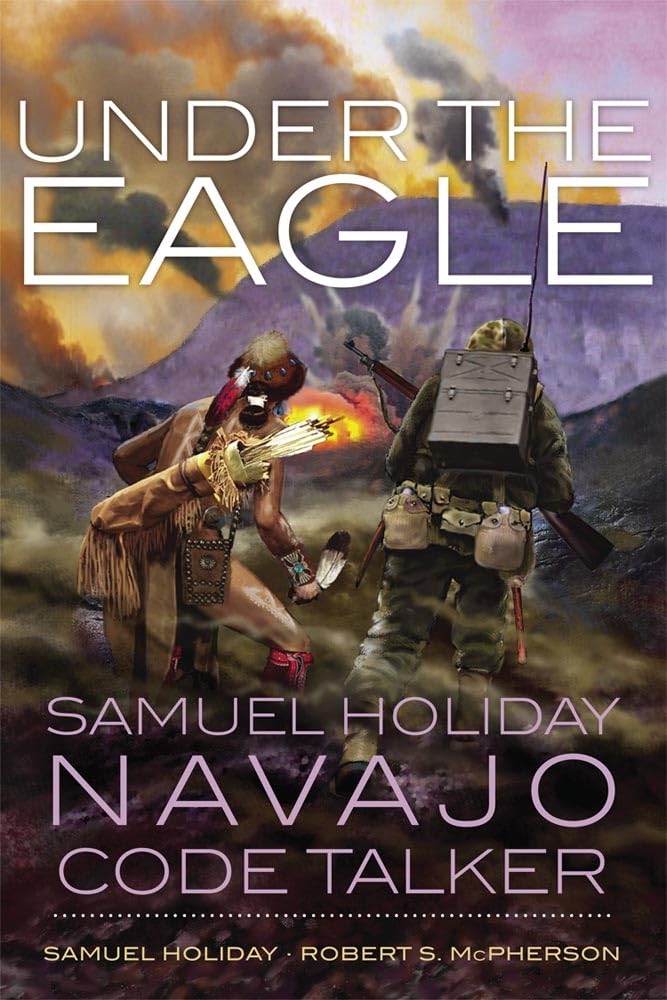



Samuel Holiday was one of a small group of Navajo men enlisted by the Marine Corps during World War II to use their native language to transmit secret communications on the battlefield. Based on extensive interviews with Robert S. McPherson, Under the Eagle is Holiday’s vivid account of his own story. It is the only book-length oral history of a Navajo code talker in which the narrator relates his experiences in his own voice and words. Under the Eagle carries the reader from Holiday’s childhood years in rural Monument Valley, Utah, into the world of the United States’s Pacific campaign against Japan—to such places as Kwajalein, Saipan, Tinian, and Iwo Jima. Central to Holiday’s story is his Navajo worldview, which shapes how he views his upbringing in Utah, his time at an Indian boarding school, and his experiences during World War II. Holiday’s story, coupled with historical and cultural commentary by McPherson, shows how traditional Navajo practices gave strength and healing to soldiers facing danger and hardship and to veterans during their difficult readjustment to life after the war. The Navajo code talkers have become famous in recent years through books and movies that have dramatized their remarkable story. Their wartime achievements are also a source of national pride for the Navajos. And yet, as McPherson explains, Holiday’s own experience was “as much mental and spiritual as it was physical.” This decorated marine served “under the eagle” not only as a soldier but also as a Navajo man deeply aware of his cultural obligations. Samuel Holiday, born in 1924, now lives in Kayenta, Arizona, at the southern end of Utah’s Monument Valley. He is one of the few surviving Navajo code talkers. Robert S. McPherson is Professor of History Emeritus at Utah State University–Blanding Campus. He is the author or coauthor of numerous books on Navajo history and the history of the Southwest, including Under the Eagle: Samuel Holiday, Navajo Code Talker (with Samuel Holiday) and Viewing the Ancestors: Perceptions of the Anaasází, Mokwic, and Hisatsinom . Under the Eagle Samuel Holiday, Navajo Code Talker By Samuel Holiday, Robert S. McPherson UNIVERSITY OF OKLAHOMA PRESS Copyright © 2013 University of Oklahoma Press, Norman, Publishing Division of the University All rights reserved. ISBN: 978-0-8061-4389-7 Contents List of Illustrations, Acknowledgments, Introduction. Decoding the Past: Origin and Context of Under the Eagle, Chapter One. Establishing Beliefs: Birth and Early Years, Chapter Two. Diné Language and Control: Boarding School and Enlistment, Chapter Three. Training and Protection: Preparation for War, Chapter Four. Traditional and Contemporary Combat: First Encounter: Kwajalein, Chapter Five. The Hard Edge of Combat: Saipan and Tinian: Protection Made Tangible, Chapter Six. The Final Crucible: Iwo Jima: The Code Talkers' Triumph, Chapter Seven. After the War: A Different Kind of Battle, Chapter Eight. Recognition and Reconciliation: Samuel and the Code Talkers Association, Notes, Bibliography, Index, CHAPTER 1 ESTABLISHING BELIEFS Birth and Early Years THE TWINS: PREPARING FOR LIFE In the palm of time following the emergence of the Holy People from the worlds beneath, the gods roamed the earth, making laws and creating things helpful for the future. They formed two women—one from turquoise the other from white shell, Changing Woman (Asdz[??][??]n nádleehé) and White Shell Woman (Yoolgai asdz[??]án)—who grew in miraculous ways, one day equaling a year of human life. Before long they were mature females who conceived through the supernatural means of sunlight and water, producing two boys. The newborns were foreordained to "take care of the ruination on the earth and to kill all of the monsters after which peace would be restored." These children, like their mothers, grew rapidly so that in four days they were twelve years old and ready for instruction. Talking God (Haashch'éélti'i) and Water Sprinkler God (Tó Neinilii) invited them to a long race, but by the time it was half completed the Holy People were running behind the boys, scourging them with mountain mahogany branches, urging them to move faster. Talking God won the race, promising to return in four days to give the boys another opportunity to compete. The lads were sore, tired, and discouraged, wondering how they could ever triumph against the powers of Talking God and Water Sprinkler. The Holy Wind (Nil'chi), which had been placed on their ear folds, learned of their concern and told them that if they practiced, they could beat the older men, because youth was on their side. For four days the boys trained hard, maturing into strong young competitors. When the race started, the confident runners began passing the two deities so that by the time the race around a mountain was half completed, the roles had reversed and the boys were behind the gods, scourging their backs and encouraging