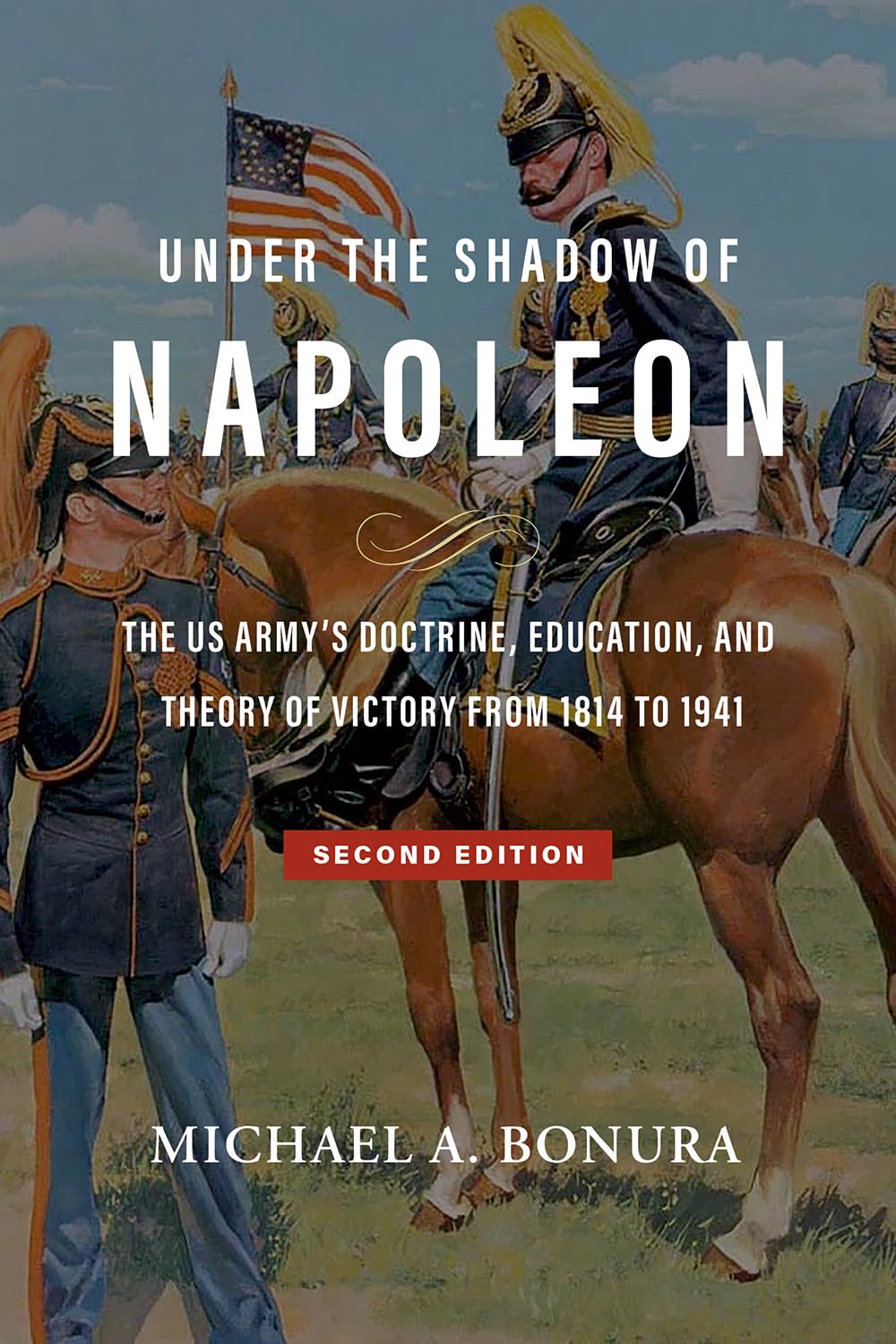
Under the Shadow of Napoleon: The US Army's Doctrine, Education, and Theory of Victory from 1814 to 1941. Second Edition (Volume 9) (American Military
$34.95
by Michael A Bonura



The way an army understands warfare and how to achieve victory on the battlefield has a tremendous impact on its organization, equipment, training, and doctrine. The central ideas of that understanding form an army’s Theory of Victory, which informs how that army fights. From the disasters of the War of 1812, Winfield Scott ensured that America adopted a series of ideas formed in the crucible of the French Revolution and perfected by Napoleon Bonaparte as the United States Army’s Theory of Victory. These French ideas dominated American warfare on the battlefields of the Mexican-American War, the American Civil War, the Spanish-American War, and World War I. The American Army remained committed to these ideas until the successes of German blitzkrieg led George C. Marshall to orchestrate the adoption of a different set of ideas that formed a different Theory of Victory in 1940. The US Army’s cycle of adopting a Theory of Victory, perfecting it, and replacing it strongly mirrored the cycle of the scientific paradigm outlined by Thomas Kuhn. The French influence in this period is remarkably consistent throughout the Army regulations and doctrine and officer education at West Point, Fort Leavenworth, the Army War College, and on American battlefields across the globe. Understanding the French ideas that dominated American warfare provides a new context to the military actions, policies, and decisions from 1814 through 1941. That new context informs more accurate analyses and helps provide more satisfying answers to the questions of American military history. This second edition is updated from the first edition of 2012 with a significant expansion of primary sources from the curriculum of the Command and General Staff College at Fort Leavenworth. Michael A. Bonura offers new analysis of how the Theory of Victory was adopted, refined, and replaced, which will inform both the study of such transitions and the attempt to do so in the future. Praise for the first edition: “This thought-provoking and well-researched book is essential for anyone interested in the US Army, the evolution of military doctrine, and, above all, the role that West Point has played in the Army’s development.”― Robert Citino, National WWII Museum “Bonura makes a provocative argument for the primacy of French and Napoleonic military thinking on American tactical development prior to World War II. His research provides convincing evidence of both the intellectual conservatism and the fixation on battle that have shaped the Army’s way of war.”― Brian M. Linn , Texas A&M University Praise for the second edition: “The shift in methodology from its previous iteration, from an emphasis on ‘Ways of Warfare’ to ‘Theories of Victory,’ gives it a fresh feel. As an intellectual history that explores the impact of ideas on military theory, doctrine, and application, the significance of this work is great.”― Martin G. Clemis , US Army Command and General Staff College “This is a mature work, a revised edition. Bonura makes a strong case against American tactical exceptionalism in the early republic.”― Ricardo A. Herrera , US Army War College “Bonura delivers an essential study that examines the intellectual foundations of the American military. Rather than treating Napoleon as a distant icon of European warfare, Bonura demonstrates―carefully and convincingly―that Napoleonic ideas exerted a sustained, institutional influence on American military doctrine, education, and battlefield theory for more than a century. The importance of this work lies in its long-term perspective. Bonura moves beyond episodic influence or superficial admiration and instead reveals how French-derived concepts of the offensive, organization, tactics, and professional education became embedded in American military institutions. By framing this continuity as a ‘Theory of Victory,’ he explains why the US Army was able to adapt to technological and organizational change while remaining intellectually consistent across conflicts as diverse as the Mexican-American War, the Civil War, World War I, and the interwar period. Napoleon’s shadow, as Bonura shows, was not merely cultural or symbolic; it structured how American officers learned to think about winning wars.”― Alexander Mikaberidze , author of The Napoleonic Wars: A Global History MICHAEL A. BONURA is an assistant professor in the Department of Joint, Interagency, and Multinational Operations at the US Army’s Command and General Staff College, where he teaches military officers about strategy, policy, and joint operations. He graduated from the US Military Academy in 1997, received his PhD in history from Florida State University in 2008, and was an assistant professor of history at the US Military Academy from 2006 to 2009. Bonura retired from the US Army as a colonel after twenty-five years of service.