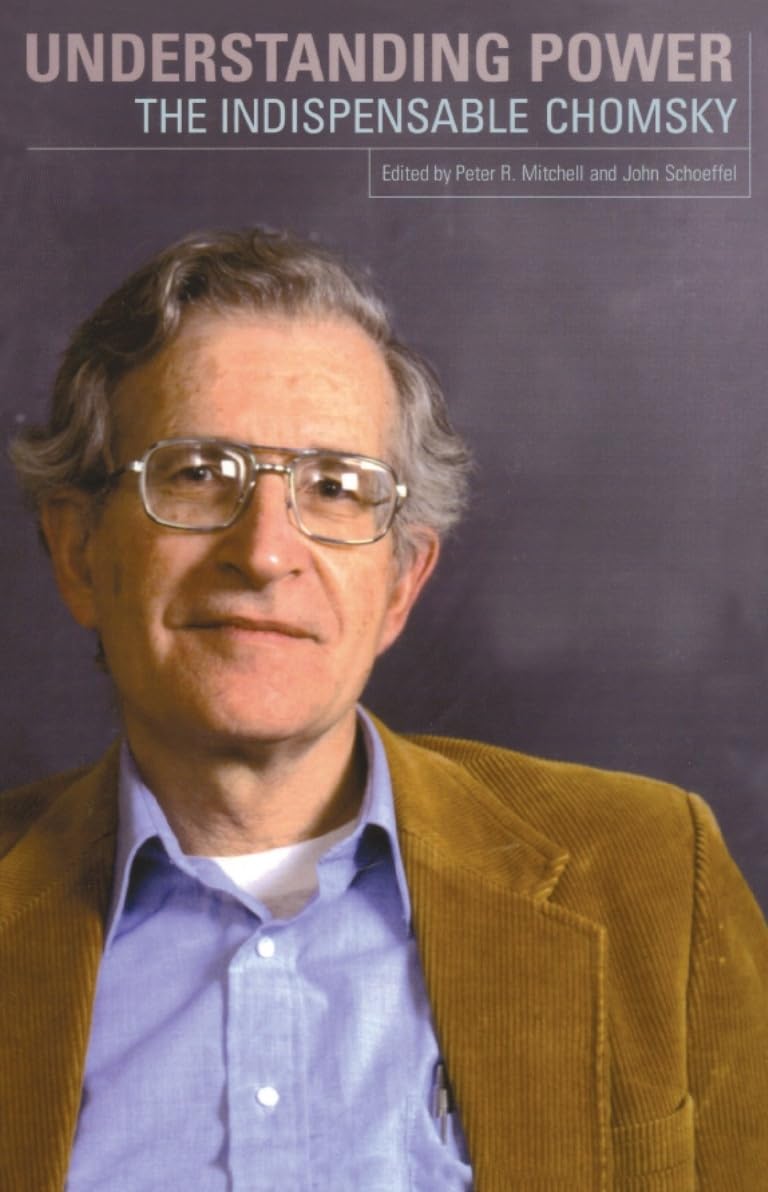



The perfect introduction to the wide-ranging thought of “the most widely read voice on foreign policy on the planet” ( The New York Times Book Review ) “Chomsky ranks with Marx, Shakespeare and the Bible as one of the ten most quoted sources in the humanities.” — The Guardian Noam Chomsky remains one of our preeminent public intellectuals, a thinker whose works on international politics and the media are read worldwide. In Understanding Power , Peter Mitchell and John Schoeffel have assembled the best of Chomsky’s talks on the politics of power. In a series of enlightening and wide-ranging discussions, all published here for the first time, Chomsky radically interprets the events of the late twentieth century, covering topics from foreign policy during Vietnam to the attacks on welfare under the Clinton administration. And as he elucidates the connection between America’s imperialistic foreign policy and the decline of domestic standards of living, Chomsky also establishes a theory of social change. Featuring his classic criticisms of media in capitalist society, as well as U.S. foreign and domestic policy, Understanding Power offers a sweeping critique of the world around us and is the definitive Chomsky. Characterized by Chomsky’s accessible and informative style, this is the ideal book for those new to his work as well as for those who have been reading for years. Click here to download a PDF of the explanatory footnotes compiled by the editors. Understanding Power is a wide-ranging collection of transcribed and previously unpublished discussions and seminars (from 1989 to 1999) with sociopolitical analyst Noam Chomsky. The chapters, each covering discrete sessions with Chomsky, arrive in a question-and-answer format that at times becomes delightfully contentious. Chomsky holds forth on such disparate topics as American third-party politics, the stifling of true dissent, the illusion of a muscular media, heavy-handed American imperialism (from Southeast Asia to Mexico), a dysfunctional and self-destructing United States political left, the gilding of the Kennedy and Carter administrations, and the impotent state of labor unions. The relatively accessibility of Understanding Power is a welcome balance to Chomsky's often formidable scholarly writings. This is a book best taken in doses: a sort of bedside reader. --H. O'Billovitch MIT-based Chomsky revolutionized linguistics in the late Fifties, but for nearly as long he has been better known as an energetic and constructive debunker of American establishment politics and behavior. However, the current Chomsky contributes nothing to the legacy he established decades ago. These two most recent productions do not reveal systematic efforts to sustain or develop any aspect of his prolifically expressed critique; indeed, they are not so much authored as collaged, with Chomsky's sanction, from talks, after-talk Q&As, and interviews with generally converted interlocutors. Understanding Power draws mainly on vintage utterances from the Nineties, and its most penetrating passage takes on, of all pressing matters, literary theory. Chomsky, who is relentless in condemning the media as incapable of any function other than converting the masses to elite desires, just as relentlessly samples mainstream reporting sources for instances of corporate and government ill doings. In trying to illustrate that he is not a crude conspiracy theorist, he conveys the opposite impression. The shorter 9-11 could not have been planned, of course, though it mostly consists of interviews conducted while the calendar still read September, suggesting both the urgency Chomsky felt to get his perspective on the record and his utter disinclination to reexamine any of his cemented opinions about world affairs. Chomsky condemns the attacks specifically and then suggests that the deaths are entirely the responsibility of capitalist globalization, which nonetheless he asserts is irrelevant to the September 11 actors. However, consistency is even less a priority for Chomsky than humility. Apparently, Chomsky believes that he has discovered the concept of blowback, not to mention imbalance in coverage of the perpetual Israeli-Palestinian murder-and-misery fetish. For him, a direct line runs from Reagan's mining of Nicaragua's harbors to the flying of commercial airliners into buildings. 9-11 is a worthwhile purchase for public libraries intent on demonstrating (or risking) balance; Understanding Power is not half as useful as Chomsky's earlier, authentic innovations in political literature, especially Manufacturing Consent (coauthored with Edward Herman). Libraries truly wishing to ensure representation of the most lucid nonconventional opinion should first check that their subscriptions to the Nation a proud carrier of Chomsky for 40 years are current. Scott H. Silverman, Bryn Mawr Coll. Lib., PA Copyright 2002 Reed Business Information, Inc. "Chomsky ranks with Marx, Shakespeare, and