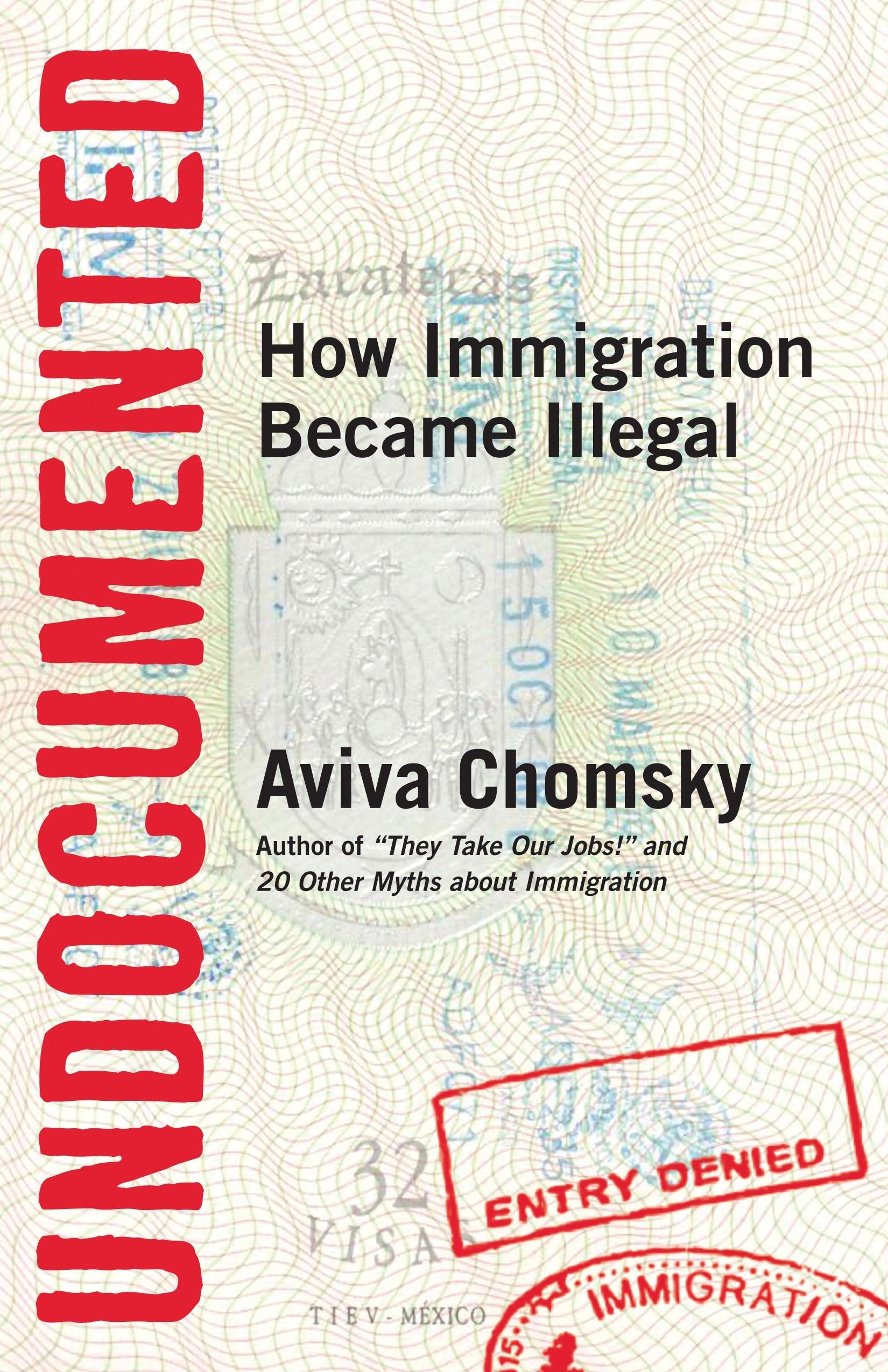



A longtime immigration activist explores what it means to be an undocumented American in this “impassioned and well-reported case for change ” ( New York Times ). In this illuminating work, immigrant rights activist Aviva Chomsky shows how “illegality” and “undocumentedness” are concepts that were created to exclude and exploit. With a focus on US policy, she probes how people, especially Mexican and Central Americans, have been assigned this status—and to what ends. Blending history with human drama, Chomsky explores what it means to be undocumented in a legal, social, economic, and historical context. The result is a powerful testament of the complex, contradictory, and ever-shifting nature of status in America. “An impassioned and well-reported case for change . . . Chomsky ably lays out just how brutal life can be for the undocumented.” — New York Times Sunday Book Review “Undocumented adds smart, new, and provocative scholarship to the immigration debate.” — Los Angeles Review of Books “From the first page to the last, Undocumented is to immigrant rights movement what We Charge Genocide was to the African American movement—a dossier that sets aside quibbles about whether immigrants contribute to the US economy or not, whether immigrants speak English or not and gives flesh to the slogan, 'Immigrant rights are human rights.' A clear-headed and smart book that locates the struggles of immigrants squarely in the struggles for human rights. Nothing less is to be accommodated, and much more is to be imagined.” —Vijay Prashad, author of The Poorer Nations: A Possible History of the Global South “Professional in her scholarship, Chomsky has written a book that will be relevant to those who do not share her position as well as to those who do.” — Publishers Weekly “Dares to call the [immigration] problem ‘manufactured,’ one that could be solved with the stroke of a pen.” — Ms. Magazine Aviva Chomsky is professor of history and coordinator of Latin American Studies at Salem State University. The author of several books, Chomsky has been active in Latin American solidarity and immigrants’ rights issues for over twenty-five years. She lives in Salem, Massachusetts. Introduction When people say, “What part of ‘illegal’ don’t you understand?” they imply that they, in fact, understand everything about it. They take illegality to be self-evident: there’s a law, you break the law, that’s illegal. Obvious, right? Actually, illegality is a lot more complicated than that. Laws are made and enforced by humans, in historical contexts, and for reasons. They change over time, and they are often created and modified to serve the interests of some groups—generally the powerful and privileged—over others. Most of the citizens who brag that their ancestors came here “the right way” are making assumptions based on ignorance. They assume that their ancestors “went through the process” and obtained visas, as people are required to do today. In fact, most of them came before any legal process existed—before the concept of “illegality” existed. THE INVENTION OF ILLEGALITY Illegality as we know it today came into existence after 1965. In the decades before 1965, the media rarely depicted immigration in negative terms. Nor did the public or Congress consider it a problem in need of legislation. By the 1970s, though, the demonization of immigrants—in particular, Mexican and other Latino immigrants—and the issue of “illegal immigration” were turning into hot-button issues. There are some particular historical reasons for these changes. Some are economic. The global and the domestic economies underwent some fundamental structural changes in the late twentieth century, changes we sometimes refer to as “globalization.” Some analysts argued that globalization was making the world “flat,” and that with the spread of connection, technology, and communication, old inequalities would melt away. Others believed that new inequalities were becoming entrenched—that a “global apartheid” being imposed, separating the Global North from the Global South, the rich from the poor, the winners in the new global economy from the losers. I’ll go more into depth about these changes and show how they contributed to a need for illegality to sustain the new world order. The second set of changes is ideological and cultural. Like the big economic shifts, ideological and cultural changes are a process; they can’t necessarily be pinpointed to a particular date or year. I use 1965 as a convenience, because that’s when some major changes were enacted in US immigration law that contributed to creating illegality. But those changes responded to, and contributed to, the more long-term economic and ideological shifts that were occurring. In the cultural realm, overt racism was going out of fashion. Civil rights movements at home and anti-colonial movements abroad undercut the legitimacy of ra