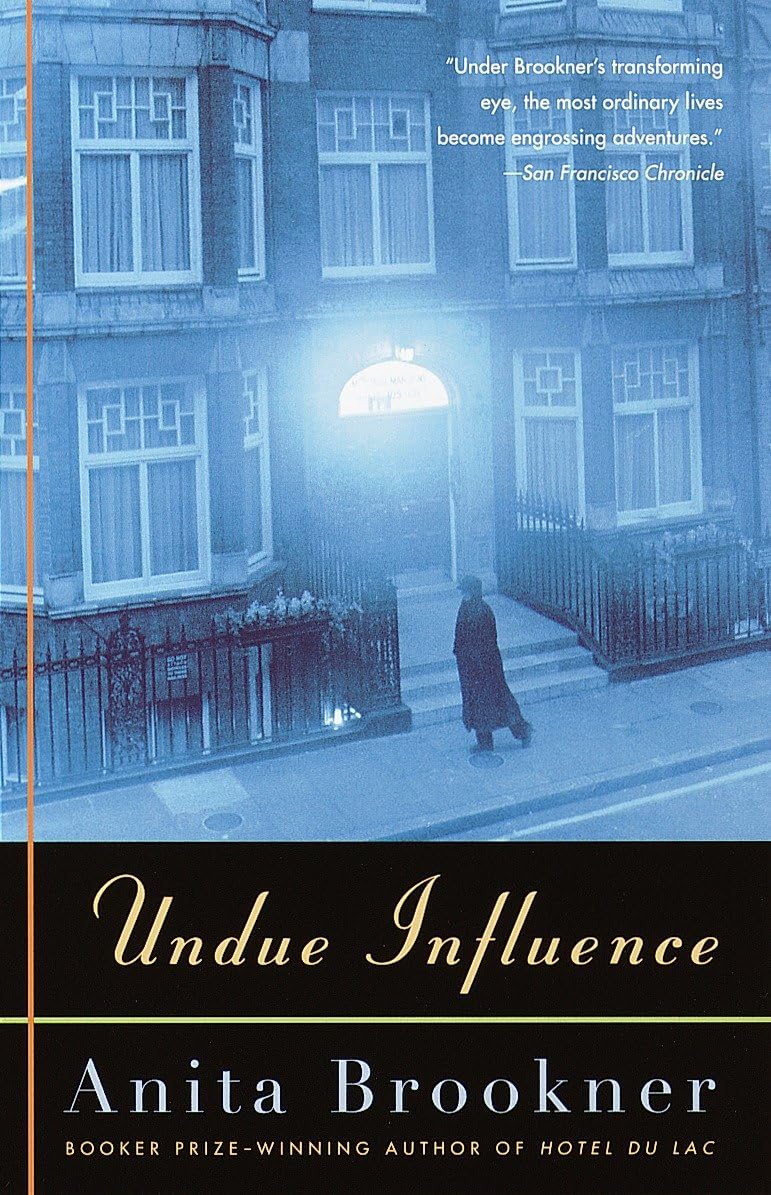



In Undue Influence , acclaimed novelist Anita Brookner proves once again that even in the most closely circumscribed of lives, hearts can venture into unknown-and potentially explosive-territory. Claire Pitt is nothing if not a practical young woman, living a life in contemporary London that is to all appearances placid, orderly and consciously lacking in surprise. And yet Claire's tangled interior life gives the lie to that illusion. She is prone to vivid speculation about the lives of others, and to fantasies about her own fate that lead her into a courtship so strange that even she wonders at its power to compel her. Martin Gibson and his chronically ill wife Cynthia come to depend on Claire to an extent that is nothing short of baffling, and yet Claire becomes ever bolder in her pursuit of their acquaintance-and, ultimately, of Martin's elusive affections. The result, a potent tale of urban loneliness and the chance intersections that assuage it, constitutes one of Brookner's finest and most psychologically acute achievements. Praise for Anita Brookner "Brookner's impeccable craftsmanship and worldly irony make each of her novels memorable."-- Publishers Weekly "One of the very few contemporary authors whose novels deserve to live on well into the next century."-- The Washington Post Book World "Brookner's control over the material is absolute."--Jane Smiley "Anita Brookner works a spell on the reader; being under it is both an education and a delight."-- The Washington Post Book World "If Henry James were around, the only writer he'd be reading with complete approval would be Anita Brookner."-- The New York Times Book Review "Brookner is a writer of great skill and precision. Passages of brilliant writing abound, hard-won insights that startle us with Brookner's clarity and succinct intelligence."--Michael Dorris, Los Angeles Times Book Review ue Influence, acclaimed novelist Anita Brookner proves once again that even in the most closely circumscribed of lives, hearts can venture into unknown-and potentially explosive-territory. Claire Pitt is nothing if not a practical young woman, living a life in contemporary London that is to all appearances placid, orderly and consciously lacking in surprise. And yet Claire's tangled interior life gives the lie to that illusion. She is prone to vivid speculation about the lives of others, and to fantasies about her own fate that lead her into a courtship so strange that even she wonders at its power to compel her. Martin Gibson and his chronically ill wife Cynthia come to depend on Claire to an extent that is nothing short of baffling, and yet Claire becomes ever bolder in her pursuit of their acquaintance-and, ultimately, of Martin's elusive affections. The result, a potent tale of urban loneliness and the chance intersections that assuage it, constitutes one of Brookner's finest a In Undue Influence, acclaimed novelist Anita Brookner proves once again that even in the most closely circumscribed of lives, hearts can venture into unknown-and potentially explosive-territory. Claire Pitt is nothing if not a practical young woman, living a life in contemporary London that is to all appearances placid, orderly and consciously lacking in surprise. And yet Claire's tangled interior life gives the lie to that illusion. She is prone to vivid speculation about the lives of others, and to fantasies about her own fate that lead her into a courtship so strange that even she wonders at its power to compel her. Martin Gibson and his chronically ill wife Cynthia come to depend on Claire to an extent that is nothing short of baffling, and yet Claire becomes ever bolder in her pursuit of their acquaintance-and, ultimately, of Martin's elusive affections. The result, a potent tale of urban loneliness and the chance intersections that assuage it, constitutes one of Brookner's finest and most psychologically acute achievements. Anita Brookner was born in London and, apart from several years in Paris, has lived there ever since. She trained as an art historian and taught at the Courtauld Institute of Art until 1988. At first the man in the basement looked to me like an older and more careworn version of the man with bowed head in the cafe in Marylebone Lane who was not Mrs Hildreth's son and for whom I had imagined a whole illusory history. (I am not infallible.) This man had the same air of lassitude, which I detected in spite of his polished appearance. He was formally dressed for his visit to a dusty bookshop, although he could not have known that it would be quite so dusty. He wore a finely tailored grey suit with a faint chalk stripe, a very white shirt, and highly polished shoes. I think it was the brilliantly laundered shirt that led me to make the comparison with Mrs Hildreth's putative son, as if this man too had emerged from the hands of a watchful woman and set out, fully caparisoned, to encounter the hazards of the ordinary working day. Except that this