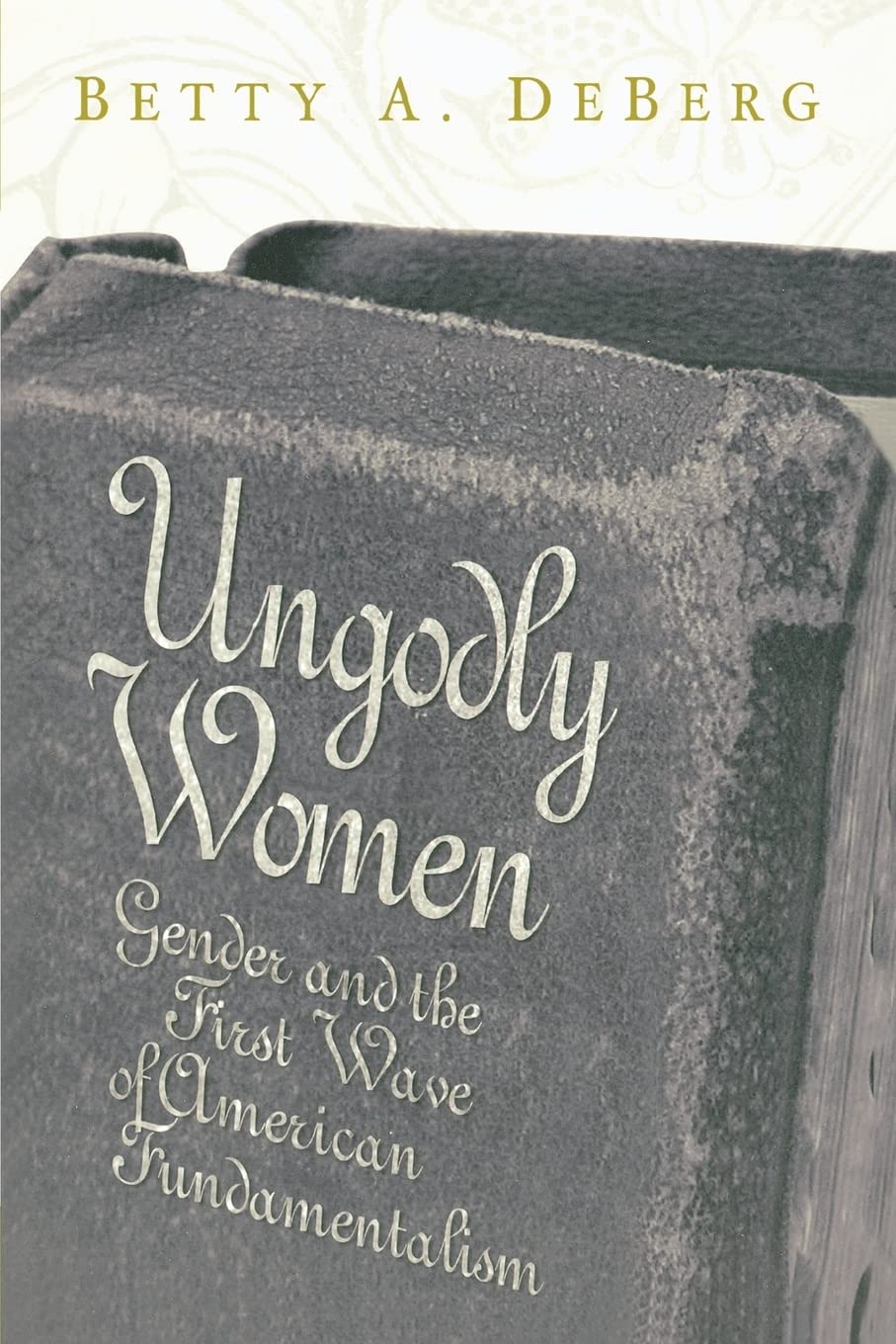
Ungodly Women: Gender and the First Wave of American Fundamentalism (Three Indispensable Studies of American Evangelicalism)
$26.49
by Betty A DeBerg



Since the rise of the Religious Right in the 1980s, analysis of American fundamentalism has neglected a large body of literature about gender roles and social conventions. In 1990, Betty A. DeBerg's groundbreaking study filled that important gap, analyzing the roots and character of fundamentalism in light of rapid changes and severe disruptions in gender-role ideology and actual social behavior in America between 1880 and 1930. Since then, Ungodly Women: Gender and the First Wave of American Fundamentalism has remained the standard source on the subject. Unlike other interpreters, DeBerg convincingly argues that these concerns were central to American fundamentalism. Advance Praise for Ungodly Women: "[Betty DeBerg's] focus on early fundamentalist concerns to preserve Victorian family values and sexual mores helps round out our understanding of the dynamics of the early movement and its continuities with recent fundamentalism."George Marsden, University of Notre Dame "DeBerg's 1990 work announced with clarity what the primary sources had long been trumpeting, if scholars had only noticed that the rise of American fundamentalism was inextricably tied to men's anxieties about retaining their dominant status over women. No book has ever shown with greater precision (or volume) of documentation just how thoroughly saturated with gender concerns the literature of early fundamentalism was.... Ungodly Women is today what it was at its original publication in 1990: the best examination of gender and fundamentalism ever written."Valarie Ziegler, DePauw University As regards both academic historians and popular understandings since the rise of the Religious Right in the 1980s, analysis of American fundamentalism has neglected a large body of literature about gender roles and social conventions. Betty A. DeBerg's groundbreaking study fills that important gap, analyzing the roots and character of fundamentalism in light of rapid changes and severe disruptions in gender-role ideology and actual social behavior in American between 1880 and 1930. Unlike interpreters such as George Marsdenwho has seen the contemporary Religious Right's concerns over feminism, abortion, and the breakdown of the family as recent developmentsDeBerg convincingly argues that these concerns were central in the "first wave of American fundamentalism." Betty A. DeBerg (Ph.D., Vanderbilt University) is professor of Religion and head of the department of Philosophy and Religion at the University of Northern Iowa in Cedar Falls. Used Book in Good Condition