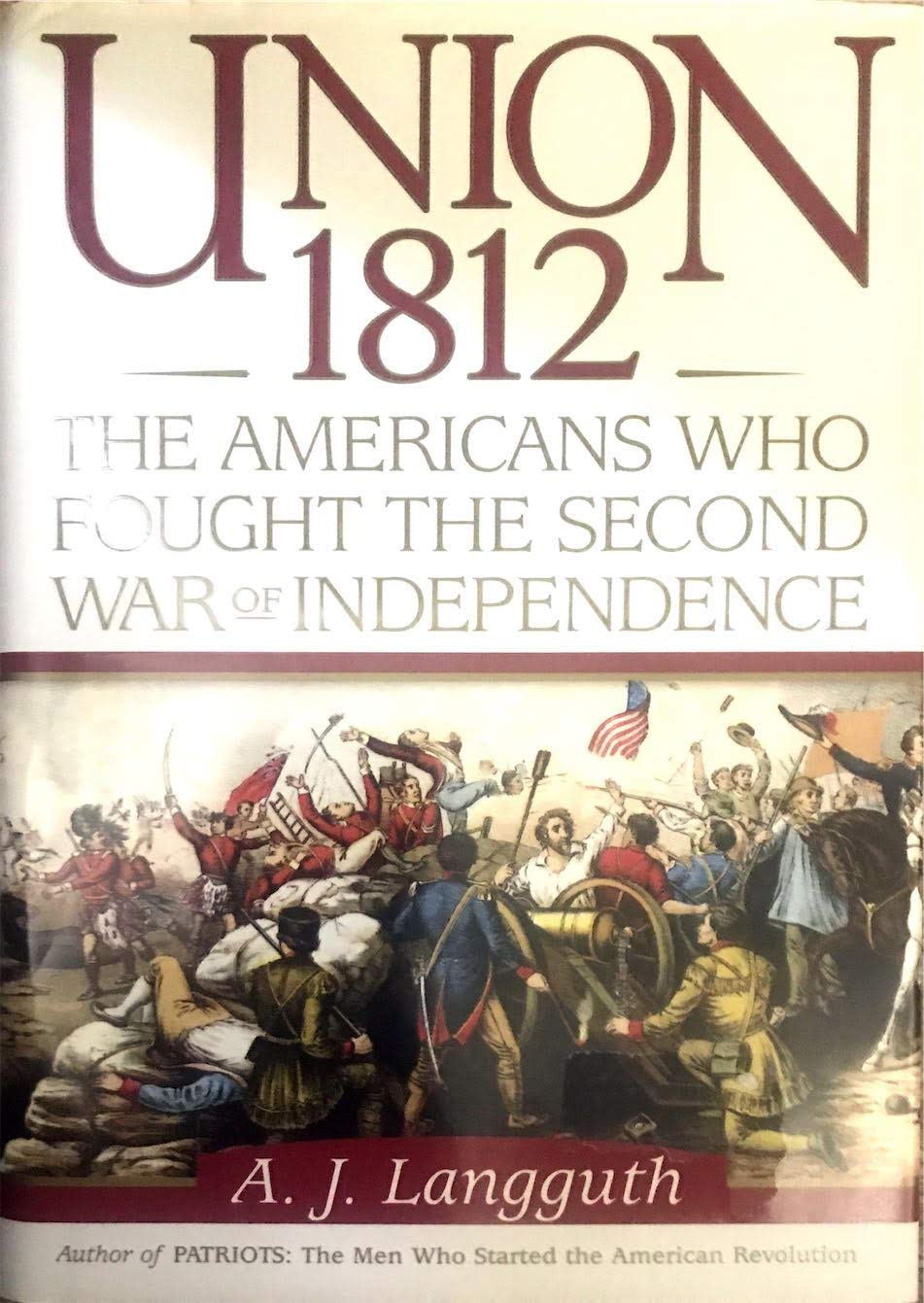
Union 1812: The Americans Who Fought the Second War of Independence
$11.98
by A.J. Langguth



Langguth (journalism, U. of Southern California), author of Patriots: The Men Who Started the American Revolution, provides a narrative of the War of 1812, tracing what led up to it, beginning with the resignation of George Washington from the Continental Army in 1783, to the peace treaty in 1815 and aftereffects up to 1861. He discusses roles played by John Adams, Thomas Jefferson, James Madison, Andrew Jackson, Tecumseh, and others, and relates the details of what happened during the war. Annotation ©2007 Book News, Inc., Portland, OR (booknews.com) Interest in the War of 1812 has revived, and Langguth contributes his narrative to a body of recent popular books by Robert Remini ( The Battle of New Orleans , 1999), Walter Borneman ( 1812 , 2004), and Ian Toll ( Six Frigates , 2006). The salient features of Langguth's recounting are, first, a summary history of America's frictions with Britain during the presidencies of Washington, Adams, Jefferson, and Madison, and, second, an emphasis on military leaders of the war itself. Titling most chapters after a president or a military officer, Langguth details the two decades preceding the War of 1812, in which the permanence of the Union was open to question, wars with Indians periodically erupted on the frontier, and the British navy harassed American trade. These issues conflated into the war, whose battles around the Great Lakes, Chesapeake Bay, and the Gulf Coast Langguth generally presents from the viewpoint of the commanders on the scene. Langguth gives a good accounting of the personalities in charge of the overall conflict. Gilbert Taylor Copyright © American Library Association. All rights reserved On Aug. 8, 1805, Zebulon Pike was dispatched from St. Louis to find the headwaters of the Mississippi River. For eight months and 22 days, this young explorer -- his small party's supplies crammed on keelboats and canoes -- planted American flags along the river in present-day Iowa, Wisconsin and Minnesota. The detailed journals Pike kept on the trek are bracing, recounting his attempts to cope with broken sleds, waterfalls, frostbite and starvation. Later, he was ordered west of the Mississippi by the Jefferson administration; his mission was to locate the headwaters of the Arkansas and Red rivers. Along the way he "discovered" Pike's Peak and was arrested in Santa Fe by Spanish authorities. Eventually, he made his way back to Natchitoches, Tex., where he encountered an American flag. "Language cannot express the gayety of my heart," he wrote on July 1, 1807, "when I once more behold the standard of my country wave aloft!" If there is a central theme to A.J. Langguth's finely written Union 1812, it's about the reach of that flag -- about how contentious the debate was over where the Stars and Stripes would fly following the American Revolution, in both the Great Lakes region and the Louisiana Territory. Framed as a sequel to Patriots, Langguth's bestselling book on the Revolution, Union 1812 seamlessly weaves together capsule biographies of historical heavy-hitters -- including Thomas Jefferson, John Adams, John Quincy Adams, James Madison and James Monroe -- as they grapple with border disputes. This makes for popular history at its most accessible, full of colorful anecdotes and pithy quotes. Many academics will cringe at Langguth's breezy prose and thumbnail sketches. They shouldn't. He practically brings the War of 1812 to life again, a literary accomplishment that would have made the old Yale diplomatic historian Samuel Flagg Bemis proud. Reading Langguth makes you pine to learn more about Isaac Brock, Tecumseh and John Armstrong Jr., among a dozen other central figures. "Historians differ on the best way to approach the past," Langguth writes. "The United States may have been carried forward on swift economic and political currents, but perhaps we may understand our history best by watching individual men and women as they struggle to keep afloat." Langguth, a professor emeritus of journalism at the University of Southern California, argues that defeating the British at Yorktown was easier than governing the new country. Ominous differences regarding taxes, trade and slavery loomed over the original 13 states. Sectional strife kept the country teetering on the brink of anarchy. At any minute, the Union seemed poised to short-circuit. Langguth details how George Washington kept the United States together despite setbacks such as the Whiskey Rebellion, the Genet Affair and Jay's Treaty. Union 1812, in fact, is yet another confirmation that Washington -- not Jefferson or Hamilton -- was the indispensable man in the forging of our nation. The power of Washington's Farewell Address of 1796, for example, still reverberates today. Besides his famous warning against "permanent alliances," he also urged his fellow citizens to "moderate the fury of party spirit, to warn against the mischief of foreign intrigue, to guard against the impostures of pretended