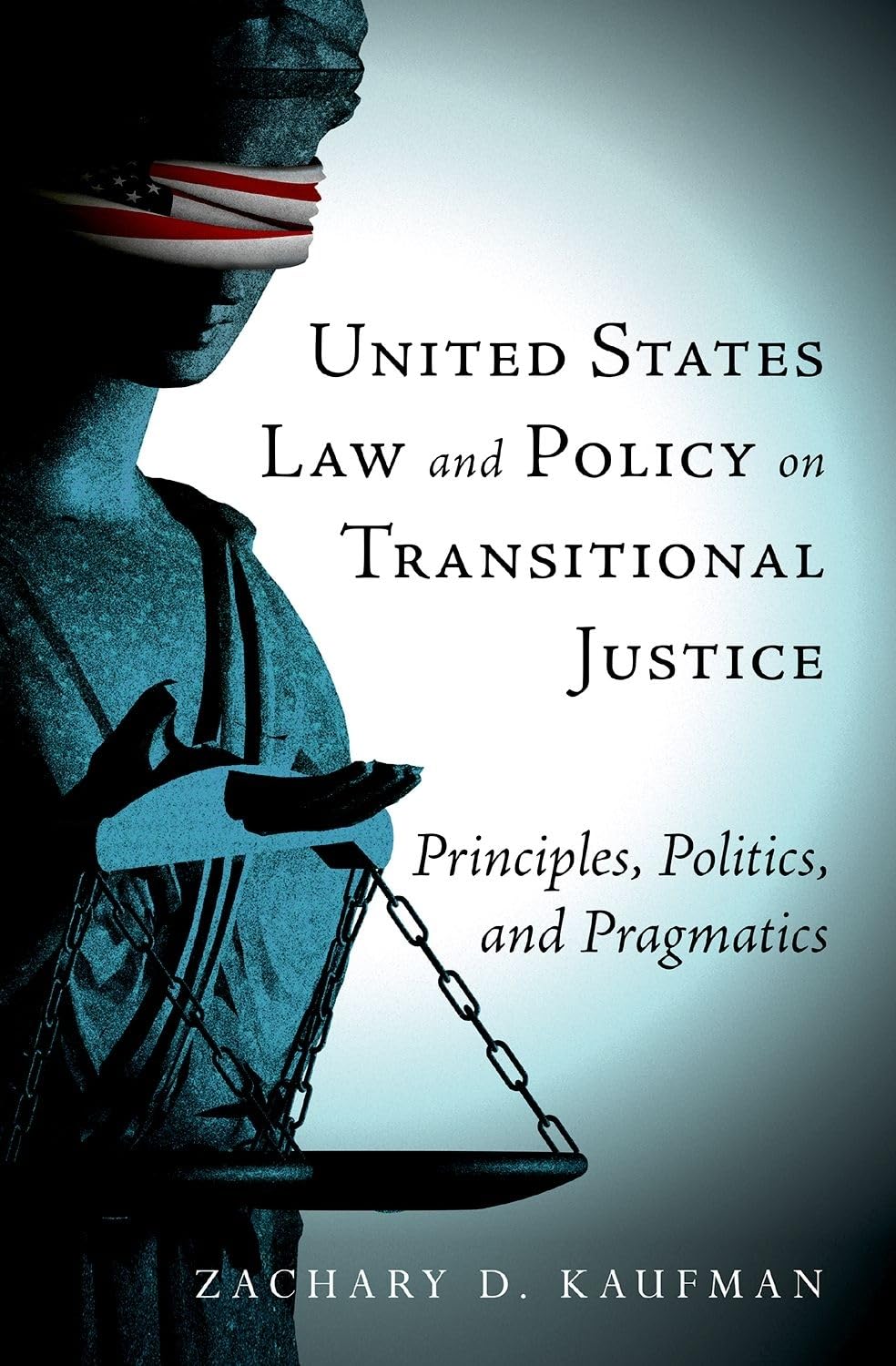
United States Law and Policy on Transitional Justice: Principles, Politics, and Pragmatics
$46.99
by Zachary D. Kaufman



In United States Law and Policy on Transitional Justice: Principles, Politics, and Pragmatics , Zachary D. Kaufman explores the U.S. government's support for, or opposition to, certain transitional justice institutions. By first presenting an overview of possible responses to atrocities (such as war crimes tribunals) and then analyzing six historical case studies, Kaufman evaluates why and how the United States has pursued particular transitional justice options since World War II. This book challenges the "legalist" paradigm, which postulates that liberal states pursue war crimes tribunals because their decision-makers hold a principled commitment to the rule of law. Kaufman develops an alternative theory-"prudentialism"-which contends that any state (liberal or illiberal) may support bona fide war crimes tribunals. More generally, prudentialism proposes that states pursue transitional justice options, not out of strict adherence to certain principles, but as a result of a case-specific balancing of politics, pragmatics, and normative beliefs. Kaufman tests these two competing theories through the U.S. experience in six contexts: Germany and Japan after World War II, the 1988 bombing of Pan Am flight 103, the 1990-1991 Iraqi offenses against Kuwaitis, the atrocities in the former Yugoslavia in the 1990s, and the 1994 Rwandan genocide. Kaufman demonstrates that political and pragmatic factors featured as or more prominently in U.S. transitional justice policy than did U.S. government officials' normative beliefs. Kaufman thus concludes that, at least for the United States, prudentialism is superior to legalism as an explanatory theory in transitional justice policymaking. "In this strikingly original and meticulously researched book, Dr. Zachary Kaufman argues that the United States has led in the creation of some crucial international criminal tribunals for prudential reasons. The book provides essential insights for all interested in preventing mass atrocity, most importantly that war crimes tribunals have been and can be a prudent policy option for the United States." - Dr. Kathryn A. Sikkink , Ryan Family Professor of Human Rights Policy, John F. Kennedy School of Government, and Carol K. Pforzheimer Professor, Radcliffe Institute for Advanced Study, Harvard University "Dr. Zachary Kaufman dissects, from the perspective of United States foreign policy, the design and establishment of four historic war crimes tribunals-Nuremberg, Tokyo, the former Yugoslavia, and Rwanda-and explains why they embodied uniquely crafted means of transitional justice. Kaufman's analytical premise for U.S. policy towards accountability for atrocity crimes is prudentialism, which he introduces as a blending of normative beliefs, politics, and pragmatics. Sometimes, however, that cocktail fails to result in a criminal tribunal, such as for Libya and Iraq following the end of the Cold War. Kaufman, a rising scholar, has written a tour de force that sets the stage for future tribunals and non-judicial approaches to transitional justice in a turbulent world." - The Honorable David J. Scheffer , Mayer Brown / Robert A. Helman Professor of Law, Northwestern University Pritzker School of Law; the first U.S. Ambassador at Large for War Crimes Issues "Dr. Zachary Kaufman is an astute scholar and experienced practitioner on transitional justice issues. Through detailed, original research, he uncovers the factors driving U.S. policymaking on transitional justice. This important book-compellingly written, meticulously documented, and persuasively argued-is a must-read for anyone interested in international law, international relations, human rights, and U.S. foreign policy." - Kate Stith , Lafayette S. Foster Professor of Law, Yale Law School "Why does the United States not consistently embrace prosecution for mass atrocities committed abroad? Dr. Zachary Kaufman has made a seminal contribution to this topic with this superbly well-documented and argued book. He improves our understanding of transitional justice, international governance, and U.S. foreign policy. The 2010 and 2015 U.S. National Security Strategies state that preventing mass atrocities is a responsibility that all nations share. Following in Kaufman's footsteps, we should seek to understand the transitional justice policies of China, India, Russia, and the one hundred liberal states parties to the International Criminal Court." - The Honorable Luis Moreno-Ocampo , first Chief Prosecutor, International Criminal Court; Senior Fellow, Jackson Institute for Global Affairs, Yale University "Dr. Zachary Kaufman is at the forefront of the transitional justice movement in the international sphere. His scholarship, his work experience with the U.S. government and three war crimes tribunals, and his personal philanthropy in Rwanda and elsewhere inform his new book, taking it out of the ivory tower and into the human and institutional wreckage left by crimes against humanity.